
The digitization of Georgian-Persian illuminated documents represents an important and urgent cultural and research desideratum. These rare manuscripts remain exceptional, fundamental sources for the study of Iranian-Georgian historical and cultural relations. Correspondingly, demand for them is high and greater accessibility necessary, which demonstrates the need for easily accessible digital copies.
It should be mentioned that several Persian (including illuminated) and Georgian-Persian (non-illuminated) documents from Georgian depositories have been already digitized and incorporated into the digital Persian archive, Asnad.org, in collaboration with Professor Ch. Werner, the Chair of Iranian Studies at the University of Bamberg, cf., e.g., documents 1106, 1107, 1108, 1109, and 1110.
No field relevant to Oriental manuscript studies has profited more thus far from technological progress in the digital age than imaging. That the number of high-quality images of manuscripts available online has been increasing exponentially since the late 1990s clearly witnesses to this fact.
The current strategy requires considering several fundamental aspects, particularly regarding scanning. No matter what quality is to be achieved, digital imaging presupposes the representation of any given object in pixels, each of them characterized by a certain degree of light intensity of different color components, mostly red, green, and blue, exposed either individually or in groups (stacks).
An early workflow for digitization applied a hybrid approach that made use of traditional (film) photography to produce color slides. These slides then served as the basis for digitization. This approach was, for example, applied in one of the earliest projects aiming at an online edition of manuscripts comprising color images of the originals.
Since 2023, the National Archives of Georgia has developed standards for digitizing both Georgian and foreign manuscripts (including Georgian illuminated documents), which are actively applied. These consist of essential international technical standards now widely used for manuscript (paper-based documents) digitization1:
a) Document selection;
b) Retrieving a document from storage;
c) Document preparation;
d) Document scanning;
e) Naming and systematizing the electronic document;
f) Annotating;
g) Archiving the electronic document.
Document scanning
1) When scanning a document, two types of electronic documents can be produced:
a) Insurance fund – an electronic document of high technical parameters, through which the original document can be fully studied, analyzed and/or migrated again to a paper-based document, with the quality as close as possible to the original;
b) Applied fund – an electronic document of low technical parameters, from which information can be fully read and easily distributed through Internet resources.
2) All pages including the cover are scanned sequentially in each case. The array of electronic files obtained as a result of scanning must be identical to the order of pages in the original document. Each page of the original document is one electronic file, unless the same information is divided into two pages (for example, a single table, which is displayed on two pages in the original, can be combined into one electronic file during scanning).
3) Scanning of documents containing geographic information is done keeping the scale corresponding to the original (1:1).
4) An area of contrasting color (for example, black) to the object, not more than 1 cm wide, is made around the scanned object.
5) When scanning, showing the image of any page (text) other than the specific scanned page is not permissible, even if it is visible due to a transparent sheet (for example, tracing paper). If necessary, a contrast sheet is used.
6) In the case of the insurance fund, the edges of the original document should be fully visible in the electronic file. At least on the first page (and, if the settings are changed during scanning, on each page of the change) distance and color palette measurement cards should be included (use of Kodak Q-13 (length: 8”) or Q-14 (length: 14”) palettes is recommended).
7) The skew of the image should not exceed 5 degrees, and the orientation (rotation) should be aligned with the main text or title.
8) The technical parameters of scanning differ depending on the characteristics of the original documents and the purpose of scanning. Basic scanning parameters result in jpg images of at least 200 ppi and a 24-bit RGB profile.
9) It is necessary to monitor every stage of the digitization process, to control the sanitary-technical condition of the scanning environment and equipment.
10) It is possible to mark the completion of scanning on the cover of the document’s case.
Annotating
In the digitization process, three types of annotations are necessary – content-based, technical, and organizational:
a) Content-based annotation refers to a set of metadata that describes the content of an electronic document and the contextual information necessary for its correct analysis.
b) Technical annotation refers to a set of metadata that describes the technical parameters of an electronic document.
c) Organizational annotation refers to a set of metadata that describes the organizational information of digitization.
For specific documents (e.g., manuscripts, maps, etc.), other annotation/description standards may be added.
The metadata described here must then be stored as separate electronic files (XML) and organized according to the international standards EAD and METS.
The metadata includes information about the ownership of the electronic document (copyright); unique name of the electronic document; URI address of the electronic document in the Internet space (if any); and electronic document completeness indicator.
Here are some excerpted samples of the most distinguished illuminated documents kept at the Georgian National Centre of Manuscripts that will be digitized according to the above-mentioned standards:

The deed was issued by the king Rostom (in 1657) about granting villages (Kumisi, Ghvtaeba, Asureti) to noblemen Elizbar and Zurab Sologhashvili.
Thin, well-processed, lightened paper, scroll, 117×26.5 cm; Georgian text is written in black ink. The Persian text is also in black ink, attached with a tughra done in golden, blue, and red ink.
The top (17×23) of the document, which is square in shape and covered in plant patterns with a standing cross in the center and peacocks on either side, is one of the document’s decorative features.

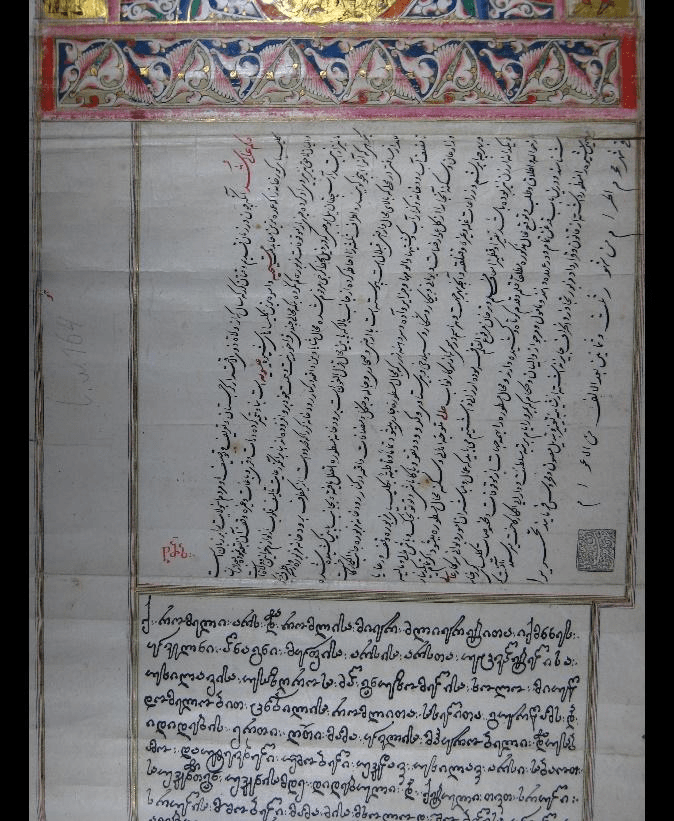
The document (1670) deals with the confirmation of lands located near the river Mtkvari to the main Christian Church, Svetitskhoveli cathedral, and liberation from taxes of the inhabitants of this region.
The document is a scroll: 208×28 cm, the main text of which is in Georgian, while the Persian text is a summary of the deeds written in calligraphic nastaʿlīq in irregular lines. Both are written in black ink.
The upper part of the document is illuminated. The twelve Apostles are represented, as is, in the middle, the Holy Trinity. On the margins there are images of Archil II, king of Kakheti (1664-1675) and catholicos Domenti III (1660-1675).
By its structure and inspiration, the document clearly illustrates different aspects of Iranian-Georgian political, social and juridical aspects. As for illumination, it could be considered of a mixed type, Persian and Georgian: borders and ornaments reflect Oriental influence, while figures are essentially Christians (Apostles, secular and religious authorities), their expression manner also remains essentially Georgian.
In conclusion, Georgian-Persian bilingual documents rank among the unique developments in the history of diplomacy and culture, both generally and particularly for the region. Their digitization will make a distinct phenomenon of the Christian and Islamic illuminated culture available to the scholarly world at large.
Helen Giunashvili.
George Tsereteli Institute of Oriental Studies/ Ilia State University, Georgia

2 thoughts on “Georgian-Persian Illuminated Historical Documents from K.Kekelidze Georgian National Centre of Manuscripts”