
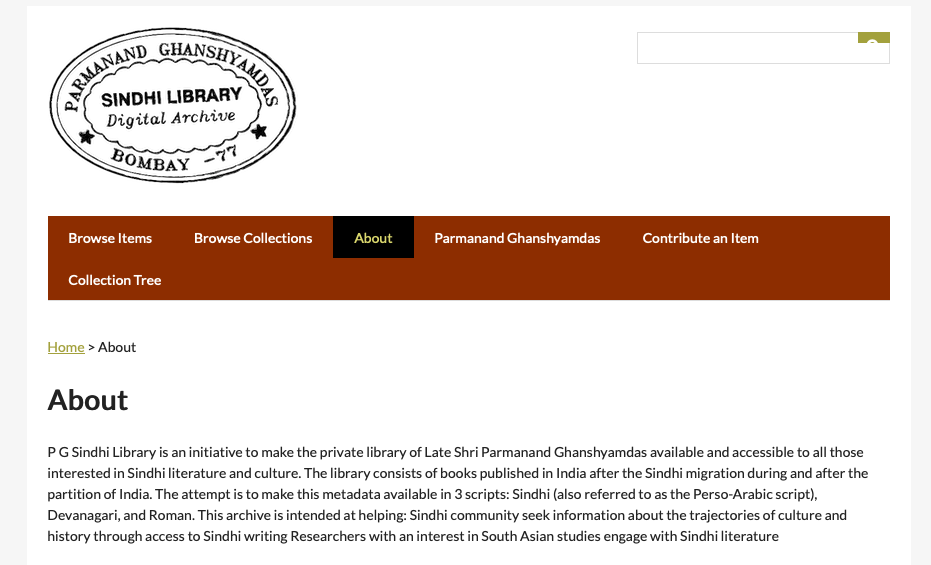
P G Sindhi Library is an archive I built to make sense of Sindhi books I found in someone else’s private collection (Sindhi is a South Asian language spoken in Sindh, Pakistan but also spoken by Sindhi diaspora in India and all around the world). Most of the books were tattered and crumbling. But they were a treasure to me because I had never seen a Sindhi book while growing up in India.
In May 2023, the archive was launched at Goethe Institut, Bengaluru. In August 2023, it went on to be showcased at the Festival of Libraries organised by the Ministry of Culture in New Delhi. In this article, I give an overview of how this archive came to be and what’s next for PG Sindhi Library.
The Library/Archive: its raison d’être
Sindhis are a linguistic minority in India. They migrated to India from Sindh, Pakistan after the Partition of India in 1947. Because Sindh was not divided (and went completely to Pakistan), Sindhis were not given a territory in India they could call their own. Given that Indian provinces are linguistically organised, the language and the community did not get one space or territory where they could belong. Both the language and the community scattered to different parts of the country. As a result, the community has suffered from a lack of environment for nurturing the publication and readership of literature. I grew up without any access to Sindhi as a written language and was unfamiliar with its literary flavour: Sindhi books weren’t around and no one talked about them in my immediate surroundings.
In my journey of learning to read and write Sindhi (I can speak and understand it because it’s my first language), someone donated their late father’s Sindhi books (around 150) to me. At some point in my learning journey, I realised that there must be others who are in need of reading materials to progress in their engagement with the language and its literature. Thus began my process of building the archive.
In 2017, the books were first sent to Servants of Knowledge Foundation in Bengaluru to scan them. They have been doing great work in digitising books in a lot of Indian languages and helpfully took in this collection as well.
The PDFs of these books were uploaded by them on archive.org. The books were thus available in the public domain.
In December 2022, I began conceptualising the need for having a dedicated space for this collection. While the books were already available on archive.org, I felt they deserved a standalone space in which I could experiment with different kinds of subcollections and curate them from time to time from different perspectives. Having books digitised is one thing but using them, curating them, and trying out different ways for them to be read is different. As I mention below, I also wanted them to be available in the Devanagari script for the majority of Sindhi speakers who do not understand the Perso-Arabic script. That, I thought, would be possible if the books found an archive of their own.
I usually teach a course on DH at SRM University. But that semester, I converted the course into a project and invited a student to help me build the archive. Having a student work with me not only sped up the process but also took care of various technical glitches that perhaps only a back end developer could have been able to handle.
The Servants of Knowledge is an organisation that also runs Sanchaya Foundation. Considering that I had no experience or resources to build and maintain this space, they very generously offered me some space on their website so that I could have the books uploaded there. They suggested that I should use Omeka: it is among the most widely used platforms, follows the Dublin Core standard (again very widely used for archival purposes), and is relatively easy to handle (though it could be made much easier).
With that, the actual project began. It involved:
1. Aesthetics: making of logo, finalising of the theme for the website (from Omeka itself)
2. Downloading of all metadata from archive.org to a spreadsheet which was then expanded to include a description of every book
3. Conversion of some aspects of the metadata such as book title and author into Perso-Arabic and Devanagari scripts (so that the information about the books is accessible in Sindhi, for in India at least, both these scripts are used, the latter, more than the former)
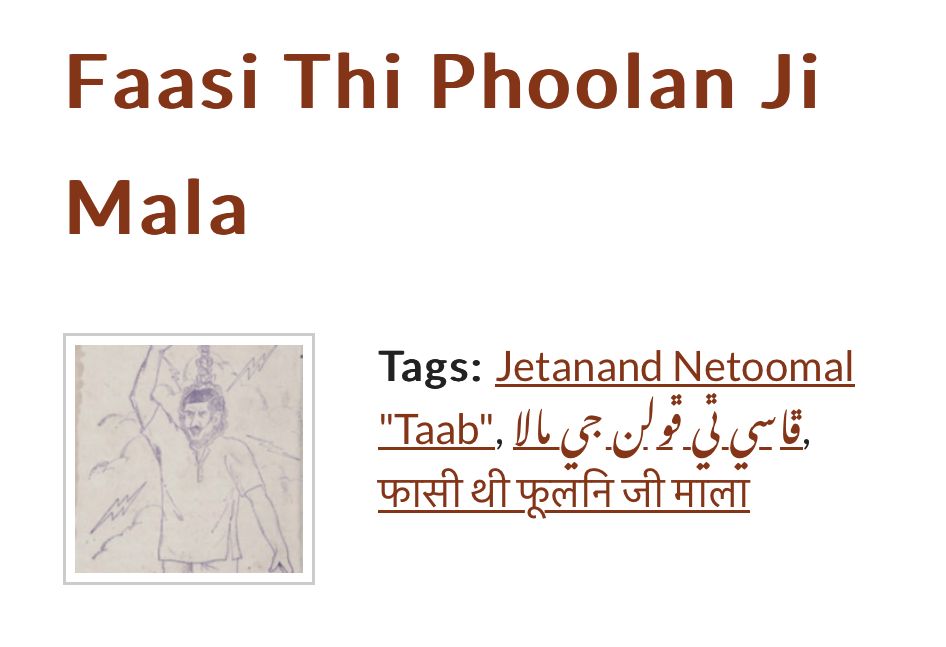
4. Organisation of the items into genres so that the books could be allotted to specific sub collections
5. Uploading of books onto the website
6. Interlinking of the different components of the archive such as the name of the author or the genre so that these could also be interoperable as search items and connect the user with other related items
7. Populating the “About” and related pages to give due credit to the people and teams involved in the making of the archive
The last step is an ongoing process. I recently discovered that there were a few more people who worked closely with Servants of Knowledge Project and helped them with filing some very basic information such as the book title and author name so that they could upload the books on archive.org. These were members of the Punjabi and Sindhi (from Pakistan) Wikipedia teams.
The process of building the archive was very exciting and enervating at the same time. There were moments when books weren’t showing up or there were other kinds of errors in displaying results. But it was all worth it and continues to be so. Archiving requires constant work and re-work and here is what I see myself doing next:
- Open the archive to readers and users for annotating the individual items and add the same to the item metadata (descriptions)
- Open the archive to readers and users for the transcription and transliteration of the content of the individual items, so that the books become available in Perso-Arabic and Devanagari scripts. This will make the archive accessible to both kinds of readers. For instance, the youth within the Sindhi diaspora are not conversant with the Perso-Arabic
- Curate different items thematically or by period to enable storytelling around the archive
Sindhi is, as I keep putting it, ‘a partitioned language and literature’. Archiving it digitally and creating other digital resources around its access, community, and consumption can serve it well. I hope that it grows and evolves into a community space.

 The Digital Orientalist
4 thoughts on “P G Sindhi Library: A Digital Archive for Sindhi Writing Published in Post-Partition India”