
While others have discussed the possibilities in utilizing Transkribus and other HTR resources in research, I want to briefly discuss my experience utilizing Transkribus in a survey course.
As a faculty member in the History Department at Central Connecticut State University I am usually asked to teach one or two introductory world history survey courses each term. These courses, counting for a general education requirement for students, are often populated by a broad subset of the student body representing all the different majors across campus. As is the challenge with courses like these, engagement and skills building are often the core components and learning outcomes for each lesson in the course. To this aim, I introduced a new low stakes midterm assignment this term that utilizes Transkribus as part of a two week project.
The course is entitled Sweet Addictions: Coffee, Tea, and Sugar in Global Empires and takes a commodities approach to introducing students to key themes in global history post-1500. As we make it to the midterm in the course, I wanted students to have something grounded in a moment in time and an assignment that exposes them to how historians do their work. For this assignment, which takes place over two weeks, I present students with three handwritten archival pages from the East India Company’s Mocha Factory Diaries which detail the issues faced by one coffee trading ship, the Stretham, in 1752 in the Yemeni port of Mocha. This document set is sourced from the Maharashtra State Archives in Mumbai, which I had originally looked through during my dissertation research as I was searching for mentions of the Mughal trading fleet that carried pilgrims to Mecca. I have since utilized these documents in upper division courses for understanding the dynamics of the early modern Red Sea, as most students do not have the language skills to look at original archival material not in English.
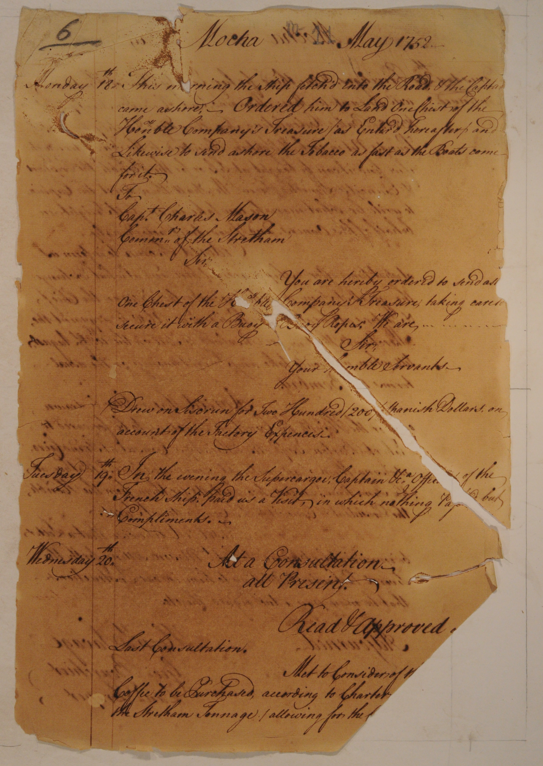
To start off, I provide a background lecture on the history of coffee in the Islamic World and the place of the port of Mocha in the global trade in coffee. From this students are then introduced to the selected pages and I provide them with an early modern English paleography guide. Then, in groups, students are introduced to Transkribus and upload the documents into the HTR program. Transkribus gets only about seventy-five percent of the paleography correct for these documents and therefore the group’s task is to work through the documents and correct the mistakes. This in-class process, over two class sessions, was quite productive, as each group worked to uncover the correct transcription, understand the meaning of each East India Company letter in the document set, and learn the specific meanings and abbreviations utilized in this type of source.
From this point in the project, students had two further requirements. The first was to provide a detailed annotated transcription of the document set. This annotation, which they could do in a GoogleDoc or in Adobe, was meant for them to highlight the meanings and important sections of each East India Company letter within the document set as well as identifying the key terms and individuals in the source material. The second portion of the assignment was for each group to make a short StoryMap (cf. this tutorial and this post with further details) utilizing the information from the transcribed documents detailing the story of the ship the Stretham and the challenges the ship faced in Mocha. Some of the stories highlighted by students from the records included issues with currency exchange in Mocha, drunken sailors from the ship causing issues with the local Yemeni governor, and the reliance of the East India Company in Mocha upon their local Yemeni broker and Indian merchants in order to participate in the booming coffee trade.
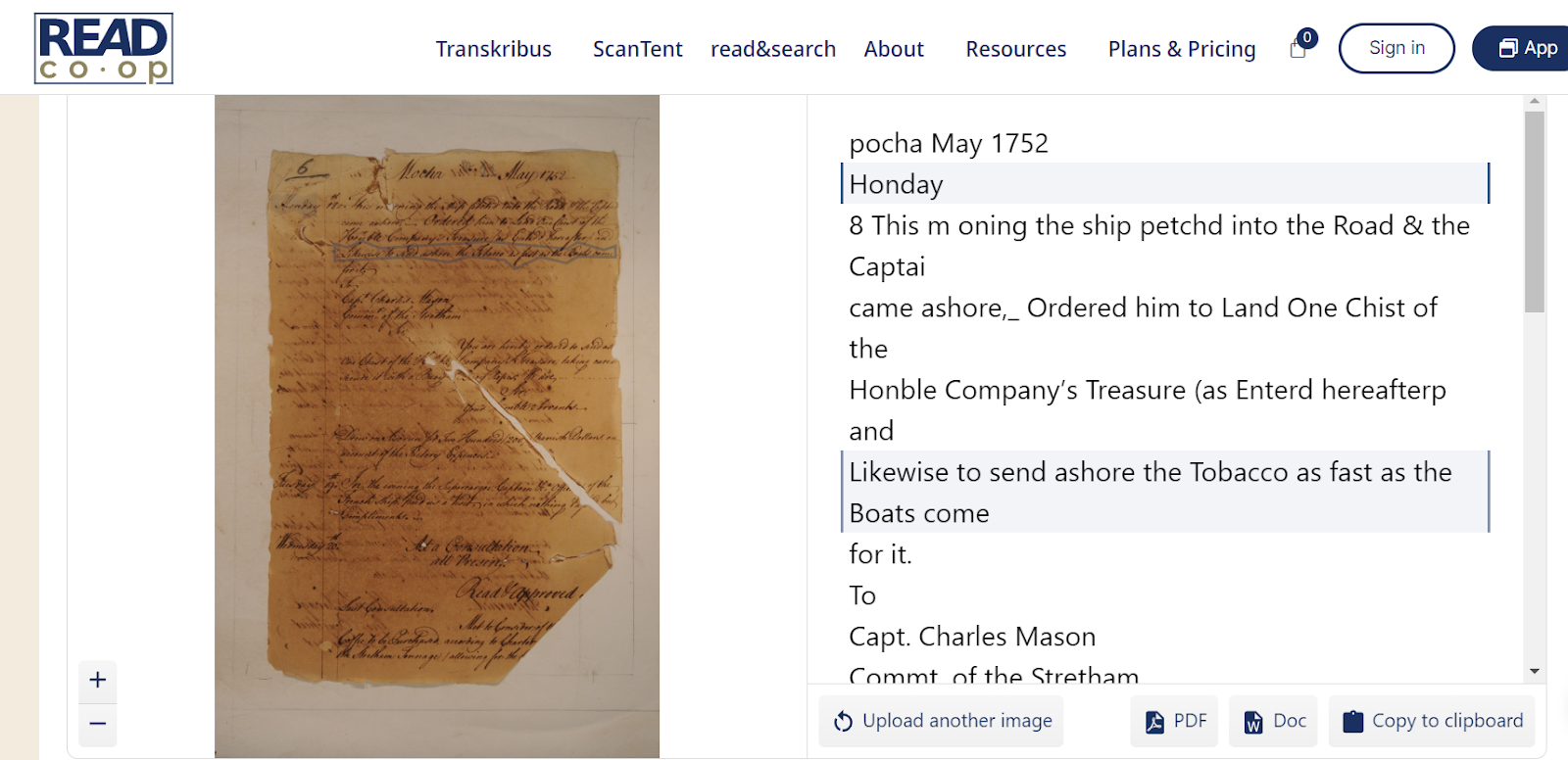
Overall, the goals of this assignment are for students to see the simple process of historical research from original manuscript archival documents to presentation of information. Without Transkribus, it would be difficult to introduce an assignment like this in a survey course with students who have no background, or sometimes even no interest, in reading original handwritten documents. However, with Transkribus, you can give the students that feeling of discovery, accomplishment, and connection to the past that comes with reading original handwritten archival material. I found that many students approached this assignment, working through fixing the mistakes of the HTR program and discovering the meanings of each East India Company letter, as putting together the pieces of a puzzle. It’s that engagement, problem solving, and a small amount of DH skills building that a low stakes assignment like this can provide in a survey classroom. I would encourage other instructors to put together an assignment utilizing Transcirbus, as (while published primary sources are often central to our teaching) having students work through handwritten material, even with the aid of an HTR program, can help students better envisions stories of the past as products of lived human experiences – written by someone’s own hand at a distinct moment in time – rather than as only a text provided to them for their course material devoid of its human context. One of the core tenets of much of our teaching is often centered around empathy and the human experience. Such an exercise embraces precisely this ideal.

 The Digital Orientalist