
This is a guest post by Helen Giunashvili | George Tsereteli Institute of Oriental Studies/Ilia State University
Introduction
In the 16th-18th centuries, under conditions of the incorporation of separate regions of Georgia by Safavid Iran and Ottoman Turkey, the impact of Islamic culture, prevalent in everyday life and all spheres of art, was reflected both in Georgian secular manuscripts and documents ‒ in the design of Georgian and Georgian-Persian legal documents imbued with Iranian impacts.
The political ties between Iran and Georgia by the eighties of the 16th century laid the groundwork for the creation of these Georgian-Persian documents that were compiled in the Georgian court of chancery and registered by Iranian officials. The bilingual historical documents that are currently in our possession are from the Kartli and Kakheti kingdoms in Eastern Georgia, and they date from 1580-1757, which was the time of broad Iranian influence over the country. Moreover, 200 Georgian-Persian royal deeds reached us.
The Georgian-Persian bilingual documents essentially rank among unique developments in the history of general diplomatics presenting the most valuable documentary material for elucidating important questions of historical and social-cultural relations of the late medieval Georgia and Safavid Iran.
They appeared as a result of the administrative system’s regular change in East Georgia. This region from the twenties of the 17th century was ruled by Georgian sovereigns, who had been converted to Islam (Gabashvili, 1951: 164-165). Only officials appointed by the Shah were ruling the principality of Kakheti; already from 1677-1703, the Bagrationi dynasty no longer reigned in Kakheti.
From Iran’s side, there was basically formal control over Georgian agrarian relations. Iran was, in fact, paving the way for the dominance of oriental land ownership in Georgia, which ultimately ensured its incorporation into the Iranian Empire. The bilingual documents express a formal dependence of the Georgian King on Iran’s government.
Thematically, bilingual documents mainly represent deeds of granting, bestowing properties and acts of release from taxes.
They are compiled in the same manner as the 16th-18th centuries’ Georgian historical documents (gujars). The main, initial text was usually written in Georgian. The Persian text, as a summary of the Georgian one, was placed on the back of the document or on its very first page in vertical or indirect lines from the Georgian text, or was written in a separate sheet.
The use of bilingual documents in Georgian legislation is thought to reflect Iran’s compromise policy Iran towards eastern Georgia, best exemplified during the reign of Rostom Khan (Khosrow Mirza), king of Kartli (1633-1658) and later, king of Kartli-Kakheti (1648-1656), the son of King David XI (Daud-Khan), the last representative of the Bagratid royal dynasty of Kartli (Gelashvili, 2015: 291-298).
From an architectonical, textual, and terminological perspective, the basic text of the Georgian-Persian bilingual document is still put together in accordance with Georgian diplomatics standards and does not undergo significant changes. In the Persian text, Georgian socio-economic terms and names are conveyed by unusual word complexes of Persian terminology (Kldiashvili, 2011: 46-49; Dundua, Ivanishvili, 2014: 38-49), which clearly shows that an Iranian official participated in the document’s creation.
Illuminated documents
Among Georgian-Persian deeds are illuminated documents that are of great importance from the viewpoint of art history. They are done in the manner, which fully preserves the traditions of refined Islamic Persian as well as Christian Georgian drawings and resemble the standards of manuscript painting of that period.
However, despite the Iranian influences, Georgian-Persian documents developed largely in a traditional manner and retained the original style (E.Machavariani,1972: 184-187).The architectonics of the Georgian-Persian document ‒ the compositional distribution of painting and Georgian text, Christian themes, the representation of the cross as artistic decoration and the portraits of the Ktitors/Ktetors ‒ is fundamentally different, both iconographically and artistically, from the principles of Persian document illumination (E.Machavariani,1972: 184-187; D. Kldiashvili, 2011: 48-49). Unlike Persian, seal and tughra appear at the end of bilingual documents.
There is a limited number of these rare Georgian-Persian illuminated documents preserved at Georgian depositories (K.Kekelidze Georgian National Centre of Manuscripts and the National Archive of Georgia. Only seven examples are included in the chapter (“A Catalogue of Georgian Documents”) of the collective monograph Illuminated Historical Documents in the Depositories of Georgia, Tbilisi, 2011, 84-91 (Kldiashvili, 2011; also http://illuminateddocument.ge/en/album/index/1/georgian).
Digitized Examples of Georgian-Persian Illuminated Documents issued by Rostom Khan
The digitization of Georgian-Persian illuminated documents, as already mentioned, represents an important and urgent cultural and research desideratum (Giunashvili, 2023), and these are some rare digitized examples:
1) Fund N 1448-5006, the National Archives of Georgia
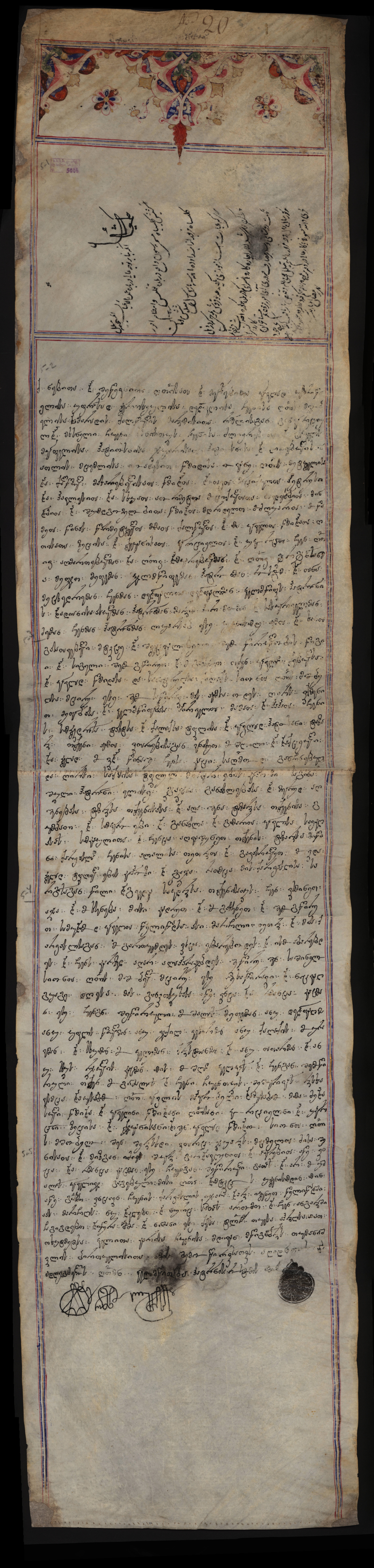
The deed of inheritance (issued in 1650) regarding land and salary of the caravanserai/caravansary for the Sioni Temple in Tbilisi.
High quality, thin, well-made parchment, two newly sewn handwritten sheets:123,5×27,3 cm; Persian and Georgian texts are recorded in a colorful linear frame, the oriental-looking head of which is decorated with ornamental motifs of gold, dark purple and blue colors.
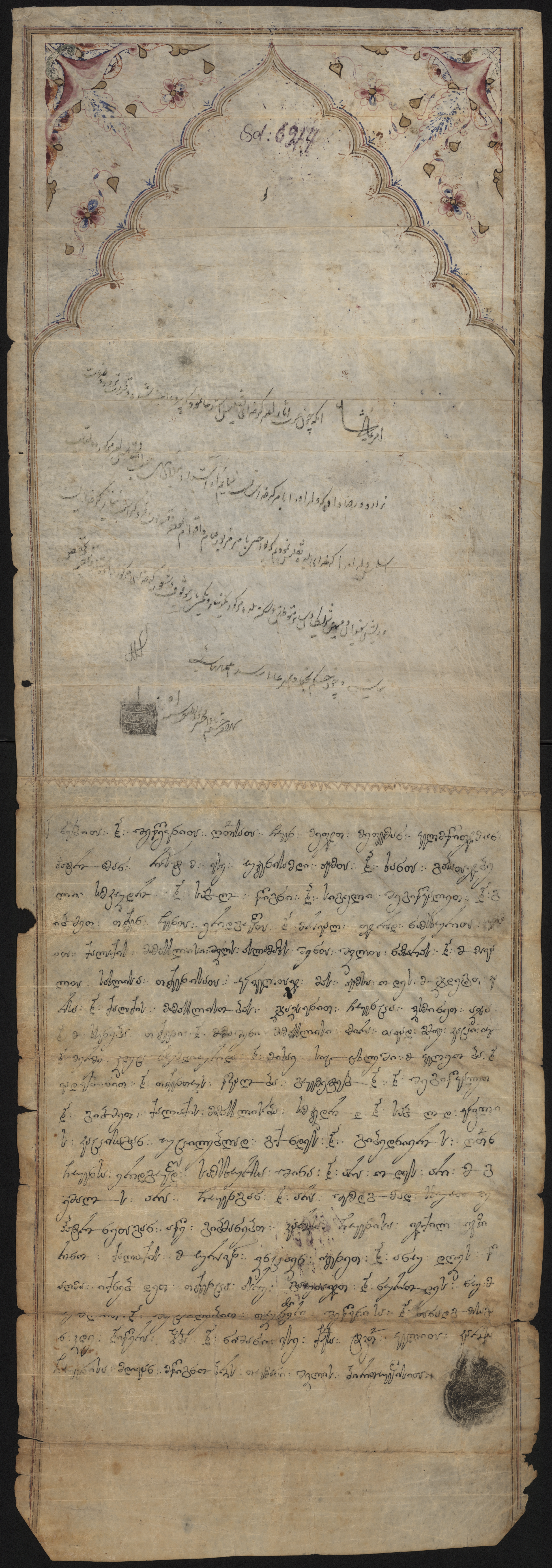
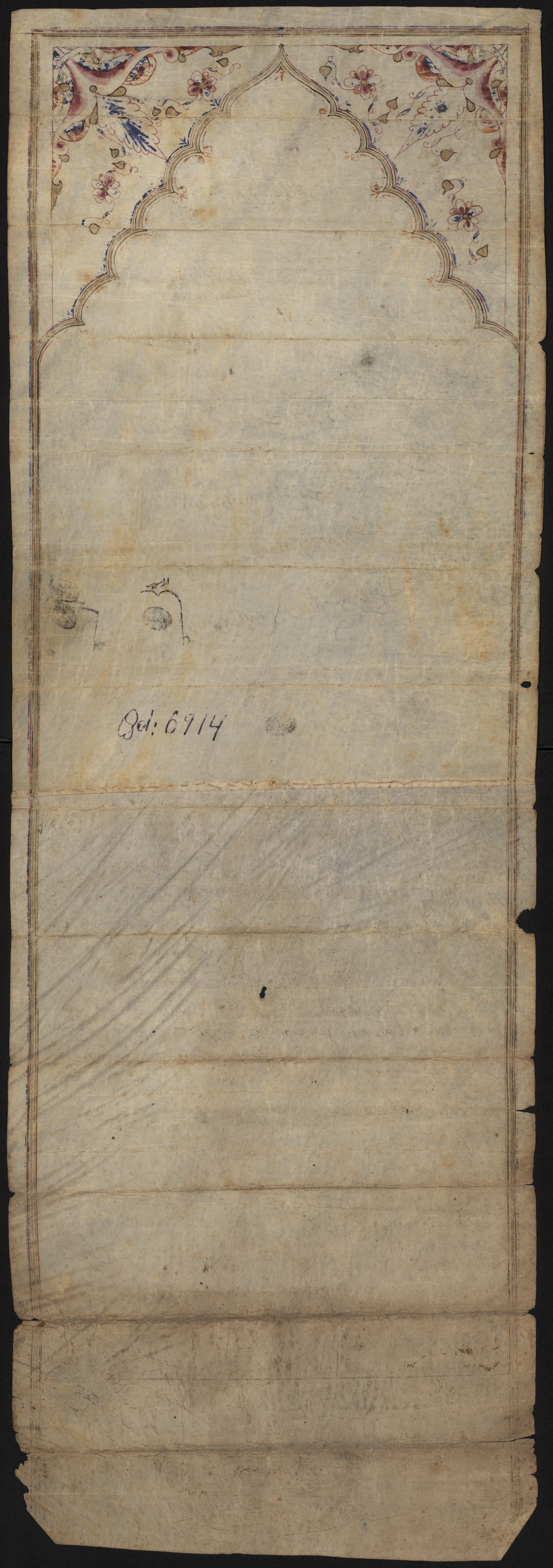
2) Qd-6914, the Georgian National Centre of Manuscripts
Scan2Net Scanner Output
Scan2Net Scanner Output
The deed (issued in 1641) granting the post of prefect to the headman’s son, Aslamaz.
Light yellow thin lightened paper, two glued handwritten sheets:70, 5×24, 2 cm;
Persian and Georgian texts are recorded in a linear frame, the head of which is decorated with plant motifs and stylized images of peacocks in gold, blue, light violet and light green colors.
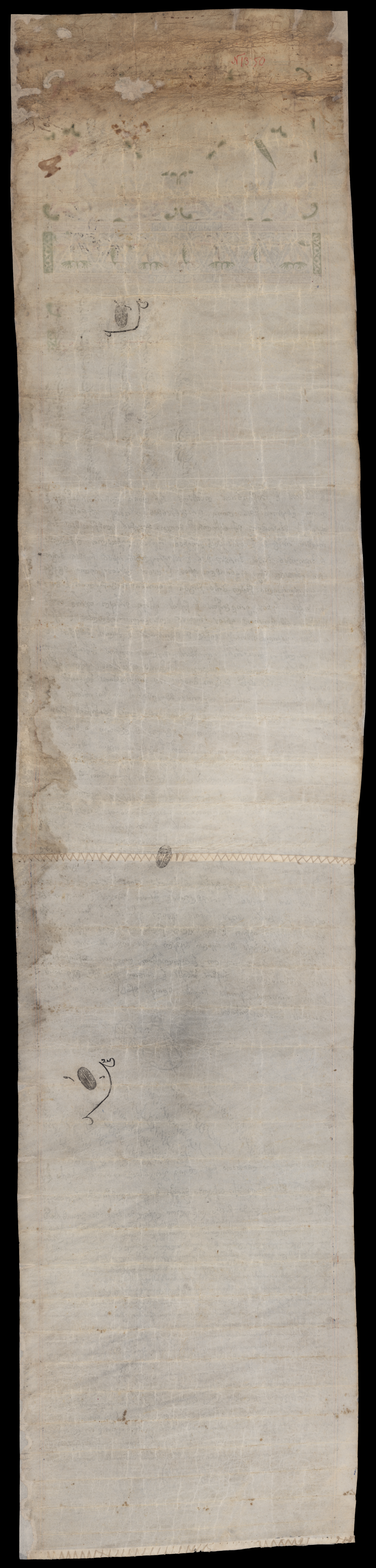
3) Hd 1350, the Georgian National Centre of Manuscripts

Scan2Net Scanner Output
Scan2Net Scanner Output
The deed (issued in 1657) about granting villages (Kumisi, Ghvtaeba, Asureti) to noblemen Elizbar and Zurab Sologhashvili.
Thin, well-processed, lightened paper, scroll, 117×26.5 cm; Georgian text is written in black ink. The Persian text is also in black ink, attached with a tughra done in golden, blue, and red ink.
The top (17×23) of the document, which is square in shape and covered in plant patterns with a standing cross in the center and peacocks on either side, is one of the document’s decorative features.
The digitization of these Georgian-Persian illuminated documents is carried out according to the standards of the National Archives of Georgia, the International Council of Archives (ICA) and the National Archives and Record Administration (NARA).
Based on the value of the documents, their digitization was carried out as electronic documents of high technical parameters, through which the original documents can be fully studied, analyzed and/or migrated again into paper-based documents, with a quality as close as possible to the original. This implies digitization by observing the following technical parameters:
● Resolution: 600 PPI;
● Format: TIFF 6.0 – without compression-ISO 12639 ver. 6;
● Color depth: 24 bit-RGB profile
When digitizing, the documents scale (scale 1:1) and the contrast field were preserved to accurately reflect the edges of each sheet. For maximum color balancing, the Kodak Q-13 color palette was displayed on the image. All pages were consistently digitized. The electronic files obtained from the digitization are identical to the sequence of pages in the original documents.
The digital documents received were annotated in terms of content, organization and technology.
These annotation fields were selected in accordance with the international standards adopted by the ICA of the International Council of Archives: ISADG and ISDIAH, as well as the annotation standards of the National Archives of Georgia (“Standard for describing the contents of an electronic document” and “Standard for technical purposes and organizational description of an archive material”). These annotations were reflected in XML files in which metadata were placed in accordance with the EAD – Encoded Archive Description standard for encoding archive descriptions. The mentioned XML file was placed in an archive information package (SIP – Submission Information Package) stored under the Archival Package Description Coding Standards (METS) architecture. Additionally, part of the content annotation was reflected in the EXIF settings of the file.
References
Nugzar Dundua, Marine Ivanishvili, “Georgian-Persian Corresponding Sounds according to (Bilingual) Historical Documents”, The Near East and Georgia, VIII, Ilia State University Press, Tbilisi, 2014:38-49, (in Georgian, summary in English, p. 329).
Valerian Gabashvili, “State System in the Late Feudal Georgia”, Mimomkhilveli, II, Tbilisi, Georgian Academy of Sciences, I. Javakhisvili Institute of Historical Studies, 1951:131-170, (in Georgian).
Nana Gelashvili, “Iranian-Georgian Relations during the Reign of Rostom (1633-58)”, Iran and the World of the Safavid Age, edited by Willem Floor and Edmund Herzig, I. B. Tauris & Co.Ltd. In Association with Iran Heritage Foundation, London-New York, 2012:491-498.
Helen Giunashvili, “Georgian-Persian Illuminated Historical Documents from K. Kekelidze Georgian National Centre of Manuscripts: Perspectives for Digitization”, Digital Orientalist, 22 September, 2023.
Darejan Kldiashvili (ed.), Illuminated Historical Documents from Georgian Depositories, Favorit Print, Tbilisi, 2011 (in Georgian, introduction in English, pp. 11-15).
Elene Machavariani, “Georgian-Persian and Persian Illuminated Historical Documents”, Philologia Orientalis, “Metsniereba”, Tbilisi, 1972: 183-187, (in Georgian, summary in Russian, p. 187).

 The Digital Orientalist
One thought on “Digitized Examples of the 17th-century Georgian-Persian Illuminated Historical Documents from Georgian Repositories ”