
Transliteration is a cornerstone in humanities research and cultural heritage work. Humanities researchers and librarians alike rely on transliteration tools to broaden access to multilingual and historical texts. For librarians and cultural heritage workers, transliteration enhances access to bibliographic records for easier retrieval and referencing, fostering inclusivity in cultural knowledge. It facilitates cross-cultural communication, supporting collaboration among teams from diverse linguistic backgrounds. In philology, transliteration is essential for converting texts from various scripts to the Roman alphabet, a process known as romanization.
More importantly, script conversion or transliteration on the fly often makes everyday lives a lot easier in linguistically diverse regions such as South Asia or South East Asia, where a single language may often be written in more than one script. For example, canonical languages like Sanskrit, Pali, or Prakrit were written in a variety of scripts depending on the region; Hindi has traditionally been written in both Devanagari and Kaithi as late as the early 20th century; Manipuri has used both Bengali and Meiti letters, while Sindhi or Punjabi continue to use both Perso-Arabic letters and Indic scripts like Devanagari and Gurumukhi respectively. This linguistic diversity often poses unique challenges for philological research, as scholars must navigate multiple scripts to access and disseminate historical texts and linguistic data.
Luckily for us, Aksharamukha offers an easy way to transliterate between a variety of scripts. Developed by Vinodh Rajan, a digital palaeographer by training, it is a free and open-source online tool that enables the conversion between various writing systems currently in use across South and Southeast Asia. Supporting interlingual transliteration between as many as 121 scripts and over 21 different romanization methods, this tool allows users to effectively navigate the complexities involved in philological research on South and Southeast Asian languages. More recently, Aksharamukha has evolved to offer conversion between Indic scripts and Semitic scripts along with Semitic script romanization. This post provides an overview of Aksharamukha and its features.
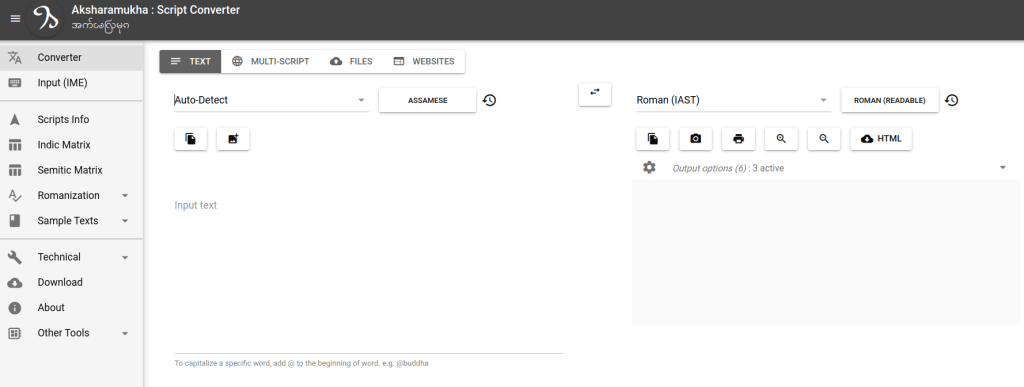
Aksharamukha: Script Converter
At its outset, Aksharamukha is a straightforward, no-frills interface designed to simplify the process of inputting and converting text for non-technical users. Users can either copy and paste the source text directly into the input field or upload files in various formats, including PDF, TXT, XML, HTML, DOCX, and JSON. There is also the option to feed an image into Aksharamukha, and it will extract the text from the image on the fly before converting the text to the script of the user’s choosing. The accuracy of optical character recognition (OCR) depends on factors such as the level of support for the script and the quality of the uploaded image. However, the option to proofread and correct the automatically recognized text saves considerable time compared to typing out the entire text manually. Moreover, if the text you want to transliterate uses more than one script, Aksharamukha has you covered with its Multiscript support option for the input.
Aksharamukha relies on straightforward letter mapping to convert one script to another, and we can explore these mappings in detail through the two different script matrices for Indic and Semitic script families.
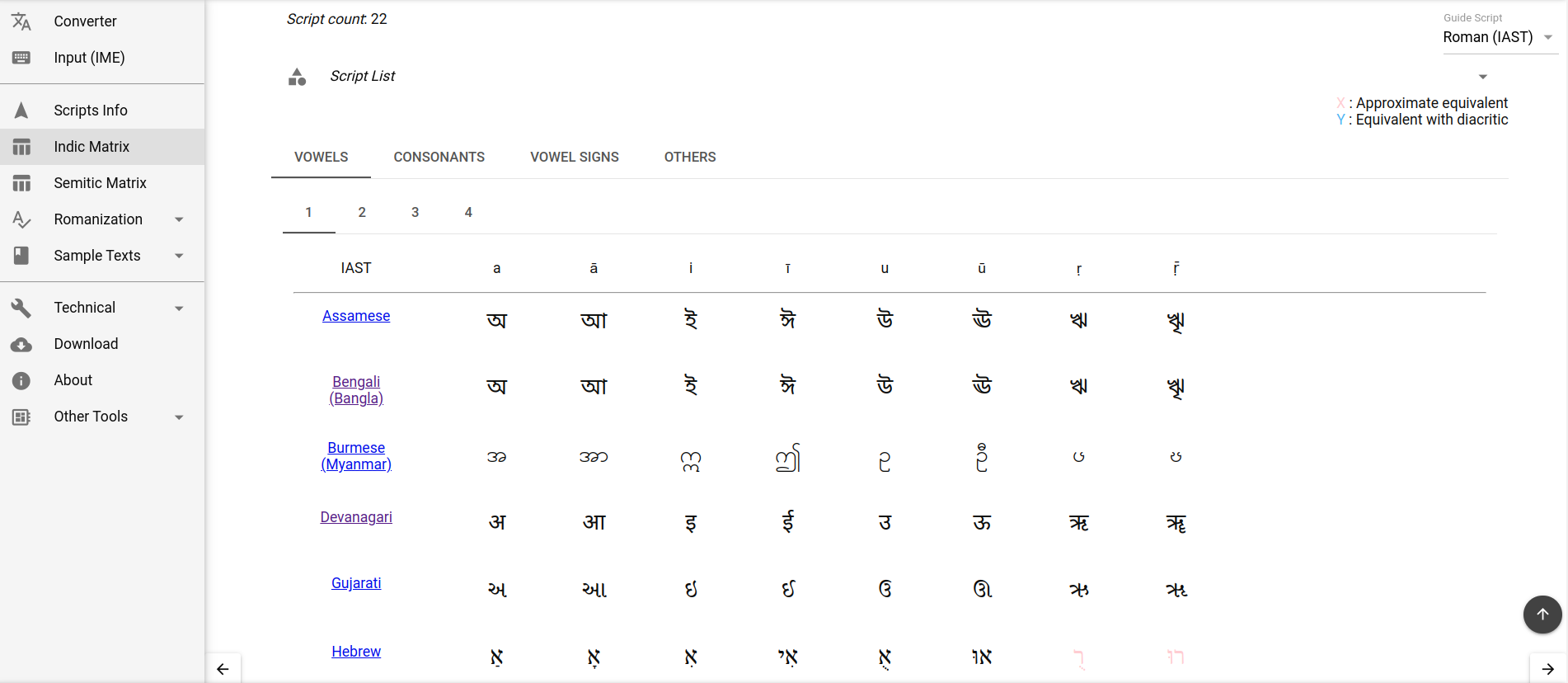
Exploring the Script Matrix for Major Living Scripts
Similarly, there is also an option to explore the mappings for different Romanization methods from the Romanization tab. Reviewing the notes and nativization conventions at the bottom of each script page is a helpful way to understand how Aksharamukha handles your chosen script.
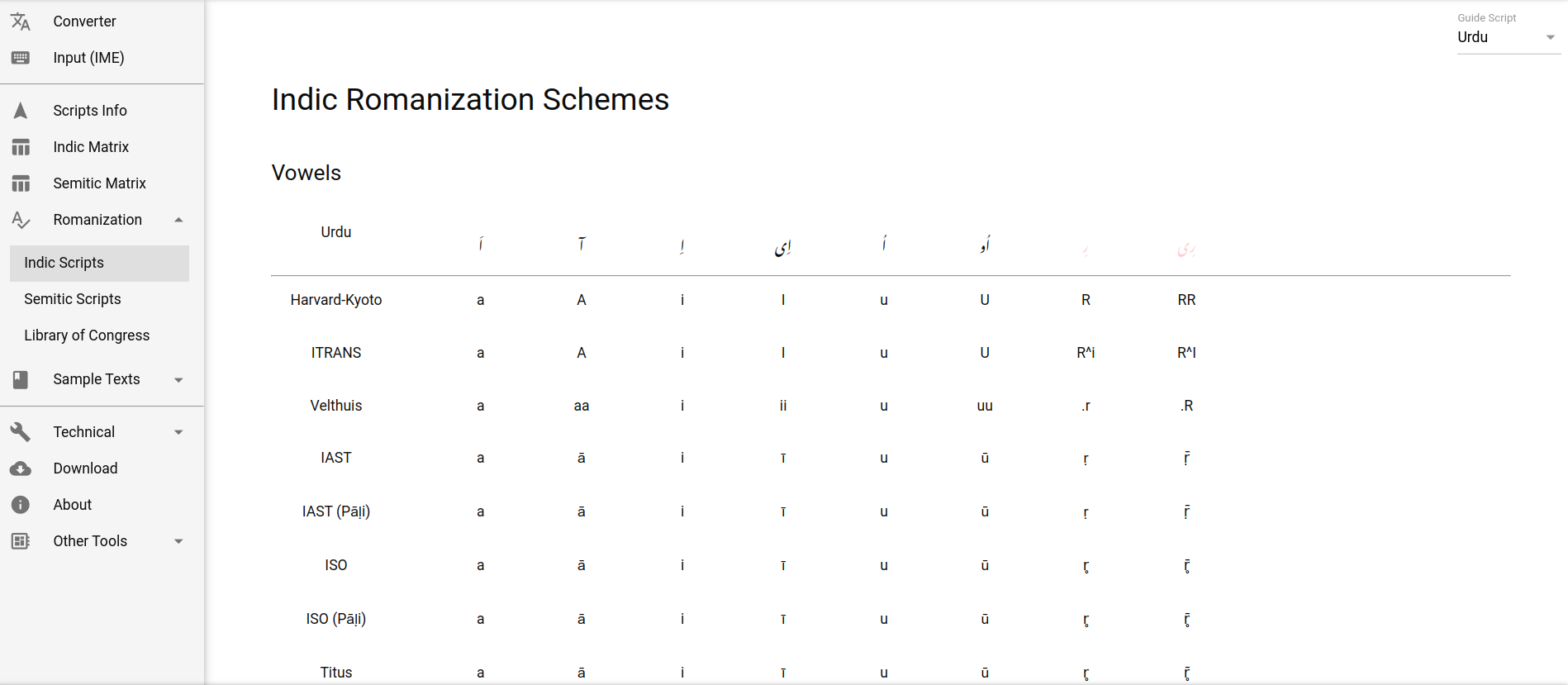
Exploring Various Romanization Schemes in Aksharamukha
Although Aksharamukha auto-detects the script of the input language, selecting the input script from the toggle down menu is generally a better strategy, especially when users want to make use of a variety of script specific orthographic conventions such as schwa deletion for Indic scripts to refine the output. Further at the output stage, Aksharamukha implements the ability to modify the results further by choosing between an array of script specific spelling choices or writing styles.

An Example of Customization Options at the Input and Output Stages in Aksharamukha
For instance, we choose schwa deletion at the input stage for Bengali and choose between two variants for converting the inherent vowel, as seen in the example above. These rules are defined within the Aksharamukha interface and vary from script to script. Sometimes these rules are applied automatically to increase readability, especially for romanization, but users also have the option to modify the settings to get the desired orthography in the output.
While the Aksharamukha’s web interface is more than capable of handling most humanities workflows, more advanced users may benefit from exploring its python package that can be installed locally on your machine. There is also an option to embed Aksharamukha into a website, and you can read more about this process here.
As a leading example of automated transliteration software, Aksharamukha is free, open-source, and an invaluable resource for everyone—from curious learners to expert researchers—streamlining humanities workflows, enhancing digital accessibility, and reshaping how we engage with diverse scripts. Those working with South and Southeast Asian scripts may find Aksharamukha a useful addition to their digital toolkit.

 The Digital Orientalist
2 thoughts on “Aksharamukha: The Automated Transliteration Tool to Simplify Script Conversion”