
This is the English version of the Japanese article at Jimbun Jōhōgaku Geppō (『人文情報学月報』: Digital Humanities Monthly), 159 (1), titled “LOD wo Kushi shita Kodai Ejiputo-shi no Digital Prosopography: Persons and Names of Middle Kingdom and Early New Kingdom Database” (LODを駆使した古代エジプト史のデジタル・プロソポグラフィー:Persons and Names of Middle Kingdom and Early New Kingdomデータベース). The URL of the online webpage version of Jimbun Jōhōgaku Geppō (『人文情報学月報』: Digital Humanities Monthly) is https://www.dhii.jp/DHM/. However, Volume 159 has not yet been published on this website, but only in the latest e-mail magazine version. For the email magazine, please register here.
Digital technology is transforming historical research. By digitizing large amounts of historical materials and building structured datasets, we can shed light on previously invisible aspects of history. Such digital history initiatives have now penetrated various fields of historical studies. In the digital history of ancient Egypt studying the Pharaonic period, particularly noteworthy is the Persons and Names of the Middle Kingdom (PNM) database developed by Alexander Ilin-Tomich at the University of Mainz, Germany. Currently, with the addition of data from the Second Intermediate Period and early New Kingdom period, it has been renamed to Persons and Names of the Middle Kingdom and Early New Kingdom. However, according to the official website, the original abbreviation PNM is still acceptable.
The PNM is a comprehensive database of personal names and titles from ancient Egypt’s Middle Kingdom through the early New Kingdom period. The Middle Kingdom (circa 21st-18th centuries BCE) was ancient Egypt’s second golden age as a unified state. This period saw important developments in various aspects of Egyptian culture, including a flourishing of literature, such as The Story of Sinuhe and the development of centralized administrative structures. The Middle Egyptian language used during this period would continue to be a classical language until the 4th century CE. The PNM database is an ambitious attempt to shed new light on the society and culture of this golden age of ancient Egyptian civilization through digital technology.
The true value of PNM lies not merely in the digitization of Middle Kingdom personal data. It is a knowledge base that expresses ancient Egyptian society’s complex human relationships and social structures through a meticulously designed data model based on Linked Open Data (LOD) principles. The database is centered around four core entities: person, personal name, title, and inscription. Each entity has its own identifier (ID) and is interlinked with others. These entities are connected to diverse metadata, including information from inscriptions, papyri, and ostraca containing personal names and titles, family relationships between individuals, gender, geographical distribution, and more.
Furthermore, this information is precisely structured to capture complex relationships between elements rather than just broad classifications. For example, it can show how an individual mentioned in one inscription might be referred to by different titles in another inscription. Thus, in PNM, data about individuals, names, titles, and inscriptions are interconnected, creating a structure that enables multifaceted searching and analysis of people and materials.
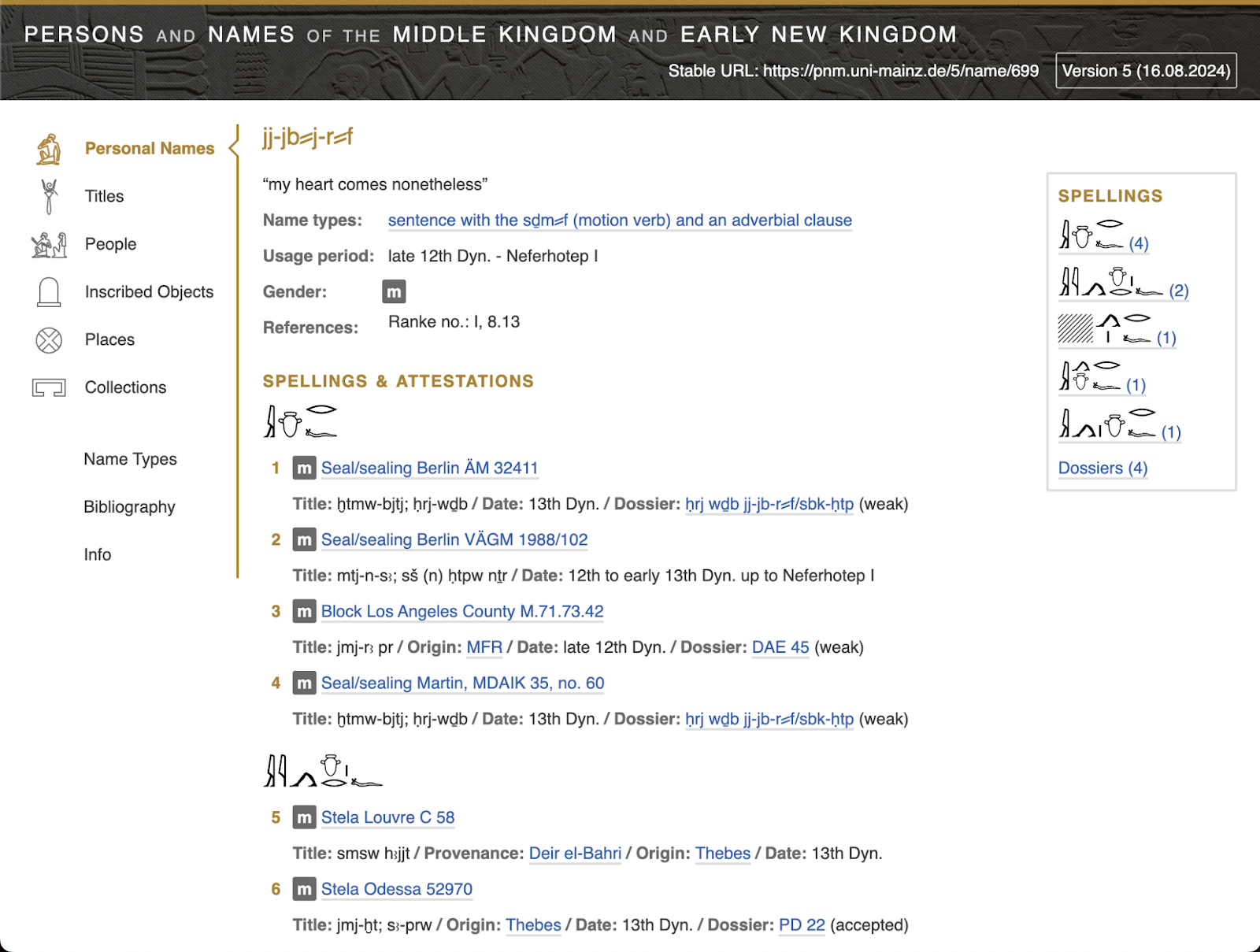
Figure 1: Various spellings and occurrence information for the personal name jj-jb=j-r=f (in this case, these are just name attestations, not referring to the same person).
The PNM database’s most significant feature lies in its comprehensiveness and sophisticated data model. For instance, in ancient Egypt, an individual could have multiple names. Ancient Egyptians sometimes used different names throughout their lives. Egyptian kings, in particular, could have many names, including birth names, throne names, Two Ladies names, Horus names, and Golden Horus names. Additionally, individuals could hold multiple titles. Ancient Egyptian bureaucrats typically acquired new titles as they were promoted.
The PNM database can accurately describe such transitions in names and titles. It’s possible to track how names and titles change throughout an individual’s career. Furthermore, it can specify which parts of which inscriptions mention each name and title. Inscriptions are also tagged with information about the objects they were carved on and their discovery locations.
To express these complex relationships, the PNM database uses RDF (Resource Description Framework), a standard data model for the semantic web. In RDF, all information is expressed as “triples” consisting of subject, predicate, and object. This simple but powerful structure enables flexible descriptions of diverse contextual details on personal names and titles.

Figure 2: Information page for the title ꜣṯ.w n sm.j.t. This name appears twice in Tomb No. 1 at Asyut (during the reign of Senusret I).
How can the PNM database be practically utilized? Its possibilities bring fresh perspectives to traditional Egyptological research methods. First, there’s web browser-based searching. Researchers can easily find information of interest, using keywords such as personal names, titles, or inscription contents. Search results are displayed in a user-friendly interface, and users can follow links to related information.
Second, data access via SPARQL is crucial. SPARQL is the standard query language for operating RDF databases. A SPARQL endpoint is publicly available for accessing all PNM database data, enabling complex searches across the entire database and integration with other datasets. This is an essential tool for digital history research.

Figure 3: PNM’s SPARQL query console.
Furthermore, PNM’s dataset is freely downloadable. The dataset is licensed under CC BY 4.0 (Creative Commons Attribution 4.0), allowing anyone to reuse the data with proper attribution. The dataset also has a DOI (Digital Object Identifier). Researchers can save the entire dataset in RDF format as well as a relational database dump on their computers and freely perform analysis and data processing. This opens up creative data utilization possibilities, such as combining PNM data with other historical data or conducting original data mining. Such open data access mechanisms are a significant feature of PNM. Access to primary sources has always been a crucial issue in historical research. PNM directly addresses this challenge by creating an environment where researchers can freely utilize their data.
PNM’s potential goes beyond mere convenience improvements. It suggests new methods of historical narrative in the digital age. Traditional Egyptology primarily focused on carefully decoding inscriptions and papyrus documents to reconstruct historical facts. However, using the PNM database, researchers can quantitatively analyze changes in personal relationships and social structures from vast amounts of historical materials. For example, tracking the geographical distribution changes of specific titles might reveal the process of state administration penetration. Changes in personal naming patterns might indicate transformations in social values.
In other words, the PNM database enables drawing macro-historical perspectives from an accumulation of micro-level primary sources. This represents one of digital history’s great possibilities. PNM’s achievements will undoubtedly provide significant insights for research into other civilizations. Additionally, the insights of the PNM database will contribute to international discussions about digitizing and structuring historical information. It should provide important reference cases for initiatives like W3C’s efforts to create Linked Open Data for cultural heritage.
Acknowledgements: I am thankful to Alexander and the editors for your careful checks.


One thought on “Digital Prosopography of Ancient Egyptian Society Using LOD: The Persons and Names of Middle Kingdom and Early New Kingdom Database”