
Introduction
A fundamental question in the history of science from antiquity to the premodern era is how people organized knowledge, what ideas shaped the classification of sciences, and how they reflect cultural worldviews and values. The study of knowledge organization has long been a crucial aspect of intellectual history and scholarly traditions, particularly in the Islamic world, which has not received as much attention as Greco-Latin or Western traditions. To facilitate the study of these classifications, Prof. Godefroid de Callataÿ and IT experts at the UCLouvain developed M-Classi in 2023—an open-access digital tool designed to explore how Islamic cultures structured knowledge over centuries.
M-Classi is a powerful platform that enables users to store, catalogue, search, and visualize classifications of sciences in the Islamicate world. While its primary focus is on Arabic, Persian, and Turkish classifications, it also integrates sources in Syriac, Greek, Latin, and Hebrew for comparative study. By offering a dynamic and open-access resource, M-Classi allows scholars to investigate the evolution of knowledge organization across different historical and cultural contexts.
Why M-Classi?
-Addressing Gaps in Scholarship
While existing research often focuses on a handful of well-known examples from the classical period, the diversity and evolution of knowledge organization across different historical and linguistic contexts remain understudied. M-Classi helps bridge this gap by offering a structured, digital platform that combines classifications from multiple traditions, enabling large-scale comparative analyses. By centralizing and structuring these classifications, M-Classi facilitates new insights into the intellectual history of the Islamic world and its interactions with other cultures.
-The Need for a Digital Solution
The study of scientific classifications in Islamic cultures has often been limited by fragmented methods, primarily focusing on textual analysis that lacks cohesion and structure. To answer intricate research questions—such as the hierarchical arrangement of sciences, the evolution of scientific terminology across languages, and variations in classifications among scholars—a comprehensive and organized database is essential.
M-Classi was developed to address these challenges by providing a dynamic and systematic platform that allows researchers to explore, analyse, and compare scientific classifications in a more integrated and accessible manner. Some of these features will be discussed in more detail below. Utilizing modern technologies, M-Classi operates on a Linux server, with a backend built on the Python (Django) web framework, and a frontend that incorporates JavaScript (Next.js and React) for a seamless user experience. The inclusion of the vis.js JavaScript library enables effective graph visualization, enhancing the platform’s ability to display complex data in a clear and responsive format.
Currently in its beta phase, M-Classi is publicly accessible upon request at https://www.m-classi.eu
Key Features and Functionality
M-Classi offers five main features:
1. Graph Visualization: An interactive cumulative graph serves as a central visualization tool, synthesizing the entire database and representing hierarchical relationships between sciences.
The cumulative graph in M-Classi offers an interactive and hierarchical representation of knowledge classifications and shows how sciences were structured historically. Central nodes, representing sciences that appear frequently across classifications and have numerous hierarchical links, highlight key areas of study, while more isolated sciences are placed at the periphery. The graph’s adaptable features, such as adjusting node and link sizes based on frequency, offer a deeper understanding of the relative importance of certain fields. The graph visually represents the flow of knowledge between fields, highlighting which ideas were most influential and how certain concepts, once considered sciences, gained prominence.
Users can filter the graph by science, period, language, or specific authors, allowing for a focused exploration of particular areas or thinkers. The authors and their works are listed in the right section, with options to sort them alphabetically or chronologically. The editable colour palette allows us to visualise the authors and classifications on the nodes to tailor their exploration to specific areas of interest. These features allow researchers to focus on particular historical periods, cultural contexts, or the classifications of individual thinkers, offering a comprehensive view of how ideas evolved across various dimensions.

Fig 1. M-Classi cumulative graph tool
2. Comparative Analysis: This enables visual comparison of two classifications from different sources, highlights similarities and differences
This feature enables visual comparison of two classifications from different sources, highlighting similarities and differences both in the graph and in a horizontal tree view, with corresponding lists displayed on the right and left sides of the page. Similar sciences are highlighted in colour in graphs and lists, and these can be adjusted by zooming in or out or replaced for a more precise comparison. This functionality is useful for studying intertextual influences and the evolution of classifications over time.
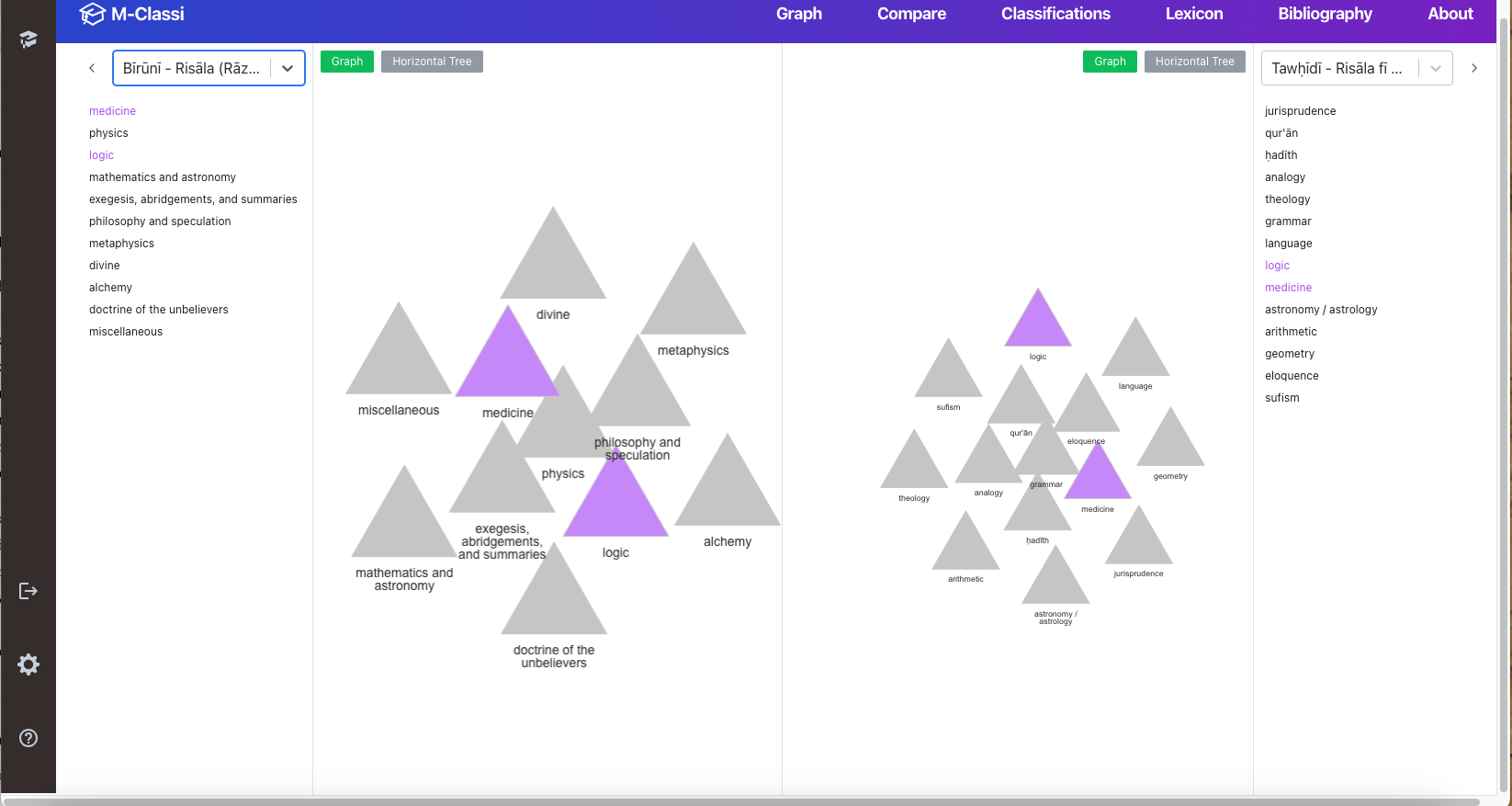
Fig 2. Comparison of two classifications (Bîrûnî and Tawhîdî)

Fig 3. Comparison of two classifications (Amulî and Râzî)
3. Classifications Overview: A metadata of classifications, organized by author, title, language, and period.
Classifications Overview is a metadata and internal database that provides a complete list of classifications, organized by author, title, title translation, language, and period. Each entry contains metadata and brief information about the source and author, along with the listed classification. It displays classifications in their original language alongside English translations. Additionally, it represents and visualizes the relationships between sciences, presenting hierarchical classifications using tree diagrams and spider charts in three different formats: graphs, horizontal trees, and vertical trees and contains galleries for manuscripts.

Fig 4. Classifications Overview for Jāmi‘ al-‘ulūm
4. Lexicon and Terminology Index: A multilingual index of scientific terms.
Lexicon provides a comprehensive index of sciences in various languages, enabling the study of terminological evolution. The Lexical Index facilitates lexical comparisons and addresses translation issues. Additionally, by clicking on each word, users can access the sources where the word has been used, along with its variations across different languages and periods.

Fig 5. Lexicon for Dream Interpretation
5. Bibliography: A structured reference list separating historical sources from modern scholarly works on scientific classification.
Expanding M-Classi: Integration with MOSAIC
M-Classi will now be integrated into a suite of digital tools as part of the ERC Synergy project MOSAIC (Mapping Occult Sciences Across Islamicate Cultures). This six-year project, set to begin in September 2025, aims to advance the study of occult sciences and the classification of knowledge in Islamicate and Eastern Christian cultures over fifteen centuries of history. Some branches of the occult sciences—such as astrology, alchemy, and magic—were essential components of the classification of sciences and often subjects of scholarly debate. These disciplines were frequently classified alongside the natural sciences in Islamic classifications of knowledge, an aspect that can be better understood through digital tools like M-Classi.
Impact and Future Directions
M-Classi holds great potential to advance the study of the history of science and the organization of knowledge, particularly in the Islamic world. It is set to revolutionize the study of knowledge classification by providing a powerful, adaptable, and user-friendly digital platform. Integrating comparative, linguistic, and graphical analysis tools, facilitates new research and deeper insights into the development and transmission of scientific knowledge and cultural interactions. The tool promotes interdisciplinary collaboration among historians, linguists, and digital humanities scholars, addressing longstanding translation and terminology challenges.
Conclusion
Knowledge classifications can reflect our deepest values and influence how we understand the world. M-Classi emphasizes the importance of critical thinking and questioning assumptions, urging us to consider the historical and cultural contexts that shape our understanding of knowledge. M-Classi serves as a bridge between cultures and historical periods, helping us appreciate the diversity of human thought and the interconnectedness of knowledge across time and space.
It’s not just about memorizing facts or accepting traditional categories—it’s about understanding how these categories were formed in the first place, what assumptions they may be based on, and how they might limit or expand our thinking. M-Classi encourages us to look beyond surface-level interpretations and think critically about the terms we use. This deeper understanding is invaluable, especially when researching the history of knowledge, as classification systems evolve to reflect new cultural values and discoveries.
These classifications tell us a great deal about cultural priorities—what was considered important, what was connected, and what was dismissed as irrelevant. M-Classi offers a unique opportunity to visualize these connections, revealing patterns and influences that might otherwise remain hidden.

 The Digital Orientalist