Image taken from DTAB CrossAsia
In the third and final part of the series, we present one of CrossAsia’s database migration projects, which enters the world of historical Tibetan deeds, seals and legal documents. For more on CrossAsia see part one and two.
The Digital Tibetan Archives Bonn (DTAB) represents a significant resource for Tibetan history, culture, and legal traditions. This collection originated from two research projects conducted between 1999 and 2005, focused on legal documents originally stored at Kundeling Monastery in Lhasa, materials from several German collections, and the Library of Tibetan Works and Archives (LTWA) in Dharamsala, India. Recently migrated to CrossAsia, this collection makes thousands of historical Tibetan documents accessible to researchers worldwide. The database now houses 4,251 digitized Tibetan legal and administrative documents and seals ranging from the 16th to the 20th centuries, offering unique insights into Tibet’s past.
From Field Research to Digital Resource
The story begins in the late 1990s at the University of Bonn, where Professor Peter Schwieger initiated an ambitious project to document and preserve Tibetan historical materials. With support from the German Research Foundation (DFG), his team undertook extensive fieldwork in Tibet and India, addressing a critical gap in Tibetan studies—access to primary source materials that had previously remained largely inaccessible to the broader research community.
The digitization process presented numerous technical challenges. The team employed specialized digital photography equipment adapted for archival work in remote locations with varying environmental conditions. This customized setup allowed them to capture materials that could only be photographed on-site due to their cultural value and institutional regulations.
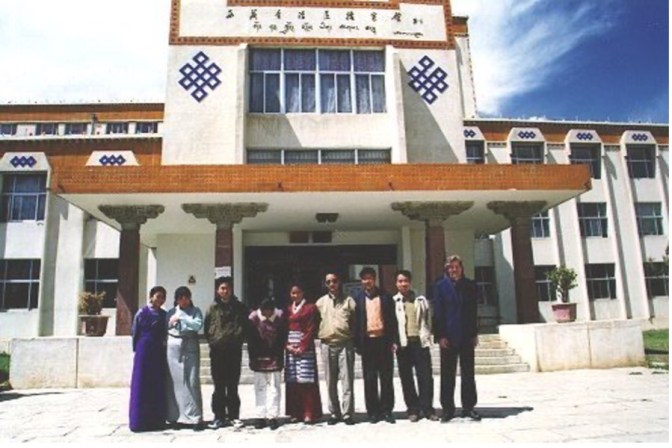
Lhasa Archives 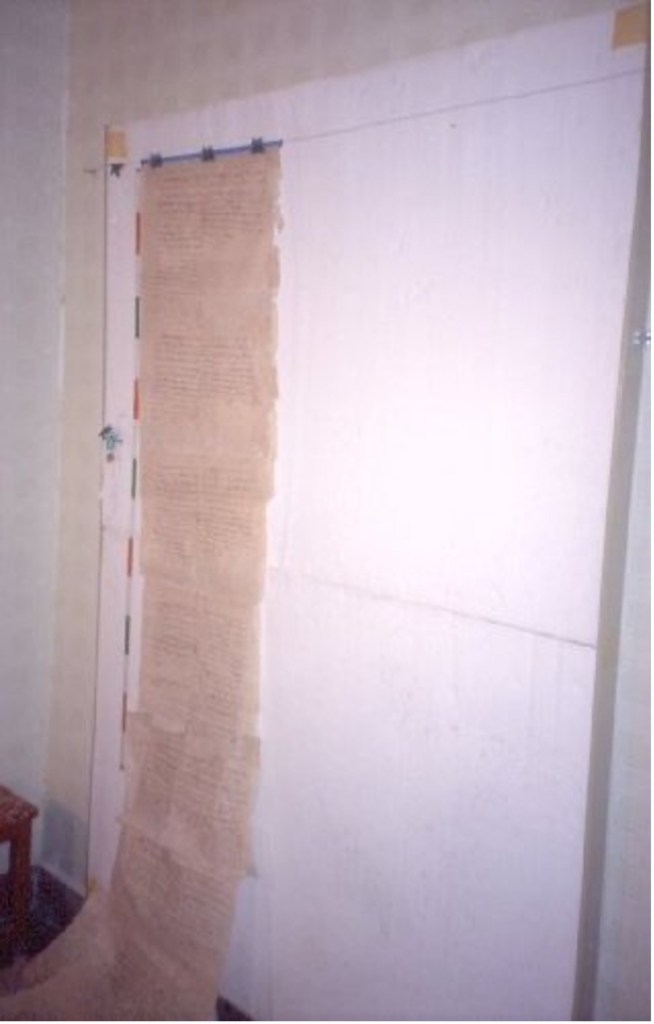
Original documents attached to the wall and several meters long… 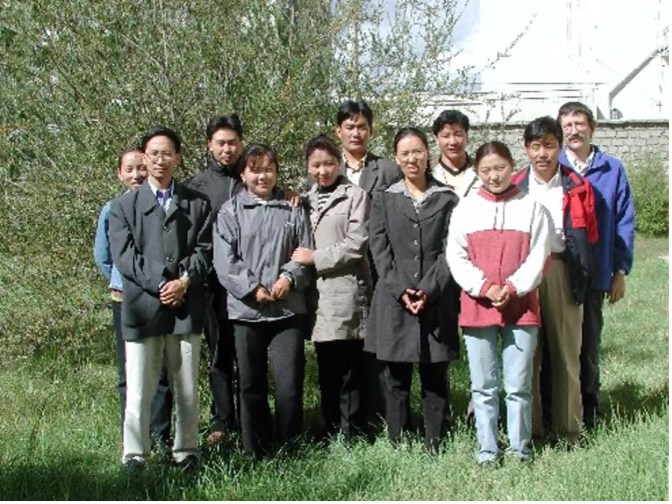
The local staff and Prof. Schwieger 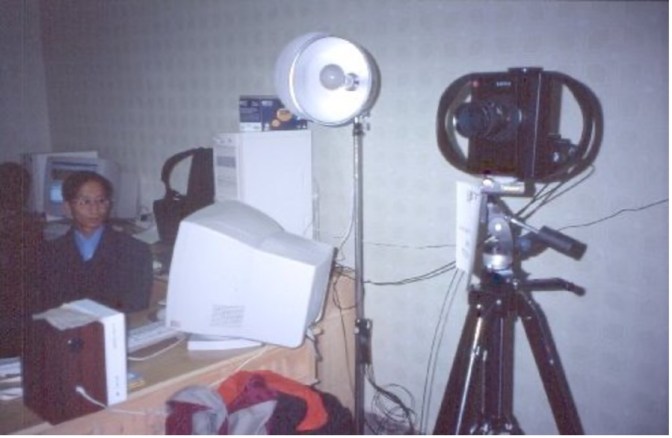
The Leica camera and lights from the front 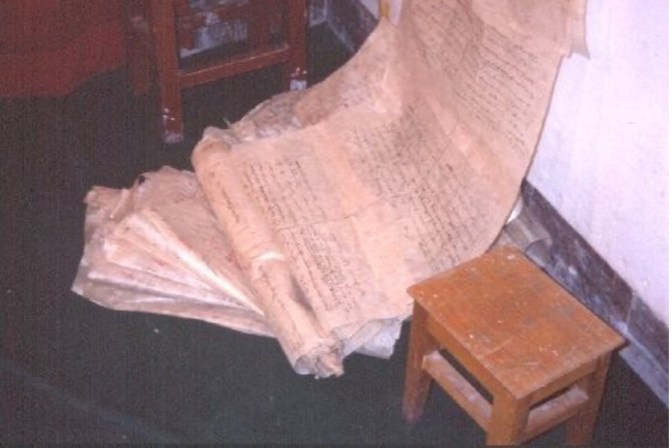
…and rolled up
Images obtained from archived versions of the website on the Internet Archive
This fieldwork resulted in tens of thousands of high-quality digital images of documents from the Tibet Autonomous Region Archives in Lhasa,1 the Library of Tibetan Works and Archives in Dharamsala, and several private collections including those of Kurt H. Dahnke and the late André Alexander (learn more about these collections here: https://iiif.crossasia.org/s/dtab/history). The subsequent DTAB collection comprises various legal and administrative documents including land sales, loans, taxation records, and dispute settlements—materials that have become invaluable primary sources for understanding Tibet’s social, economic, and legal history.
Digital Resurrection
The resulting database was originally hosted on servers at the University of Bonn. When Professor Peter Schwieger retired, the university’s IT department soon identified potential security vulnerabilities and took the site offline in 2018, despite its popularity among researchers. By that time, DTAB had already established itself as an essential primary source for Tibetan studies cited in publications such as Dbus gtsang lo rgyus chen mo [The Great History of Central Tibet] (Tsangdruk Topla et al. 2021. 3 vols. Dharamsala, India) and Taxation in Tibetan Societies (Travers et al. 2023, Leiden: Brill).
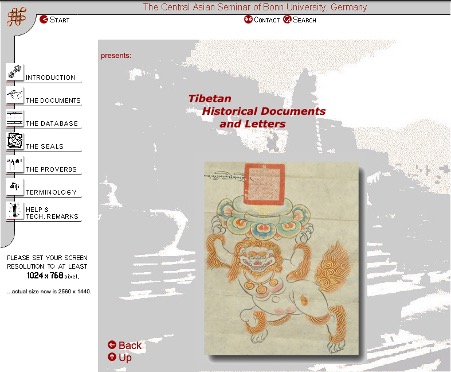
Old DTAB website design
Rather than allow this valuable resource to disappear, Schwieger’s sons Robert and Sebastian undertook the considerable task of recovering the offline site. The recovered database was transferred to CrossAsia at the Staatsbibliothek zu Berlin in 2020, where in 2024 it again reached its technical end and the data was transformed by CrossAsia staff into standardised catalogue records and IIIF manifests; the objects can now be explored via the CrossAsia presentation platform and are stored within the CrossAsia infrastructure.
The original Digital Tibetan Archives were not just a collection of documents but a treasure trove of paleographic knowledge. Researchers had carefully documented the distinctive hands of individual scribes, the fluid variations in Tibetan writing styles, and the fascinating world of historical seals. While CrossAsia’s new home for the collection retains these insights through convenient filters for scripts, languages and seal characteristics (generated from the underlying metadata), some of the more detailed paleographic analyses (which were not recovered) had to be streamlined. What may seem like a compromise is in fact an important success story—where an institution like CrossAsia has stepped in to provide a sustainable, long-term home for valuable research material that might otherwise have been lost altogether.The transfer itself posed significant challenges for the two CrossAsia members Martina Siebert and Antje Ziemer. Initially lacking proper documentation of its structure and key relational elements, the database required considerable effort to make it operational in its new home. They found a permanent solution for it—and other digital collections of interest to CrossAsia users that are not part of the Staatsbibliothek’s collection—in the MADOC platform, an open-source application designed for the curation of IIIF-based digital objects. This system allows for hierarchical organization of materials, enabling researchers to navigate the collection through multiple pathways—by document type, date range, or geographic origin.
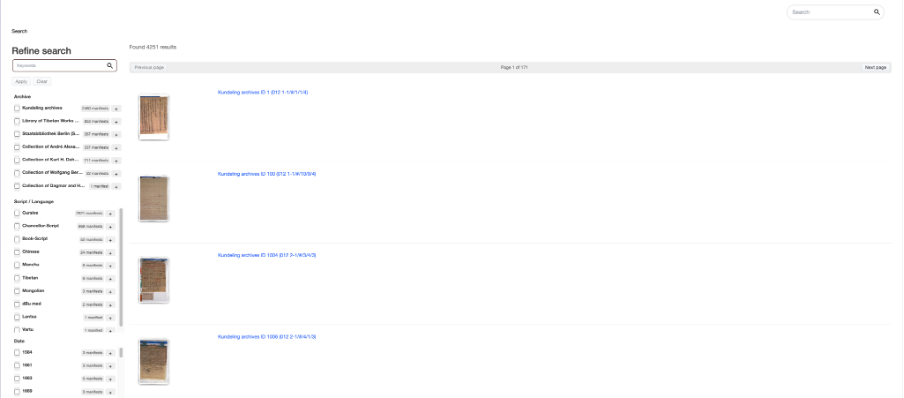
DTAB filter section in action
Beyond DTAB, the MADOC framework has proven effective for other CrossAsia preservation projects, particularly in safeguarding Southeast Asian cultural heritage. Two prominent examples are the LANNA Project—focusing on Northern Thai manuscripts, and the Digital Library of Lao Manuscripts (DLLM).
The LANNA project digitizes and catalogs materials from the Lanna Kingdom, including religious texts, chronicles, and legal documents, ensuring their accessibility to a global audience. With a user base of over 1,100 monthly visitors,2 LANNA has become a cornerstone in the study of Northern Thai cultural history.
Similarly, the DLLM safeguards an extensive collection of Lao manuscripts, many of which were at risk of deterioration. The over 12,000 texts and other multimedia data, attracting considerable attention from both local populations and researchers worldwide. Its multilingual interface allows Lao-speaking communities to directly explore these materials, fostering community interaction with their cultural heritage.
Future Scholarly Engagement and Crowd-sourcing
Building on these successful implementations of MADOC, DTAB is now poised to expand its capabilities beyond basic preservation and access. CrossAsia has outlined plans to implement annotation capabilities that would transform DTAB from a static archive into a platform for active scholarly engagement. Using IIIF annotation standards, researchers will be able to contribute translations, transcriptions and contextual information directly to the digital objects. The annotation layer would allow researchers to create meaning from these primary sources without altering the underlying digital objects. This separation of content and interpretation preserves the integrity of the original materials while enabling ongoing scholarly discourse about their significance and relationships to other historical sources.
These annotations would themselves become valuable scholarly outputs—citable, shareable contributions that can be referenced independently of the source documents (something I have suggested in an earlier DO blog post). The potential for crowd-sourced annotations represents a significant advancement in digital humanities research and DTAB could facilitate the discovery of previously unrecognized connections between documents while creating citable scholarly contributions in their own right.
Conclusion
The journey of DTAB from its origins in field research to its current implementation at CrossAsia illustrates both the challenges and opportunities inherent in digital preservation work. The project has overcome technical obstacles, institutional changes, and the evolution of digital standards to ensure continued access to important historical materials.
Looking ahead, DTAB exemplifies both the challenges and opportunities of digital preservation. While some features from the original database at the University of Bonn could not be maintained in their full detail, the project demonstrates how institutional support like CrossAsia’s can provide crucial long-term solutions when technical or financial constraints threaten digital resources. Through planned annotation capabilities and enhanced accessibility features, these historical documents will hopefully continue to generate new insights into Tibet’s rich cultural and legal heritage. More than just an archive, DTAB’s journey from Bonn to Berlin shows how digital preservation can both safeguard historical materials and adapt them for future scholarship—a positive example in a field where we too often see valuable digital resources fade away entirely.
- The Archives in Lhasa stores around 3,5 million documents of about 120 Tibetan monasteries. Among the 3,5 million there are 30,000 administrative documents, belonging to the monastery of Kündeling. ↩︎
- See https://blog.crossasia.org/about/lizenzierung/?lang=en for more usage statistics. ↩︎

 The Digital Orientalist
One thought on “From Bonn to Berlin: The Journey of Tibetan Digital Archives (CrossAsia Series Part 3)”