
This is part three of a three-part series on the biases surrounding Hellenistic Central Asia in generative artificial intelligence (AI) datasets. In the first article, I discussed how generative image AI tool outputs are a conglomeration of the available sources in their datasets and how these datasets are heavily biased towards modern representations and conceptions of the ancient world. In the second, I discussed how generative music AI tools present stereotypical biases of Hellenistic Central Asia in music, lyrics, and cover art. In this final part, I planned to discuss how Hellenistic Central Asia was biased in conversational AI models, such as ChatGPT 4o and Gemini 1.0, but newer “Deep Research” functions have since replaced and exponentially increased the capabilities of those legacy models.
“Deep Research” is an agentic function of newer AI reasoning models, such as ChatGPT o3 and Gemini 2.0 Flash. Agentic AI systems can act proactively and autonomously without human oversight. For Deep Research, these systems design a series of tasks based on user input and then complete those tasks with the independence to add and complete further actions which are deemed necessary to effectively produce the requested output. They are programmed to show their work so users can see how many searches were made in the creation of the output, why each search was made, and the sources that were used.
To test the reach and capacities of the OpenAI and Google Deep Research models, I inputted a major point of debate in Hellenistic Central Asian studies: the identity of the Aï Khanoum sanctuary main cult statue. All that remains of this statue is a fragment of the foot.
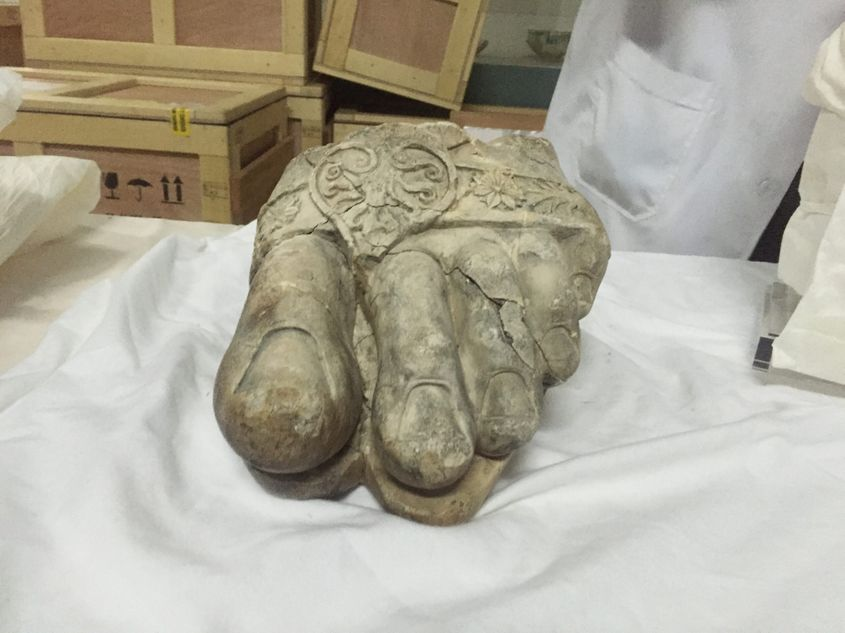
Figure 1: The marble foot fragment found in “The Temple of Indented Niches” in Aï Khanoum, Afghanistan. Photographed while the fragment was held by the Japan Committee for the Protection of Displaced Cultural Properties in 2016. “The Foot of Zeus,” Prospect, August 03, 2016, available at: https://www.prospectmagazine.co.uk/world/43169/the-foot-of-zeus. ©Llewelyn Morgan.
The foot has been identified as a wide variety of deities commonly found in Hellenistic Central Asia, including Zeus, Artemis, Cybele, Ahura Mazda, Mithra, and the Oxus River. This attribution has been discussed in scholarly works in at least 10 languages since its discovery in the 1960s. To avoid biasing my input towards any of these figures, I kept the initial prompt vague and asked for three layers of detail:
What deity was represented by the Ai Khanoum foot fragment found in the Temple with Indented Niches? Provide a detailed discussion using archaeological interpretations, iconographic analysis, and historical-religious context. Cite all sources used.
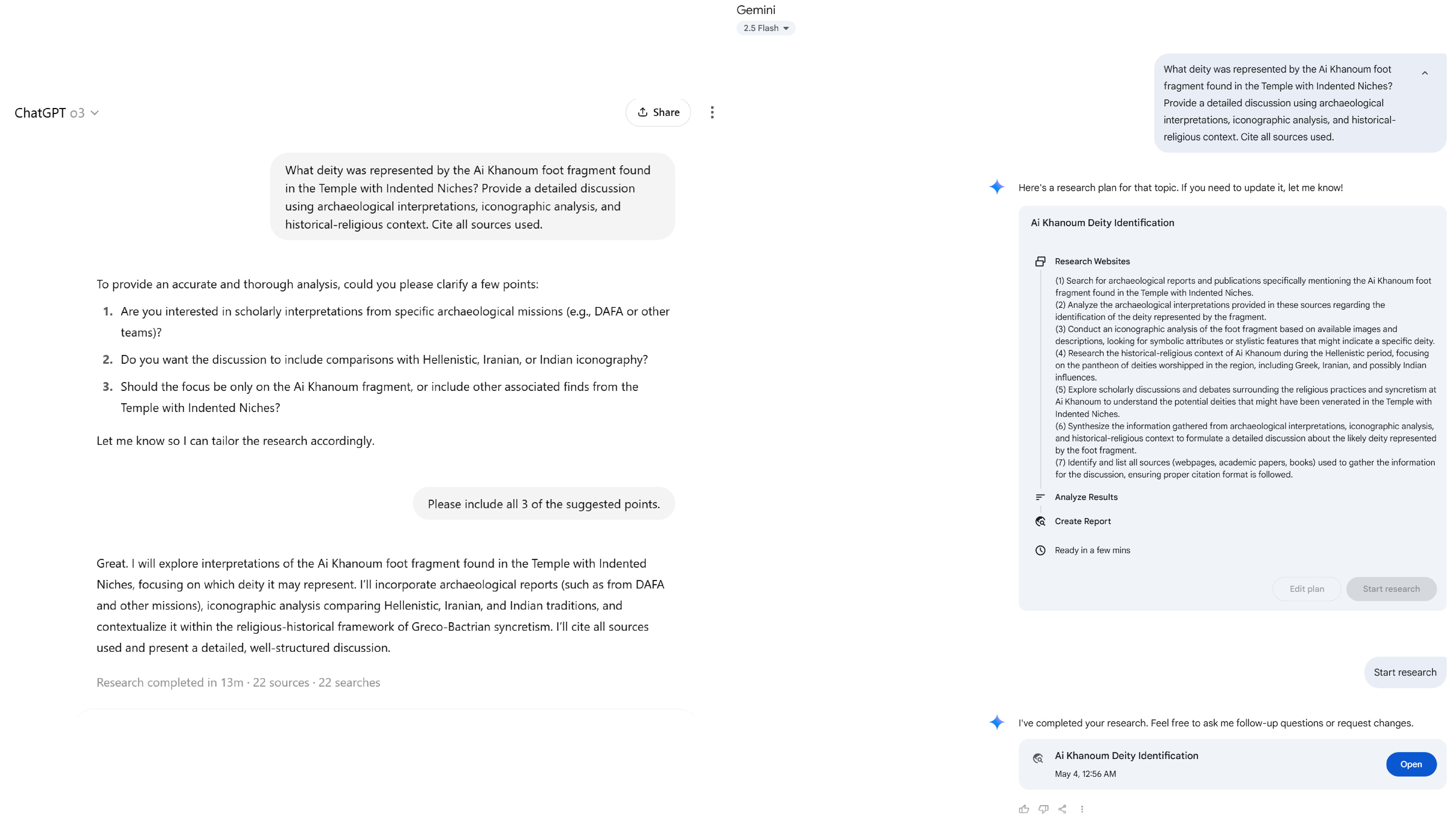
Figure 2: Left: OpenAI, ChatGPT o3 Deep Research, 29 April 2025 version, personal communication, generated on 4 May 2025 by Edward A. S. Ross; Right: Google, Gemini 2.0 Flash Deep Research, 22 April 2025 version, personal communication, generated on 4 May 2025 by Edward A. S. Ross.
ChatGPT o3 completed the output in 13 minutes with 22 searches and 22 sources. The output included an activity documentation of its search history and reasoning process, a list of all sources read during these searches, and a completed text with citations.
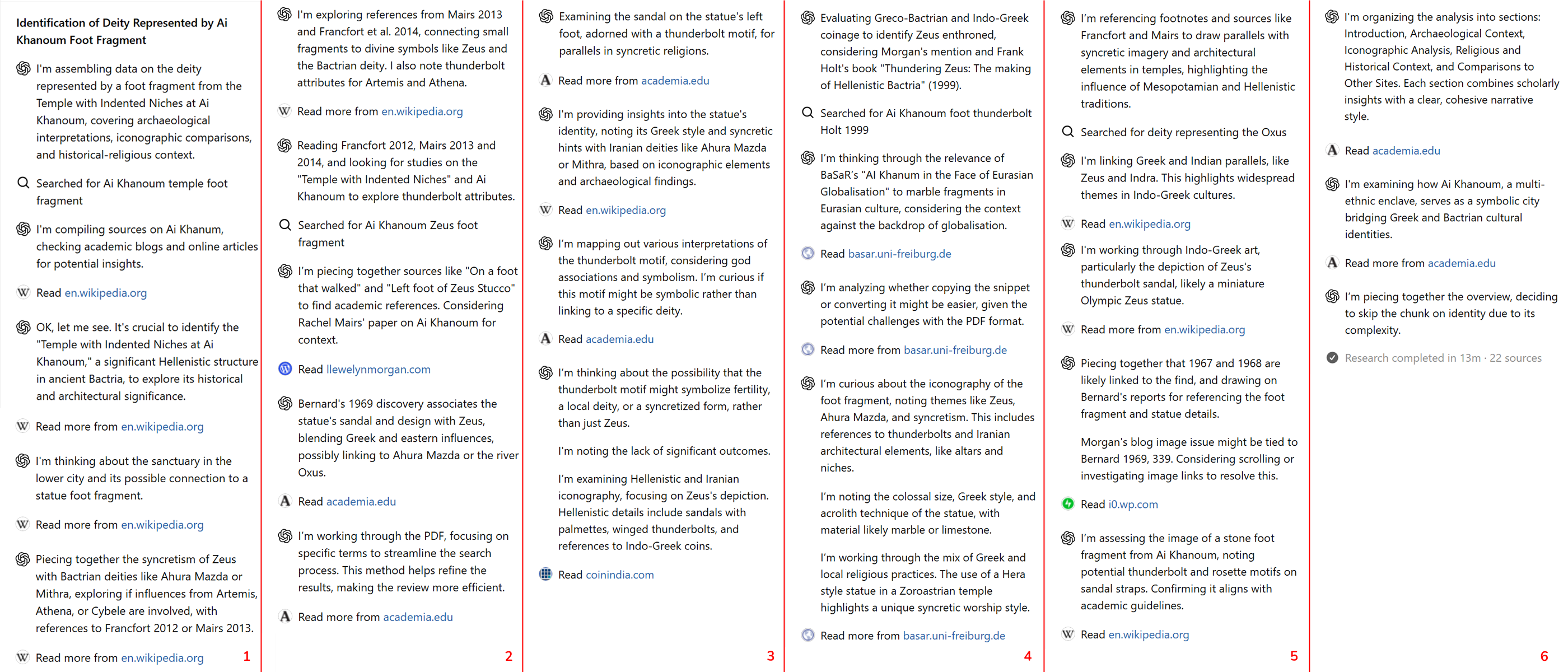
Figure 3: Activity Log from OpenAI, ChatGPT o3 Deep Research, 29 April 2025 version, personal communication, generated on 4 May 2025 by Edward A. S. Ross.
The texts cited primarily come from Wikipedia, Academia.edu, and academic blogs. The cited articles are human-authored works, but there are some portions of the cited websites, mostly on Academic.edu, that also include AI-generated pdf summaries and abstracts. In this way, we are beginning to see AI-generated content contributing to the production of further AI-generated content, which may become an increasingly problematic issue.
A user can export the ChatGPT o3 deep research output as a pdf. This pdf included the completed text, citations, and a source list, but the activity documentation and initial conversation were not included in the file.
Figure 4: OpenAI, ChatGPT o3 Deep Research, 29 April 2025 version, personal communication, generated on 4 May 2025 by Edward A. S. Ross. Prompt: “What deity was represented by the Ai Khanoum foot fragment found in the Temple with Indented Niches? Provide a detailed discussion using archaeological interpretations, iconographic analysis, and historical-religious context. Cite all sources used.”
Although the inclusion of a ChatGPT logo in the exported file clearly indicates that this work is AI-generated, readers are unable to assess the model’s reasoning without the activity log and original input.
The text produced by ChatGPT o3 covers some major discussions related to the Aï Khanoum foot, primarily focusing on the identification of Zeus but also highlighting most of the other theorized deities. It is essentially an adequate essay summary of the relevant debates using the immediately available English sources found in an initial search. However, the most recent source comes from 2019, and none of the vast collection of non-English materials studying this foot fragment are included in the source list. Without more recent works and the full breadth of non-English works exploring the topic, ChatGPT o3’s Deep Research output simply reinforces pre-existing Western, anglo-centric notions of the Aï Khanoum deity.
Gemini 2.0 Flash completed the output in 4 minutes with 6 searches and 141 sources. This output was quite similar to ChatGPT o3, including an activity documentation (“Thoughts”), a source list, and a completed text with citations. However, Gemini 2.0 Flash took this a step further and divided its significantly larger source list into two sections: “Sources used in the report” and “Sources read but not used in the report.”
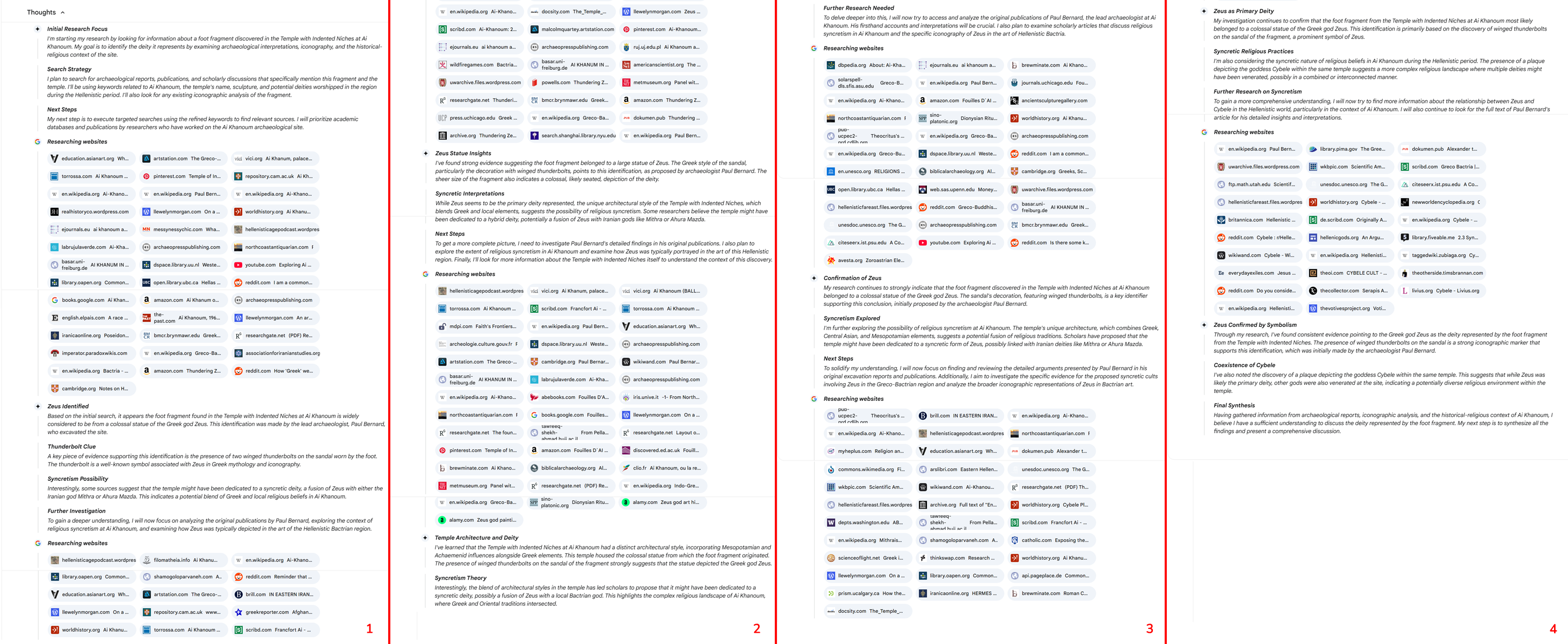
Figure 5: Thoughts Log from Google, Gemini 2.0 Flash Deep Research, 22 April 2025 version, personal communication, generated on 4 May 2025 by Edward A. S. Ross.
The cited texts in the output come from a much broader collection of sources than ChatGPT o3, including Wikipedia, ResearchGate, and academic blogs, but also message boards, like Reddit and Pinterest, stock photo websites, like Alamy and Art Station, and essay repositories, like Scribd. There are many more instances of AI-generated text and images in this source list, further increasing the risk of the AI tool recursively training on previously generated outputs and potentially leading to model collapse.
The Gemini Deep Research output can also be exported as a GoogleDoc, including the full text and source list, but the “Thoughts” log and “Sources read but not used in the report” are not included in the exported text.
Figure 6: Google, Gemini 2.0 Flash Deep Research, 22 April 2025 version, personal communication, generated on 4 May 2025 by Edward A. S. Ross. Prompt: “What deity was represented by the Ai Khanoum foot fragment found in the Temple with Indented Niches? Provide a detailed discussion using archaeological interpretations, iconographic analysis, and historical-religious context. Cite all sources used.”
Unlike ChatGPT o3, Gemini 2.0 Flash does not include a clear logo in the exported file, so it will take more effort for a user to identify that the text was AI-generated.
The text of the Gemini 2.0 Flash Deep Research output is formatted more like a bullet point list in sections. Gemini 2.0 Flash’s discussion includes a broader exploration of the history of how the foot was uncovered, but it leans quite heavily on the attribution of the foot to Zeus. This is surprising considering the sheer number of sources used in the generation (84 directly cited in the exported output), suggesting that the output should include a broader collection of perspectives. The most recent source in this output is from 2021, so it includes some more recent elements than the ChatGPT o3 output, but all the included sources are also in English. Overall, Gemini’s output is less applicable to the task than ChatGPT’s, despite a wider source base. This may be connected to the increased amount of AI-generated content present in Gemini’s source list.
Viewing these deep research outputs, I question the usefulness of a reasoning model of this kind. With hundreds of billions of parameters, these reasoning models require a significantly higher amount of processing power and in turn energy to run. The exact figure for this impact is still unclear due to OpenAI and Google’s refusal to release their energy usage figures, but it is estimated to be significantly higher than that of standard text generation use. We must also be aware that this energy use translates into CO2 output and freshwater consumption.
In this series, I explored how generative AI models bias Hellenistic Central Asia in its outputs and discussed some of the major ethical issues with these tools. From the anachronistic images to the Orientalist songs to the anglo-centric research summaries, generative AI models present an interesting way to address our own biases while bearing in mind their ethical problems. We are at a critical point where we can still work towards reducing the societal and environmental impact of these tools, but we need to be aware of their existence to do this. Keep informed, remain critical, and speak to your friends and family.
Cover Image: OpenAI, ChatGPT o4-mini, 29 April 2025 version, personal communication, generated on 4 May 2025 by Edward A. S. Ross. Prompt: “Create a landscape image of the Ai Khanoum Temple with Indented Niches. Make sure to include the main cult statue.”
References
Bogmans, Christian, Gomez-Gonzalez, Patricia, Melina, Giovanni, and Thube, Sneha. “AI Needs More Abundant Power Supplies to Keep Driving Economic Growth.” IMF Blog, May 13, 2025. Accessed May 20, 2025. https://www.imf.org/en/Blogs/Articles/2025/05/13/ai-needs-more-abundant-power-supplies-to-keep-driving-economic-growth#:~:text=Efficient%2C%20open%2Dsource%20AI%20models,energy%20investments%2C%20causing%20higher%20prices.
Francfort, Henri-Paul. “Ai Khanoum ‘temple à niches indentées’ (temple with indented niches) and Takht-i Sangin ‘Oxus temple’ in historical cultural perspective: a hypothesis about the cults.” Parthica 14 (2012): 109-136.
Google. Gemini 2.0 Flash (22 April 2025 version) [Large language model]. 2025. https://gemini.google.com/.
Google. “Gemini Deep Research.” Gemini. Accessed May 3, 2025. https://gemini.google/overview/deep-research/?hl=en-GB.
Morgan, Llewelyn. “The foot of Zeus.” Prospect, August 03, 2016. Accessed May 15, 2025. https://www.prospectmagazine.co.uk/world/43169/the-foot-of-zeus.
Nicoletti, Leonardo, Ma, Michelle, and Bass, Dana. “AI is Draining Water from Areas that Need it Most.” Bloomberg, May 8, 2025. Accessed May 20, 2025. https://www.bloomberg.com/graphics/2025-ai-impacts-data-centers-water-data/.
O’Donnell, James, and Crownhart, Casey. “Everything you need to know about estimating AI’s energy and emissions burden.” MIT Technology Review, May 20, 2025. Accessed May 20, 2025. https://www.technologyreview.com/2025/05/20/1116331/ai-energy-demand-methodology/.
O’Donnell, James, and Crownhart, Casey. “We did the math on AI’s energy footprint. Here’s the story you haven’t heard.” MIT Technology Review, May 20, 2025. Accessed May 20, 2025. https://www.technologyreview.com/2025/05/20/1116327/ai-energy-usage-climate-footprint-big-tech/.
OpenAI. ChatGPT-o3 (29 April 2025 version) [Large language model]. 2025. https://chatgpt.com/.
OpenAI. “Introducing deep research.” OpenAI, February 2, 2025. Accessed May 3, 2025. https://openai.com/index/introducing-deep-research/.
Purdy, Mark. “What is Agentic AI, and How Will it Change Work?” Harvard Business Review, December 12, 2024. Accessed May 3, 2025. https://hbr.org/2024/12/what-is-agentic-ai-and-how-will-it-change-work.
Ross, Edward A. S. “Hellenistic Central Asia through the Eyes of GenAI – Part 2: Music.” The Digital Orientalist, January 28, 2025. Accessed May 4, 2025. https://digitalorientalist.com/2025/01/28/hellenistic-central-asia-through-the-eyes-of-genai-part-2-music/.
Ross, Edward A. S. “Hellenistic Central Asia through the Eyes of GenAI – Part 1: Images.” The Digital Orientalist, October 22, 2024. Accessed January 15, 2025. https://digitalorientalist.com/2024/10/22/hellenistic-central-asia-through-the-eyes-of-genai-part-1-images/.
Shumailov, Ilia, Shumaylov, Zakhar, Zhao, Yiren, Papernot, Nicolas, Anderson, Ross, and Gal, Yarin. “AI models collapse when trained on recursively generated data.” Nature 631 (2024): 755-759. https://doi.org/10.1038/s41586-024-07566-y.

 The Digital Orientalist
One thought on “Hellenistic Central Asia through the Eyes of GenAI – Part 3: Deep Research”