
In my previous discussion, I examined AKU-PAL, the palaeographical database for hieratic script among ancient Egyptian writing systems. This article focuses on the palaeographical database for demotic script, another crucial ancient Egyptian writing system. While the AKU Portal was developed primarily by Johannes Gutenberg University Mainz in Rhineland-Palatinate, the Demotic Palaeographical Database Project (DPDP) presented here is being developed by Ruprecht Karl University Heidelberg in western Baden-Württemberg.
This is a modified and extended English version of a Japanese article in the Jimbunjohogaku Geppo [Digital Humanities Monthly] web magazine (ISSN 2189-1621 / Founded August 27, 2011, Circulation 1,083), No. 146-1, published by the International Institute for Digital Humanities, Tokyo, on August 31, 2023; an archived version: https://www.dhii.jp/DHM/dhm146-1; the registration to the web magazine: https://w.bme.jp/bm/p/f/tf.php?id=dhm&task=regist.
Understanding Demotic Script
For readers unfamiliar with ancient Egyptian writing systems, it is essential to understand that the ancient Egyptians employed three main scripts throughout their history: hieroglyphic, hieratic, and demotic. Hieroglyphic script, the most recognizable with its pictographic characters, was primarily used for monumental inscriptions and religious texts. Hieratic, a cursive form of hieroglyphics, served as the administrative and literary script for much of Egyptian history. Demotic, the subject of this database, represents the most cursive and simplified of these scripts.
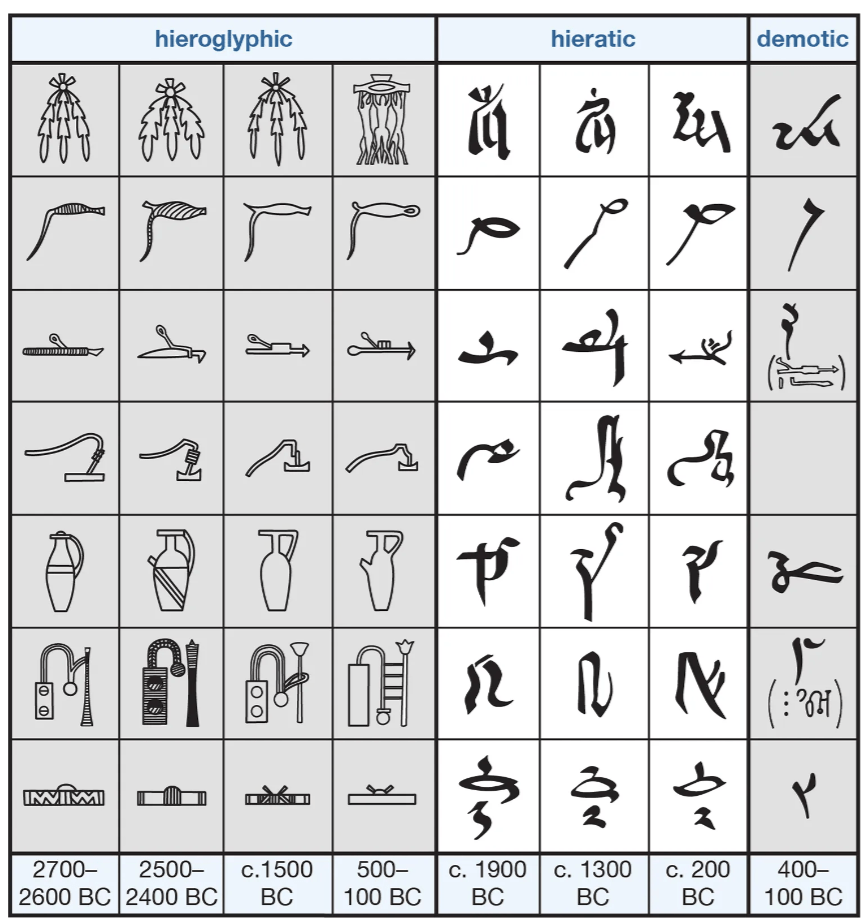
Figure 1: Differences among Hieroglyphs, Hieratics, and Demotics based on Möller 1919: 78, created by Muñoz Sánchez 2024: 157
The term “demotic” derives from the Greek word “dēmotikós,” meaning “popular” or “of the people”. Visually, demotic appears as flowing, connected strokes that bear little resemblance to the original hieroglyphic pictures. To the untrained eye, demotic script might appear as abstract lines and curves, making it particularly challenging to decipher without specialized training. This complexity underscores the importance of digital databases that can help scholars identify and compare character forms.
The Demotic Palaeographical Database Project
The Demotic Palaeographical Database Project constitutes a comprehensive database initiative for documentary materials written in ancient Egyptian demotic script. Demotic was employed from approximately the 7th century BCE during the Late Period through the 5th century CE in the early Byzantine period—a span of over 1,200 years. This extensive temporal range means that demotic witnessed significant historical events, from the Persian and Greek conquests of Egypt to the Roman period and the rise of Christianity.
The Egyptian language recorded in demotic script is termed Demotic Egyptian, which represents a late stage of the Egyptian language. Its grammar closely approximates that of Coptic, the final stage of the Egyptian language that was written using a modified Greek alphabet and survived as a liturgical language in the Coptic Christian Church. This linguistic connection makes demotic texts crucial for understanding the evolution of the Egyptian language.
The project’s objective is to systematically collect, analyze, and classify ancient Egyptian demotic documents and share these resources with researchers and the general public. Of particular significance is that this project is led by Professor Joachim Friedrich Quack of Heidelberg University, who stands as one of the world’s foremost authorities on demotic studies. Professor Quack’s involvement lends exceptional scholarly weight to the project; his decades of groundbreaking research in demotic philology, religious texts, and documentary materials have fundamentally shaped modern understanding of this script. His expertise spans the entire chronological range of demotic texts and encompasses both literary and documentary materials, making him uniquely qualified to oversee such a comprehensive database project. The team also includes accomplished scholars such as Dr. Claudia Maderna-Sieben, Jannik Korte, and Fabian Wespi, forming a group that represents some of the leading expertise in demotic studies globally.
Database Content and Significance
The DPDP database encompasses documents collected throughout Egypt, ranging from business contracts and personal letters to religious texts and literary works. This diversity is particularly significant because demotic, unlike hieroglyphic script, which was often reserved for religious and monumental contexts, was used for everyday communication. These texts provide unprecedented insights into daily life in ancient Egypt—from marriage contracts and tax receipts to personal letters discussing family matters and business dealings.
The database web application comprises five modules: (1) djehuti (limited access), (2) corpus, (3) palaeography (beta version), (4) full text search (beta version), and (5) words. The djehuti module is not currently publicly accessible, and its functionality remains undisclosed.
The Corpus module enables viewing of demotic textual documents—namely, corpora with their translations and metadata. A corpus constitutes a collection of texts assembled based on specific languages, periods, or regions, serving as indispensable material for diverse research in linguistics, philology, and history. Each document entry specifies identifiers, document type, discovery location, document date, and identification codes established by other projects (such as TM and TLA). Unfortunately, these corpora are currently available only in PDF format. Development of tagged corpora with searchable text and translations, featuring glosses and part-of-speech tags, remains anticipated. The language employed for descriptions and translations is German, necessitating the creation of an English version for the international Egyptological community.
The Revolutionary Palaeography Module
The Palaeography module represents a particularly groundbreaking development in demotic studies. Palaeography—the study of ancient handwriting and script evolution—is essential for dating documents and understanding regional variations in writing. For demotic script, with its highly cursive nature and significant variation across time and space, palaeographical analysis has traditionally been extremely challenging.
Prior to this database, no large-scale online palaeographical resource existed for demotic. Researchers were limited to referencing character variants recorded in Wolja Erichsen’s 1954 lexicon, the Chicago Demotic Dictionary, palaeography of O. El-Aguizy, or the facsimiles in the “Demotisches Namenbuch” by Lüddeckens et al.. While Ludwig Maximilian University Munich has released an online demotic word list, the quantity of data regarding different character forms has not yet surpassed Erichsen’s lexicon. Having accompanied the Johns Hopkins University and Yale University joint research team investigating demotic papyri in the Suzuki Collection at Tokai University, I observed that demotic specialists primarily utilize Erichsen’s lexicon to examine character form data. However, this process requires extensive page-turning and visual comparison, consuming considerable time and potentially missing subtle variations.

When searching for or selecting a specific character from the list, comprehensive information displays as shown in Figure 1. The interface shows the hieroglyph corresponding to the demotic character, consonantal transcription, and frequency ranking. The system also displays occurrence frequency, contextual environment, and links to other ancient Egyptian writing databases such as the hieratic database AKU.

Figure 3: Character form images of the logogram representing ḥm and visualization of regional and temporal occurrence frequency
Figure 3 demonstrates the database’s revolutionary capacity to display character form images by discovery location, along with temporal and regional occurrence frequency visualizations. This feature allows researchers to track how writing styles evolved over time and varied across different regions of Egypt—crucial information for dating undated texts and understanding scribal traditions.
Finally, the project enables palaeography-based full-text search, allowing users to search for specific vocabulary while filtering by scripts, characters, modifications, periods, and regions. Search results display as concordances with contextual information, Latin transliteration, and modern language translations.

Figure 4: Screenshot showing search results for first-person singular independent personal pronouns in full-text search
Future Implications
The Demotic Palaeographical Database Project represents a multifunctional and sophisticated database with potential to dramatically advance research on ancient Egyptian demotic documentary materials. Under Professor Quack’s expert leadership, this project exemplifies how world-class scholarship combined with digital tools can transform traditional philological research, making previously inaccessible materials searchable and comparable on an unprecedented scale. For digital humanities scholars, it demonstrates the importance of having leading domain experts guide technical implementations to ensure scholarly rigor and practical utility. Through this database, numerous unresolved questions regarding ancient Egypt’s social, economic, and cultural history are expected to find new answers, while opening entirely new avenues of research into the daily lives of ancient Egyptians.
Bibliography (selected)
Korte, Jannik, Claudia Maderna-Sieben, and Fabian Wespi. “Deciphering Demotic Digitally.” In Altertumswissenschaften in a Digital Age: Egyptology, Papyrology and beyond; Proceedings of a Conference and Workshop in Leipzig, November 4-6, 2015, edited by Monica Berti and Franziska Naether, Beitrag 19. Leipzig: Qucosa, 2016. urn:nbn:de:bsz:15-qucosa-201668.
El-Aguizy, Ola. A Palaeographical Study of Demotic Papyri in the Cairo Museum from the Reign of King Taharka to the End of the Ptolemaic Period (684-30 B.C.). Mémoires publiés par les membres de l’Institut français d’archéologie orientale 113. Cairo: Institut français d’archéologie orientale, 1998.
Erichsen, Wolja. Demotisches Glossar. Copenhagen: Ejnar Munksgaard, 1954.
Jasnow, Richard, Myriam Krutzsch, J. G. Manning, and Kyoko Yamahana. The Demotic and Hieratic Papyri in the Suzuki Collection of Tokai University, Japan. Cultural Legacies. Atlanta: Lockwood Press, 2016.
Johnson, Janet H., ed. The Demotic Dictionary of the Oriental Institute of the University of Chicago (CDD). Chicago: Oriental Institute, University of Chicago, 2001–. Online publication. https://oi.uchicago.edu/research/publications/demotic-dictionary-oriental-institute-university-chicago.
Lüddeckens, Erich, Wolfgang Brunsch, Günter Vittmann, Karl-Theodor Zauzich, and Heinz-Josef Thissen. Demotisches Namenbuch. Wiesbaden: Dr. Ludwig Reichert Verlag, 1980–2000.
Miyagawa, So. “Glyph Image Database and Text Corpus of Ancient Egyptian Demotic: Demotic Palaeographical Database Project.” Jimbunjohogaku Geppo, no. 146-1 (September 30, 2023). Archived at https://www.dhii.jp/DHM/dhm146-1.
Möller, Georg. “Die Buchschrift der alten Ägypter.” Zeitschrift des Deutschen Vereins für Buchwesen und Schrifttum 2 (1919): 73–79.
Muñoz Sánchez, Ricardo. “When Hieroglyphs Meet Technology: A Linguistic Journey through Ancient Egypt Using Natural Language Processing.” In Proceedings of the Third Workshop on Language Technologies for Historical and Ancient Languages (LT4HALA) @ LREC-COLING-2024, edited by Rachele Sprugnoli and Marco Passarotti, 156–169. Torino, Italia: ELRA and ICCL, 2024. https://aclanthology.org/2024.lt4hala-1.18/.
Quack, Joachim F., Claudia Maderna-Sieben, Jannik Korte, and Fabian Wespi. “Demotic Palaeography.” In The Oxford Handbook of Egyptian Epigraphy and Palaeography, edited by Vanessa Davies and Dimitri Laboury, 618–631. New York: Oxford University Press, 2020.
Wespi, Fabian, Jannik Korte, and Claudia Maderna-Sieben. “Deciphering Demotic Digitally: The Demotic Palaeographical Database Project.” In Altertumswissenschaften in a Digital Age: Egyptology, Papyrology and beyond; proceedings of a conference and workshop in Leipzig, November 4-6, 2015, edited by Monica Berti and Franziska Naether. Leipzig: Universitätsbibliothek Leipzig, 2016. https://nbn-resolving.org/urn:nbn:de:bsz:15-qucosa-201668.
Wespi, Fabian, Jannik Korte, and Claudia Maderna-Sieben. “The Demotic Palaeographical Database Project.” Paper presented at the XIth International Congress of Egyptologists, Florence, August 23–30, 2015.
Acknowledgements
I am grateful to Fabian Wespi for his invaluable comments on this article.

