
(This is a guest post by Chandini Jaswal)
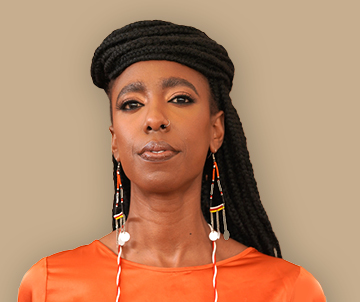
Chao Tayiana Maina is a Kenyan historian and digital heritage specialist working at the intersection of digital humanities and public education in African histories.
Maina co-founded the Museum of British Colonialism (MBC), a joint British-Kenyan initiative that aims to present a more truthful account of British colonialism in Kenya. In a major project, the MBC worked to restore the previously suppressed history of detention camps during the Mau Mau Emergency in Kenya in the 1950s by creating 3D site reconstructions of the camps and presenting these in physical and digital exhibitions.
In 2019, she founded African Digital Heritage (ADH), a non-profit organisation that seeks to encourage a more critical, holistic and knowledge-based approach to digital solutions within African heritage. In 2020, she co-founded Open Restitution Africa, an open data project seeking to make accessible information on restitution of African material culture and human ancestors. She is a recipient of many prestigious awards including the 2016 Google Anita Borg scholarship for Women in technology and the Dan David Prize 2023.
_____________________________________________________________________
This two part interview-blog series has been taken for a guest contribution for the Digital Orientalist by Chandini Jaswal. Maina discusses the importance of DH in 21st Century, the changing perception of DH in Africa, the obstacles grappling this young industry and her future projects as a DH Specialist.
Chandini: Let us start with the basics: why is Digital Heritage (DH) important in the 21st century?
Chao: Well, there are many reasons. The first I can think of is that Digital Heritage gives us the means to translate history into mediums and languages that history has not been interpreted before. DH can translate information for different audiences, particularly those who have either been left out of the historical narrative or those never given the agency to define their histories.
Digital Heritage has a much lower barrier of entry, which means that the amount of ethos that was required to have consumers, 100 or 50 years ago, when you needed to go to a printing press, find a publisher etc. Now we have direct linkages between audiences and their platforms – it is no longer the institution that is controlling historical narrative.
DH gives the power of narrative back to audiences, ordinary people, and creators – countering the dominant narratives that the institutionalisation of history through colonialism, the museum sector, and the publishing sector had created. These narratives, even though wrong, have become cemented in time. After all, they have been repeated over and over again for so many years!
DH is also a way to look at narratives outside the canon of demonic narratives. For example, “ABC” is a narrative of African history that is told, read and accepted; but other narratives exist too, right? Thus, allowing alternative, marginalised narratives to grow is also extremely important. DH is a means to do that.
Chandini: In one of your interviews, you mentioned that the greatest concern facing Digital Heritage is its survival on donations. At a time when DH is still nascent, how do you, as a digital heritage specialist, inform and educate people that they invest in a niche project like DH, like MBC or ADH?
Chao: The primary concern for me in the industry is that DH is no longer a luxury. That, when you have extra resources, that’s when you do digital work. Technology is rapidly (and non-uniformly) growing in different parts of the world.
However, if you look at the percentage of scholarly content generated in Africa on the internet, it is less than 5%. So, digital heritage is not just a matter of digital access, it is a matter of digital representation, of digital equality online. It’s a matter of access to narratives that represent you. It’s a matter of artificial intelligence, having data sets that are not inherently white and inherently biased. So, in terms of convincing people, I think there’s never been a more urgent time to take digital heritage seriously than now. As we see rapid advancement in technology, what we also see is that people who have more money are more in control of digital spaces, infrastructure, and narratives.
This is serious because we are now relying on technology for most of the things happening today. So, if you’re looking at technology as a mainstay in healthcare, finance, banking, and agriculture, it’s also a priority within the heritage space – especially for countries and people who have undergone a lot of historical injustices – colonialism and imperialism. It’s more urgent in those spaces because it’s truly an opportunity to determine what history can do for us, and what history should do.
This is also because history and heritage have been weaponised traditionally against minority communities. They’ve been used to erase the history of people, their participation, and knowledge systems – contributing to low esteem or self-perception.
Thus, we also have to look at how history has been used traditionally to entrench extremely harmful logic. It has been used to justify violence and stealing resources from humans. For me, there are two ways this can go. Technology can either be used to further these narratives by replicating them online and entrenching them further in digital spaces; or we have an opportunity to push back against these narratives, refuse them, change them, and actively imagine other alternatives to our heritage and history. So for countries such as Kenya, India, and those around the world that are grappling with issues like anti-blackness identity, identity formation, and digital heritage is an opportunity that we must take. Also to mention here that artificial intelligence brings a completely new dynamic to this scheme because AI is based on the data sets that are used to train it. So if we are relying on data sets that hold these same violent, colonial logics, then we are essentially replicating and recreating a world in which these logics do not just exist in real life, but are perpetuated again online, which reinforces them in real life, which then reinforces them online. So there’s a vicious cycle. This is also extremely important in light of societies where a considerable amount of information is slowly moving out of living memory, because people are getting old, and all languages are going extinct.
So what happens when we don’t have that resource to tap into for other alternatives of our history? How are we ensuring that a generation that doesn’t have access to this living memory has access to it differently? So in those ways, I think it justifies why we need DH and why we need to do it now.

Chandini: Speaking of old communities, a lot of your work depends on oral history projects. In my experience of working with oral histories in India, at times when talking with interviewees, they express their discomfort in sharing their stories of trauma on record. Since colonial histories are mostly traumatic, how have you ensured that their experiences get digitised without us traumatising them further?
Chao: To begin with, it is a fact that everyone has a right to privacy. We don’t work with the assumption that everything should be online. And it is really important when people express that and that it is respected. There are still ways of documenting history indirectly. Perhaps you translate it into a written piece, a dramatic performance or a visual piece. As DH practitioners we should also accept that technology is not here to solve all our problems and that we are responsible for how we use it.
So, in my case, I would find different ways to speak about it, perhaps looking at it through a different lens, not through the person. If they talk about, for example, a particular location, a particular site of detention, then the site is also an entry point into that history – but they led me there. So I think that’s essentially about interpretation, ethics, and care.
_____________________________________________________________________
Chandini Jaswal, who authored this guest contribution, is a second-year postgraduate history student at Panjab University, India. She secured the gold medal in her undergraduate history degree. Jaswal is a core team member at Karwaan Heritage, India and a communication member at The Museum of British Colonialism, UK-Kenya. Jaswal has published 15 research papers and 27 articles focusing on subcontinental history, particularly pre-modern India. She is also engaged in documenting oral histories of the 1947 Partition. Her research papers have been recognised at various conferences and workshops, including the New York Conference on Asian Studies and the Indian Association for South Asian Studies among others. Twitter handle: jaswalC05.

 The Digital Orientalist
One thought on “Situating Digital Heritage in Africa: An Interview with the DH Specialist and 2023 Dan David Prize Winner, Chao Tayiana Maina (Part 1)”