
During the DNP Foundation for Cultural Promotion: Graphic Culture Research Grant’s annual research report meeting in November 2023, I had the pleasure of learning about the work being conducted by Ishizaki Yasuko and her team. Using the Hiroshi Komiyama Collection (J. Komiyama Hiroshi bunko 小宮山博文庫) at Yokohama History Museum (J. Yokohama-shi rekishi hakubutsukan 横浜市歴史博物館), which includes 312 type specimen books, Ishizaki’s team created an online database of hiragana and katakana characters.
The database entitled Moji no katachi no dētabēsu, Komiyama Hiroshi bunko, Kana jikei ichiran 「文字のかたちのデータベース」小宮山博文庫・仮名字形一覧 (E. “Database of Character Forms, Hiroshi Komiyama Collection, List of Kana Glyphs) can be accessed through a dedicated webpage on Yokohama History Museum’s website and contains over 60,000 characters from 94 type specimen books. Most of the specimen books used in the database are from the Meiji period (1968-1912), although other later texts are also included. As such, it does not include a great number of variant characters with the database even noting the policy of the creators to exclude variants. Linked to this, I believe that it is likely to be of most interest to those working on modern Japan rather than pre-modernists.
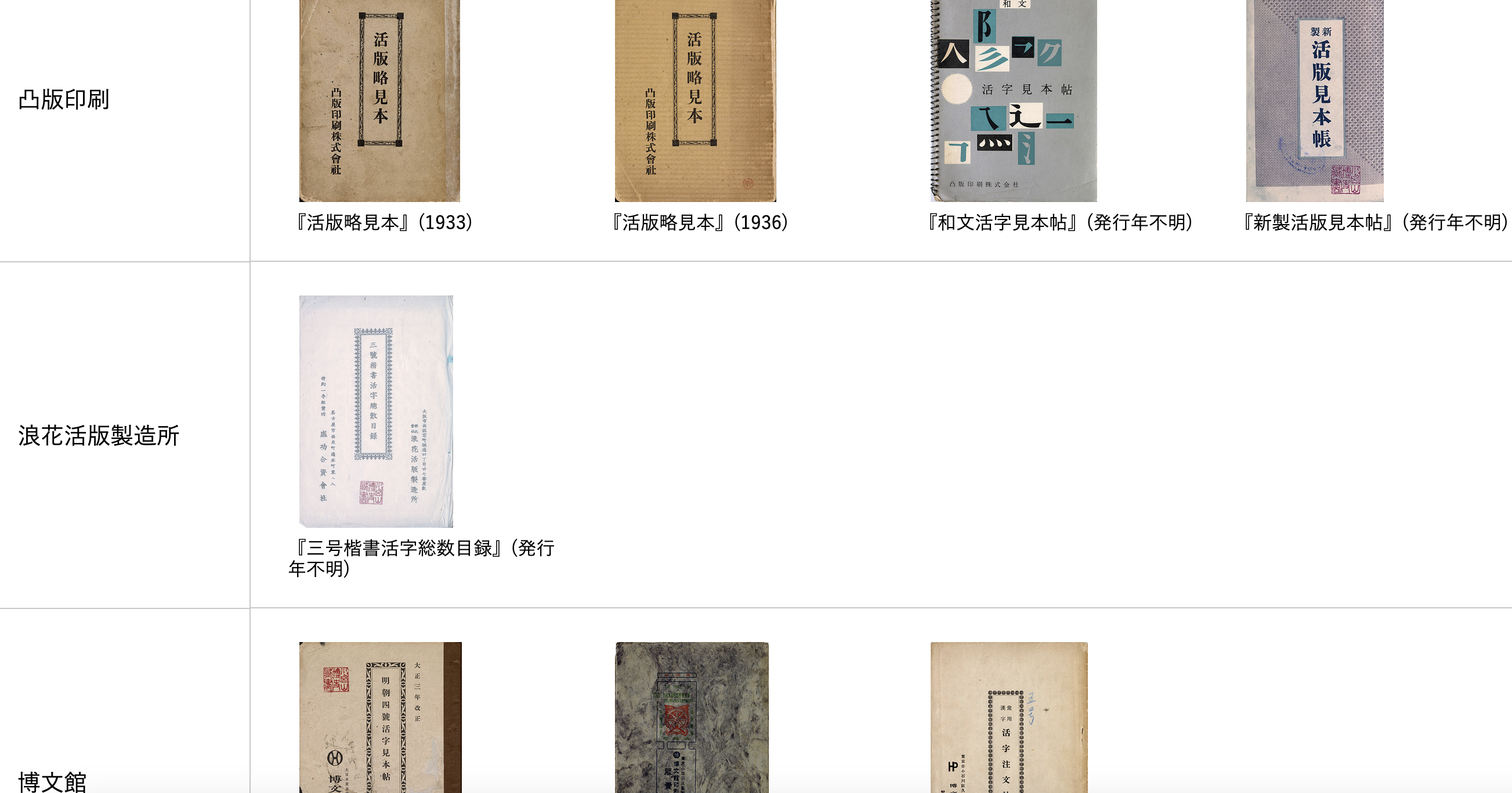
The user can search for characters in two different ways. First, they can navigate via type sample books which allows users to look at the typefaces used in the individual type specimen books that make up the collection. The user can then navigate to the image of an individual character from the text, inspect it, save or copy the image etc. Second, they can search for individual kana (with two separate search options for hiragana and katakana). In order to conduct this sort of search users select the character they want to find from a table of kana, some small kana variants (J. sutegana 捨て仮名), some iteration marks (J. odoriji 踊り字), and punctuation. For this second type of search, results are listed according to the books from which images were taken. This option is particularly useful for comparing variants including both within a single text and across multiple texts.
It is recommended that users use either Microsoft Edge or Safari, but I have had no problems viewing the database with other browsers such as Firefox. The main limitation, as far as I can tell, is that the quality of some of the images suffers when the user chooses to click on and expand them. When viewed in tabular form, however, the quality of the images is more than sufficient.

For most, the database is likely to serve as little more than a curiosity, however, there are numerous ways that it can potentially be used. One of the uses envisaged by Ishizaki is that it will aid typographers in getting ideas for the creation of new fonts. It is also possible that scholars use it to conduct in-depth research into the evolution of kana typefaces during the late 19th and early 20th centuries. In my own brief reflections, I wonder if there is some utility in using some of the images in the classroom particularly where variants have been included or styles have changed. Nevertheless, there are much better resources available for this purpose. As such, I imagine that Ishizaki’s assumption is likely correctly and that the database will become primarily useful for those interested in font design.
In any case, this is a beautifully designed little database which is likely of passing interest to all sorts of Japanologists. It serves as a fantastic example of what can be achieved by small scale projects. I recommend giving it a look!

 The Digital Orientalist
One thought on “The Hiroshi Komiyama Collection, Database of Character Forms”