
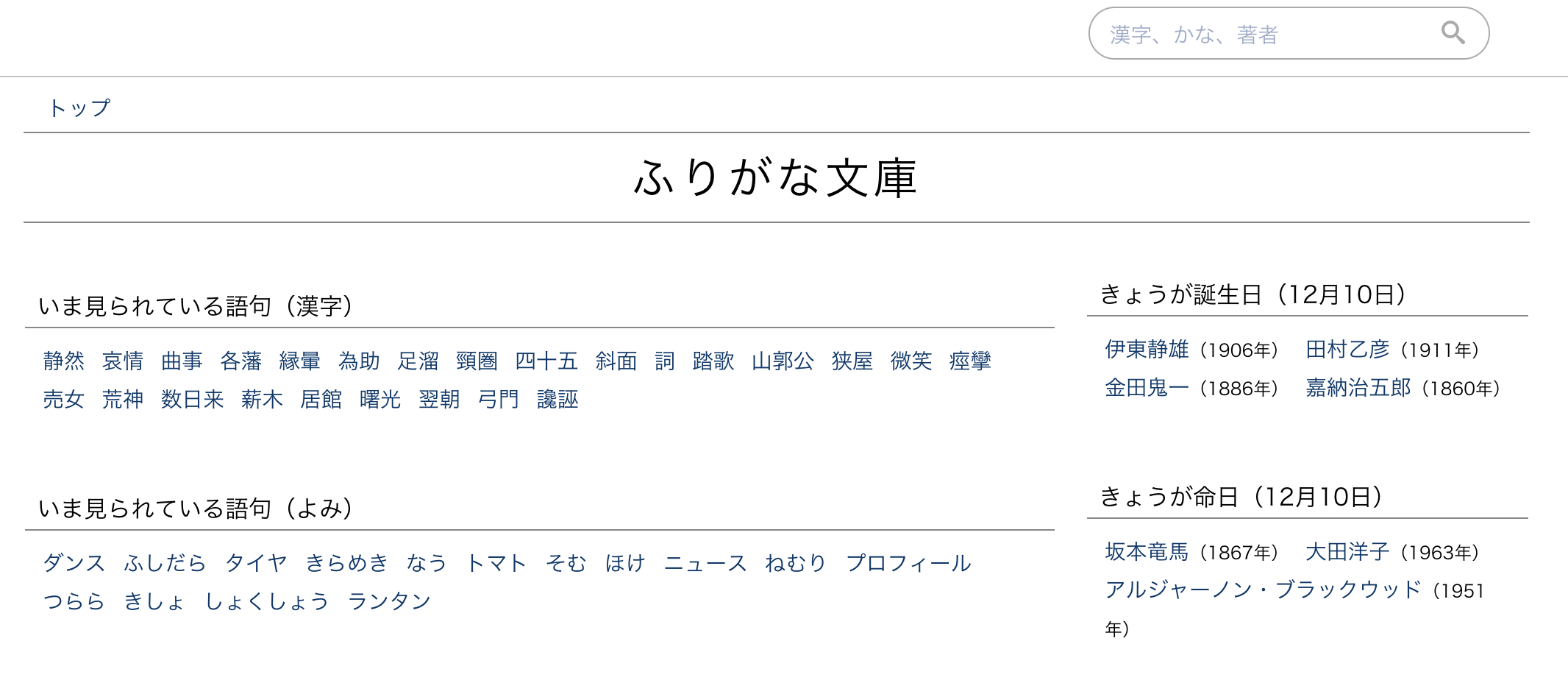
Those who have spoken to me about transcription might know that I swear by Furigana Bunko. Sadly, I rarely find this enthusiasm shared by others, and when I recommend the platform few start using it. I decided that it might be wise not only to share the platform itself, but also notes on how I use it.
Furigana Bunko is a searchable dictionary of word readings and their frequencies which uses data from Aozora Bunko, parts of Wikipedia and Wiktionary, and Japanese WordNet. The main page includes a search bar in the top-right corner, and other ways to quickly navigate to topics such as by yojijukugo 四字熟語 (four-character compounds), or by plant or animal types. A typical search result includes the word or character’s reading and their frequencies, example sentences using the term, explanations of the characters being used i.e. stroke number, principal radical etc., synonyms, words or phrases that include the character or word etc. Results may also include definitions, a list of author’s using the term, and other related vocabulary. This is a lot of information and features so I imagine that users are likely to find many more ways to use the platform than the quite limited applications I supply here.
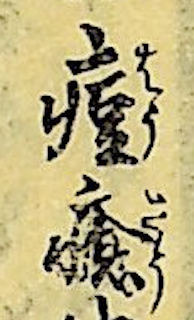
If you are looking for a classical dictionary—a place to search for the meaning of terms—there are much better platforms, but for other purposes Furigana Bunko can be extremely useful particularly during transcription. Imagine that you come across some characters that you can’t read—perhaps the ones in the picture below—but you have been able to decipher the gloss (the furigana)—in this case, hōsō はうさう.
You can use Furigana Bunko to search for words using this gloss (hōsō はうさう) and easily identify the word. In this case, Furigana Bunko provides two potential formulations (疱瘡 and 痘瘡) and although the platform suggests that the first rendering is much more common we can easily identify it as the second form by looking closely at the characters on screen.
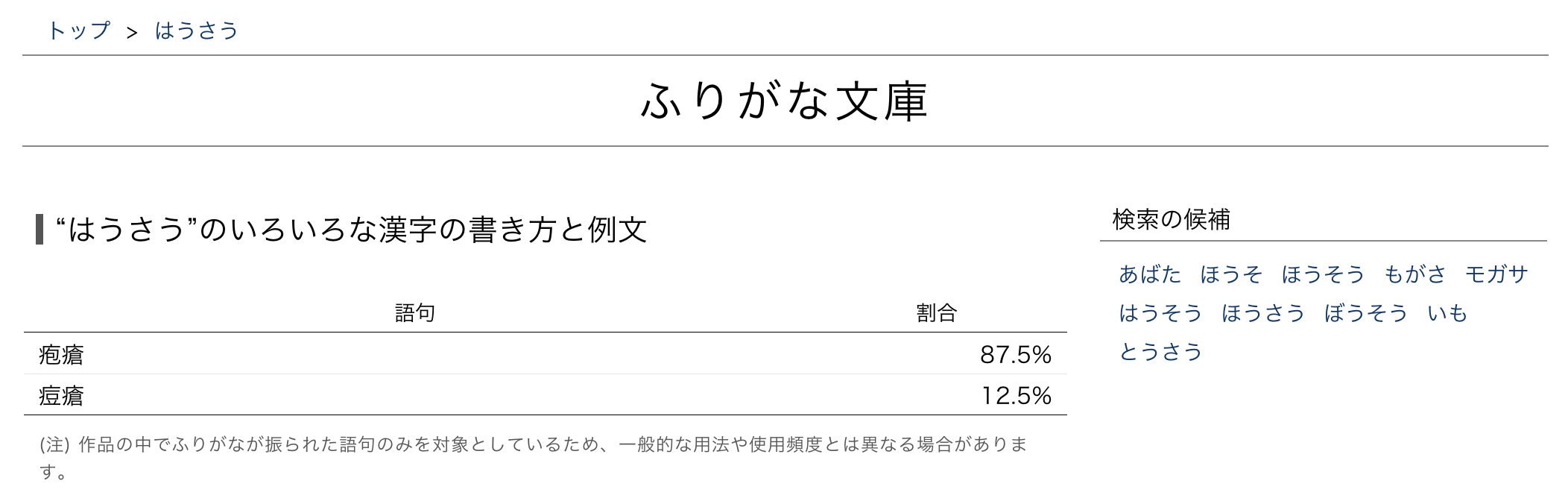
Readers familiar with materials of medicine and illness may already be doubting the utility of Furigana Bunko. There are more potential renderings for the word hōsō (smallpox) than the two results suggest. What if one of those renderings appeared here instead? This is a problem of orthography and can easily be addressed. For example, if I search instead for hōsō ほうそう (はうさう in modern orthography), I gain other results including 疱痘, 種痘, 庖瘡, 疱疽 etc. Luckily, links to words with similar readings or meanings are offered in the right-hand column on the search results page, so these can be quickly identified and searched. Here we have various renderings of hōsō as well as alternative words such as abata あばた and mogasa もがさ. In the case that the characters did not match those that appear in the document, using these links to alternatives or searching for alternatives manually are potential ways to discover them.
Alternatively you might have recognized the characters, but perhaps the gloss is causing issues—there might be an unusual rendering or it may be poorly written or printed. In this case, searching for the characters might help to identify the correct gloss.
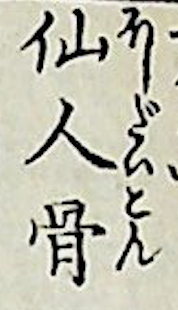
Of course, this isn’t a fail-safe method. The system may not work with readings, characters, or character combinations that are particularly unusual. Here is an example. This text clearly has the characters 仙人骨 and the gloss tells us to read it hoshidaikon ほしだいこん, however, this character combination does not feature in Furigana Bunko and so does not appear in the results.
Another way that I use Furigana Bunko is to identify compounds (combinations of characters). You may have identified one character in a string of characters and may have even recognized parts of a subsequent character, but you are for whatever reason unable to work out the word. Here is an example. Let’s imagine that you come across the word below and recognize the first character as hina 雛, but you are unable to work out what the second character is.
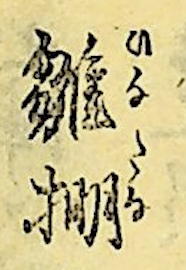
You can search for the character hina on Furigana Bunko and then navigate to the linked page that features terms (compounds) including the character. You know that the character is the first of two, so you access the relevant list (2 character words beginning with hina). Here you can search for a compound that looks like the one in the text. Perhaps you have been able to decipher a little of the second character and you recognize that the radical is 木, now you can narrow what you are looking for even further. This will allow you to find the term hinadana 雛棚 in the list. Now you can use other resources to look up how tana 棚 is written in cursive and compare it to the character in the text or find other ways to confirm or disregard this option.
Although it isn’t perfect in its coverage, I find Fuirgana Bunko extremely useful in my transcription work, particularly when I come across terms that I am struggling to read or which feature unusual readings. There are a whole range of ways to use the platform, but for those interested working on the transcription of pre-modern pieces I can’t recommend the platform enough as a tool for helping to decipher “unknown” characters or character combinations.

 The Digital Orientalist
One thought on “Using Furigana Bunko”