
Introduction
In 2021, Japan’s NDL launched a project to digitise around 300,000 books (approximately 45 million digital images) in that fiscal year, marking the largest single mass digitisation effort since the first one in 2009 and 2010. The NDL continued to digitise its collection thereafter, and as of October 2024, its digital collection encompassed 2.6 million books, 1.37 million periodicals, 100,000 rare books and old materials, as well as hundreds of thousands of newspapers, official gazettes, doctoral dissertations, and more. Along with digitalisation, the full-text search system of the NDL database has been renewed, with the extension of OCR of millions books
However, the majority of digitised books and periodicals can only be viewed at the NDL. Even for those readers with an officially registered NDL account (who can use the ‘Digitised Contents Transmission Service for Individuals’), only about 18 percent of digitised books and 1.5 percent of digitised periodicals can be accessed online without visiting the NDL. Nevertheless, this series of articles will demonstrate that the full-text searching that can be applied to the limited number of NDL digital collections is already very useful for researching the history of modern Japan and East Asia. Recently, the NDL has also added a new feature to this functionality: a pin is displayed on digitised images to indicate the position of the search term found in full-text searches of its digital collections. As this series will show, this is extremely helpful for researchers to swiftly locate the search term, especially in dense text such as gentry and company directories.
This series of three articles focuses on the possibilities of using the NDL database’s full-text search system to research a variety of historical topics. The first will use the life and religious beliefs of Kugimiya Iwao (1888-1961) to illustrate how the system can effectively and efficiently trace the forgotten lives of some Japanese historical figures (basically no mention in Wikipedia and Google) and their “hidden” backgrounds. The second blog post will demonstrate the usefulness of the system in researching the financing and background information of some regional and medium-sized companies that actively participated in Japan’s colonial enterprise, but were not (directly) affiliated with the zaibatsu or other industrial giants. The third post will show how the system can be used when reading modern Japanese diaries. For example, celebrity diaries often mention the names of ryōtei, but it is difficult, if not impossible, for readers to trace the background and location of these restaurants. In the third post, I will show how this problem could be overcome by using the system, which could also deepen our understanding of the urban planning and spatial politics in wartime Tokyo.
Who is Kugimiya Iwao?
If you Google ‘Kugimiya Iwao,’ the first result is a photo file from Wikimedia Commons entitled ‘Kugimiya Iwao switch on blasting for break through of Kammon [Kanmon] railway tunnel.’ A middle-aged, smiling, and well-dressed man stands in the centre, and as the file name describes, this is Kugimiya waiting to switch on the blasting for the breakthrough of the Kanmon Railway Tunnel. It was the first undersea tunnel of Japan, running under the Kanmon Strait and linking the islands of Honshū and Kyūshū. Despite being the mastermind behind this remarkable construction, Kugimiya does not even have a Wikipedia page, in either Japanese or English.
For those researching modern Japanese or East Asian history, it is not surprising that there are no readily available online biographies of lesser-known figures such as Kugimiya. While biographical dictionaries may contain entries on these under-researched figures, they are not often available online, especially those published after the 1970s. This article aims to use Kugimiya as an example to demonstrate how the NDL database’s full-text search system would be a convenient tool for researchers to swiftly compile the biographies of obscure figures without having to search multiple dictionaries in libraries.
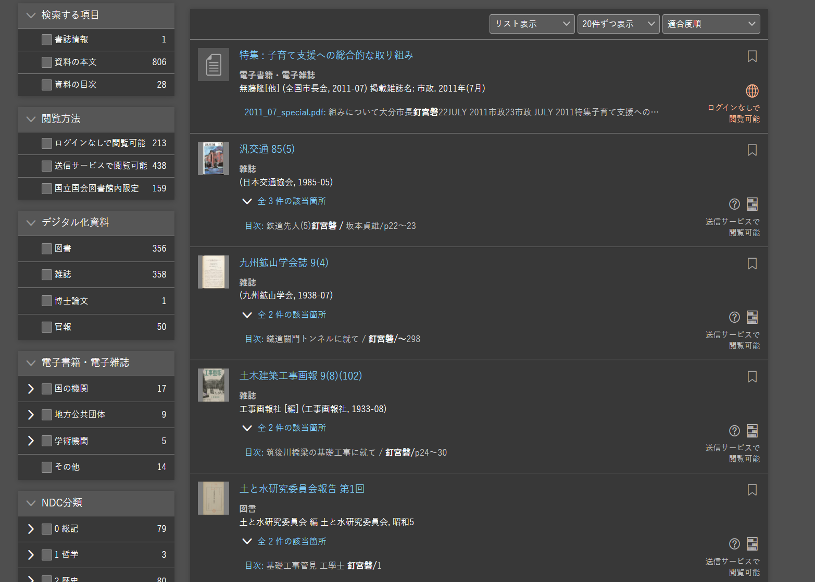
The NDL database’s full-text search system contains a total of 810 digitised materials related to Kugimiya Iwao, of which 213 are accessible without an officially registered NDL account, 438 require an account, and the remaining 159 are only available at the NDL terminals (although remote photoduplication service is available at a charge) (figure 1). In other words, if you have an officially registered NDL account, you can access 80 percent of these digitised materials online without having to travel to Tokyo. It should be noted, however, that some of these materials refer to Kugimiya Ban instead of Kugimiya Iwao, such as the first result shown in the database. Kugimiya Ban is a contemporary politician who served as mayor of Ōita City and was a member of both the House of Councillors and the House of Representatives. The NDL database shows materials related to both Kugimiya, as their names are written the same in kanji, although the pronunciations are different.
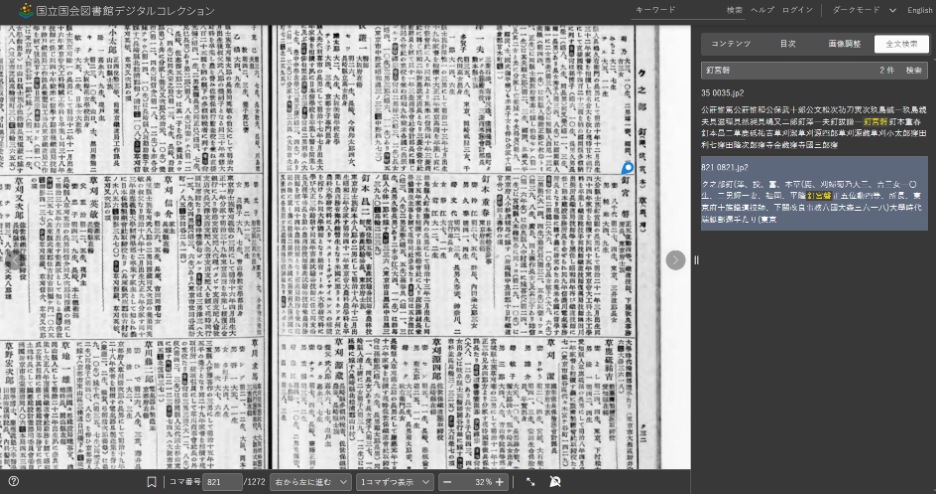
The digitised materials allow us to swiftly sketch Kugimiya’s life, especially through the biographical directories published in the 1930s and 1940s (figure 2), such as the Who’s Who for the General Public (Taishū jinjiroku), the Directory of Japanese Gentlemen (Nihon shinshiroku), and the Who’s Who (Jinji kōshinroku, see note 1). The new feature that a pin can be displayed on digitised images to indicate the position of the search term further accelerates the process of navigating the dense text in these monstrous directories (figure 3). Kugimiya’s life can be summarised as follows. He was born in the Ōita Prefecture in March 1888 and relocated to Tokyo with his parents at the age of four. He attended Tokyo First Junior High School (now the Tokyo Metropolitan Hibiya High School), First High School (now the College of Arts and Sciences, University of Tokyo), and then studied civil engineering at the College of Engineering of the Tokyo Imperial University (now the Faculty of Engineering, University of Tokyo), graduating in July 1912. In the same month, he joined the Ministry of Railways (Tetsudōin) and worked there until August 1941 (at the time of his resignation, the name of the ministry was changed to Tetsudōshō). During his time in the ministry, he was involved in various projects in Tokyo, Nagoya, Kumamoto, Niigata, and in July 1936 he was appointed as the Director of the Shimonoseki Improvement Office (Shimonoseki kairyō jimusho-chō), overseeing the design and construction of the Kanmon Railway Tunnel. From June to September 1938, Kugimiya went to the United States on a tunnelling expedition. He then introduced new methods, such as the use of tunnel boring machines, to the Kanmon Railway Tunnel project. The exploratory tunnel was completed in April 1939, and in September Kugimiya’s title was changed to Director of the Shimonoseki Construction Office (Shimonoseki kōji jimusho-chō). On 10 July 1941, the Kyūshū-bound tunnel broke through, and Kugimiya was the one who started the blasting, as shown in the photo from Wikimedia Commons. Kugimiya resigned from the ministry the following month. In April 1942, he became a professor at the Second Faculty of Engineering at Tokyo Imperial University, teaching methods of civil engineering, and in the same month was awarded the Asahi Prize (Asahi bunka shō, it became the Asahi shō in 1976) for his contribution to the Kanmon Railway Tunnel. The tunnel also earned him the Order of the Rising Sun, Gold Rays with Neck Ribbon (3rd class) in November 1942. In March 1948, at the age of 60, Kugimiya retired from the University of Tokyo and in May he became an associate adviser (jun komon) to the Mitsui Mining Company. In April 1953, he became a consultant to the Kumagai Gumi Company. In September, he retired from Mitsui Mining Company and then became an adviser to Shiraishi Foundation Construction, founded by Shiraishi Tashirō (1887-1954) who had been Kugimiya’s classmate at Tokyo First Junior High School, First High School, and the College of Engineering of Tokyo Imperial University, and they worked together at the Ministry of Railways after graduation.

The Networks of Orthodox Christians
The previous section summarised Kugimiya’s life from the biographical directories published in the 1930s and 1970s. Something seems to be missing—his family. The biographical directories mention that Kugimiya was the eldest son of Kugimiya Tsuyoshi (1847-1911), a shizoku from Ōita Prefecture. Kugimiya Iwao’s wife, Yachiyo (or Yachiyoko, 1894-?), was the eldest daughter of Mii Dōrō (1858-1940). Kugimiya’s younger sister Toyoko (1896-?) was married to Kosugi Koroma (1892-1973), an accountant. None of the directories published before or after Kugimiya’s death in 1961, however, explain the relationships between these figures beyond that of family. Indeed, as revealed by the NDL database’s full-text search system, they are all Orthodox Christians. Since Kugimiya never discussed his religious beliefs outside of the church, and thus other than church publications, a short biography of Kugimiya collected in the Record of Railway Pioneers (Tetsudō senjinroku), edited by the Japan Transportation Association in 1972, becomes a rare piece of evidence that provides some clues to Kugimiya’s beliefs. While it does not directly say that Kugimiya was an Orthodox Christian, it does state that Kugimiya’s funeral was held in Tokyo’s Holy Resurrection Cathedral, the main cathedral of the Japanese Orthodox Church (figure 4).

Beyond mere inference, the NDL database’s full-text search system facilitates in-depth investigation of Kugimiya’s beliefs and activities within the church by referencing church publications. The Orthodox Times (Seikyō jihō), the official bulletin of the Japanese Orthodox Church, is available in the NDL database, and has provided information on Kugimiya and his family’s religious background, including their baptismal names and positions in the church. For instance, an obituary of Kugimiya’s father, Stephen Kugimiya Tsuyoshi, published in the Orthodox Times on 15 June 1911, revealed that he was a protodeacon, his wife (Kugimiya’s mother) was Maria Kugimiya Koma (1858-1914), and the baptismal name of Kugimiya Iwao was Peter (figure 5). Through the Orthodox Times we also learn that Kugimiya’s sister, Martha Kugimiya Toyoko, graduated first in her class from the Orthodox Women’s Seminary (Seikyō joshi shingakkō) in April 1914 and married Ignatius Kosugi Koroma in June 1921. Kosugi was a graduate of Senshū University and a deacon of the Kanda Church (Kanda kyōkai). Around the time that Martha Kugimiya was studying at the seminary, Kugimiya (Mii) Yachiyo was teaching there, but it is not certain that she had yet married Kugimiya Iwao. Yachiyo had also been the hymn director (seika shunin) of a religious magic lantern show (shūkyō gentōkai).Her father, Simeon Mii Dōrō, was an archpriest. In 1883, he undertook a period of study in Russia, together with Arsenius Iwasawa Heikichi (1863-1943). Iwasawa became an army teaching officer (Rikugun kyōju) in 1917 and taught Russian at the Preparatory Military School and Imperial Japanese Army Academy before retiring in March 1935. In September 1940, Metropolitan Sergius (1871-1945), the head of the Japanese Orthodox Church, who was Russian, was ousted from his position under the Japanese government’s pressure and was succeeded by Iwasawa, the then professor at the Orthodox Seminary (Seikyō shingakuin).

The Orthodox Times also reveals that Kugimiya is a devout Orthodox Christian who is actively engaged in church activities. When the Kugimiya family moved to Tokyo in 1892, they settled in the Kanda-Surugadai district, where the Holy Resurrection Cathedral was located. Kugimiya was a member of the Kanda Church, together with his future brother-in-law, Ignatius Kosugi. Before WWII, Kugimiya had been secretary of the Orthodox Church’s Youth Association (Seikyō seinenkai), councillor of the Tokyo Church’s Sunday School (Tōkyō honkai nichiyō gakkō), and a member of the Cathedral Reconstruction Committee (Daiseidō fukkō iinkai, his father-in-law, Simeon Mii, was also a committee member, while Ignatius Kosugi was the accounting auditor [kaikei kansayaku]). In the late 1950s, Kugimiya became an advisor of the Church’s Bureau of Religious Affairs (Shūmu kyoku).
A Tool for Uncovering Historical Networks
This article demonstrated how the NDL database’s full-text search system can effectively and efficiently trace the forgotten and “hidden” lives of obscure figures such as Kugimiya Iwao. The aforementioned content of Kugimiya’s life is all drawn from the sources that can be accessed without using the terminals in the NDL. The next blog post in this series will move beyond the networks of human entities and show how the NDL system can be used to trace the financial networks and background information of some of the regional and medium-sized companies that actively participated in Japan’s colonial enterprise, but were not necessarily affiliated with the zaibatsu or other industrial giants.
Note 1: A free full-text search database of Who’s Who (Jinji kōshinroku) is provided by Nagoya University, and yet it only covers the contents of Who’s Who published up to 1928, https://jahis.law.nagoya-u.ac.jp/who/search/about.
Appendix 1: Sources
官報
正教時報
朝日新聞
芦原事務所編集:《株式会社白石50年史》(東京:株式会社白石,1984年)。
交詢社《日本紳士録》編纂部:《日本紳士録(第四十二版)》(東京:交詢社,1938年)。
今村信吉編集:《追憶白石多士良》(東京:白石基礎工事,1955年)。
勝田一編纂:《帝国大学出身名鑑》(東京:校友調査会,1932年)。
人事興信所編:《第十三版人事興信録 上》(東京:人事興信所,1941年)。
総理府賞勲局編:《特別叙勲類纂(生存者) 下》(東京:大蔵省印刷局,1982年)。
朝日新聞社編:《昭和十九年朝日年鑑》(大阪:朝日新聞社,1943年)。
朝日新聞社編:《昭和二十年朝日年鑑》(大阪:朝日新聞社,1944年)。
帝国大学新聞社編:《帝国大学年鑑 昭和十九年版》(東京:帝国大学新聞社,1943年)。
帝国秘密探偵社編纂部編:《大衆人事録 第十版》(東京:帝国秘密探偵社・国勢協会,1934年)。
鉄道時報局編纂:《鉄道省高等官人事要録》(東京:鉄道時報局,1933年)。
《東京大学百年史》編集委員会:《東京大学百年史 資料三》(東京:東京大学,1986年),頁128。
読売新聞社編:《読売政治年鑑 昭和廿四年版》(東京:読売新聞社,1948年)。
日本官界情報社編纂部編:《日本官界名鑑 昭和12年版》(東京:日本官界情報社,1936年)。
日本交通協会《鉄道先人録》編集部編:《鉄道先人録》(東京:日本停車場株式会社出版事業部,1972年)。
《日本正教会教役者住所姓名録》(東京:正教時報社,1913年)。
比屋根安定:《日本基督教史 第四巻 復興篇》(東京:教文館,1939年),頁194。
明石博隆,松浦総三編:《昭和特高弾圧史 3—宗教人にたいする弾圧 上》(東京:太平出版社,1975年)。
Appendix 2: Glossary
accounting auditor 会計監査役
army teaching officer 陸軍教授
Arsenius Iwasawa Heikichi アルセ二イ岩沢丙吉
Asahi bunka shō 朝日文化賞
Asahi shō 朝日賞
associate adviser 準顧問
Bureau of Religious Affairs 宗務局
Cathedral Reconstruction Committee 大聖堂復興委員会
College of Arts and Sciences, University of Tokyo 東京大学教養学部
College of Engineering of the Tokyo Imperial University 東京帝国大学工科大学土木工学科
Director of the Shimonoseki Construction Office 下関工事事務所長
Director of the Shimonoseki Improvement Office 下関改良事務所長
Directory of Japanese Gentlemen 日本紳士録
Faculty of Engineering, University of Tokyo 東京大学工学部
First High School 第一高等学校
hymn director 聖歌主任
Ignatius Kosugi Koroma イグナチイ小杉虎狼馬
Imperial Japanese Army Academy 陸軍士官学校
Japan Transportation Association 日本交通協会
Kanda Church 神田教会
Kanmon Railway Tunnel 関門トンネル
Kugimiya (Mii) Yachiyo (Yachiyoko) 釘宮 (三井) 八千代 (八千代子)
Kumagai Gumi Company 熊谷組
Maria Kugimiya Koma マリヤ釘宮こま
Martha Kosugi (Kugimiya) Toyoko マルハ/マルファ小杉 (釘宮) とよ子
Mitsui Mining Company 三井鉱山
Order of the Rising Sun, Gold Rays with Neck Ribbon (3rd class) 三等旭日中綬章
Orthodox Church’s Youth Association 正教青年会
Orthodox Seminary 正教神学院
Orthodox Times 正教時報
Orthodox Women’s Seminary 正教女子神学校
Peter Kugimiya Iwao ペトル/ペートル釘宮磐
Preparatory Military School 陸軍中央幼年学校
Record of Railway Pioneers 鉄道先人録
religious magic lantern show 宗教幻灯会
ryōtei 料亭
Second Faculty of Engineering at Tokyo Imperial University 東京大学第二工学部
Senshū University 専修大学
Shiraishi Foundation Construction 白石基礎工事
Shiraishi Tashirō 白石多士良
shizoku 士族
Simeon Mii Dōrō シメオン三井道郎
Stephen Kugimiya Tsuyoshi ステファン釘宮剛
Tetsudōin 鉄道院
Tetsudōshō 鉄道省
Tokyo Church’s Sunday School 東京本会日曜学校
Tokyo First Junior High School 東京府立第一中学校
Tokyo Metropolitan Hibiya High School 東京都立日比谷高等学校
Who’s Who for the General Public 大衆人事録
Who’s Who 人事興信録
zaibatsu 財閥

 The Digital Orientalist

3 thoughts on “Unearthing Modern Japan’s Subterranean Networks with the National Diet Library’s (NDL) Full-Text Search System (Part 1): Kugimiya Iwao and the Circles of Orthodox Christians”