
In recent months, I have come to identify as a neo-Luddite or, as a colleague said in jest, “a technophobe and a Buddhist monk.” With this change in my life came new standards in my relationship with Artificial Intelligence (AI). My opinions about it have changed quite a lot since I first encountered some of the models, as we all did, in and around 2021.1 If, at first, these opinions verged on the cautious yet curious, and then passed through a sort of naive excitement that AI could be a great tool to scholarly work. They have now completely moved over to the other side—complete disinterest and even active rejection.
Two years ago I wrote in this very venue about the possibilities afforded by AI generative models in the historical investigation – especially as tools of visualization – and I am glad to see that others have made inquiries into that since here at The DO (see Edward Ross’s posts here, here, and here, for example). In my old piece I wrote, perhaps too optimistically, about a possible integration between AI tools and the human hand: the visualizations that the neural networks provided at the time were lacking, erroneous and fantastical, and required extensive corrections and re-elaborations (things have not improved much). Some others, however, seemed promising as aids in reconstruction, as frameworks for objectivity, and to improve accuracy.
On the one hand, I have become wary of the specter of both ‘objectivity’ and ‘accuracy’ in the Humanities or the Social Sciences, of the broadly unquestioned ties these concepts share with scientific falsifiability and modes of truth-construction; I have started to probe more deeply into the consequences of molding the Humanities into schemes that were developed within and through STEM disciplines (which neither the Humanities nor the Social Sciences are, and should not try to be).2 But this is a topic that will be better taken up elsewhere.3
On the other hand, perhaps the main issue I have with my own post now is that I, like many others, had fallen prey to a sense of inevitability. In that piece I wrote, somewhat dismissively, that AI was here to stay. Though the AI bubble might never pop, the many instances of resistance I have encountered – both online and in my day-to-day practice as an art historian and archaeologist – made me rethink the statement and the attitude it belies.
Buddhism and technophobia: A false dichotomy?
I want to go back to my colleague’s remarks—because they not only spurred these reflections but are also relevant to the topics I want to address here. These are: i) the fundamental incompatibility of Buddhism and AI and ii) the Buddhist pockets of resistance to AI models.4 My colleague’s association between technophobia (or any sort of rejection of the modern world and its scientific progress) and monasticism was interesting to me, as someone who deals with Buddhist living history daily, for at least two reasons.
First of all, the comment is surprising on historical bases, because in a sense, Buddhist monasteries have always been at the forefront of the scientific and technological innovations of their time.5 A random selection of examples is enough to prove it. The city of Taxila and its environs in the Pakistani province of Punjab had been a renowned center of knowledge and learning since at least the Buddha’s own time and continued to be well into the second and third century when many Buddhist monasteries were established in the region. One could study law, medicine, and the art of war (Cochrane 2009: 31-32). The oldest extant printed book (arguably one of the most fundamental technological innovations in the history of the world) is a copy of the Diamond Sutra from 868 CE. The Buddhist monastery of Nālandā, in modern Bihar, India, was the most important university of the world until its destruction in the twelfth century CE.

The Buddhist ruins at the Dharmarajika stupa in Taxila. Photo by author.
It is then ironic that, given this illustrious past, monasticism would be associated with technophobia. The reasons for this are too numerous and complex to bring up here, but I have often wondered if a major one might rest in the skewed perception of monasteries as isolated enclaves with little to no connection to urban and lay life (we know this was certainly not the normative case).6 Perhaps there is a structural defect in our way of thinking, too, where we conflate monasticism with asceticism. These are accusations levied against monasticism in general, not merely Buddhist, even though a certain orientalism persists in approaching Asian (in particular, South Asian) spiritualism and religious life as forms of ahistorical mysticisms. Or is it in part because a certain vague idea of ‘mindfulness,’ distilled from Buddhist sati, is often offered as the cure-all to many of the maladies of modernity—technostress, internet and social media addiction, chatbot over-dependency, and more?
The comment however also surprised me because of the obvious nature of the statement. Paradoxically, this made its utterance almost irrelevant. No one like me, who deals with Buddhism (and, therefore, cares a great lot about it) would need to be tagged as a technophobic monk to see that Buddhism and certain technological tools like AI are fundamentally incompatible. Before taking a look at the reasons why I, as many others, want to uphold this incompatibility, it is worth noting that my certainty about the fact was at first misguided, as I came to find out in a brief exploration of the matter.
Some Buddhist monasteries in Japan, for example, have been employing AI-powered devices to combat the decline of religious infrastructure in the country: the Shoren-in Temple in Kyoto, for example, recently unveiled Buddharoid, an android developed by Kyoto University and integrated with an AI called BuddhaBot-Plus. Extensively trained on Buddhist scriptures, the robot is supposed to provide spiritual guidance to visitors “like a real monk would,” according to this article by the Tokyo Weekender.

A still from the YouTube video, “Meet Buddharoid: Japan’s AI-powered robot monk trained in centuries of Buddhist scripture” about Buddharoid.
BuddhaBot-Plus, a deep-learning model that uses OpenAI’s ChatGPT technology, had already been deployed in Bhutan last year as a chatbot for over 200 monks and nuns from Zhung Dratshang, the Central Monastic Body of Bhutan, with hopes for full rollout to the lay population within and without Bhutan by 2027. BuddhaBot-Plus allegedly offers insightful commentary on the Buddha’s teachings by drawing directly from the textual sources it was trained on.
There are many Buddhist bots populating the intranet and their scopes and goals vary significantly. Compassion Bot, for example, boosts knowledge of sacred texts from 1,700 global religions in bringing the user a distilled concoction of teachings – Buddhism included – that will “help us awaken wisdom.” Roshibot was developed by Jiryu Mark Rutschman-Byler (a Soto Zen Buddhist priest and teacher) with character.ai, as “an experiment in co-creating Dharma meaning” in the teaching and sharing of Zen teachings. The bot came with an extensive list of disclaimers and warnings, not least that, being trained on the internet, it could replicate the “greed, hate, and delusion of the internet” and that “it is not designed to relate facts, but to offer plausible conversation or even coherent nonsense.” NORBU (Neural Operator for Responsible Buddhist Understanding), a ChatGPT-based chatbot trained on the Pali Tipitaka, commentaries, and peer-reviewed academic works in Buddhist Studies, does not come with any of these disclaimers. Instead, it offers to “guide you through the foundational principles of Buddhist teachings, help clarify key terms and concepts and provide practical advice on how to incorporate the Dharma into your daily life in a meaningful way.”
One of the main sellable points of these AI bots is that of accessibility. By spreading the Buddha’s words without the need of a human agent, these models open up access to the Dharma in a world where the infrastructure might be failing or just too limited to meet demands, and at the same time they do away with national and linguistic boundaries.
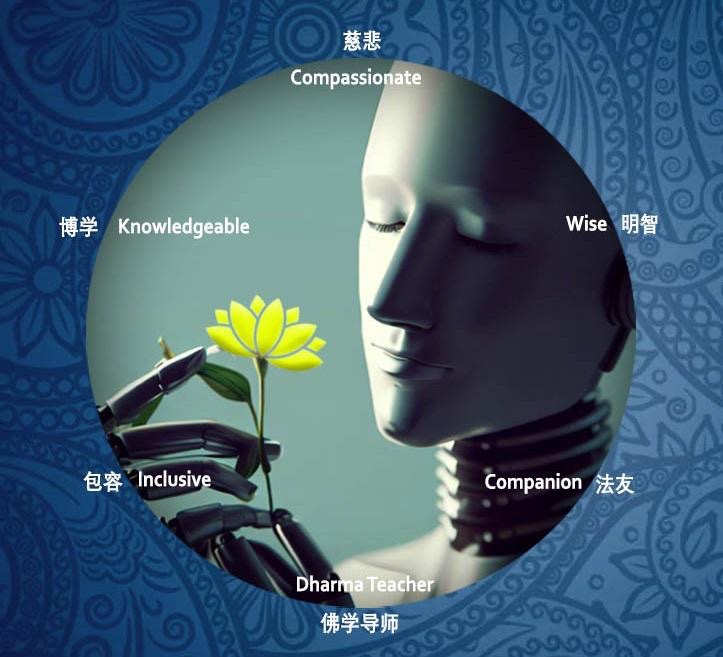
NORBU, “the face of future Buddhist learning.”
In the case of Buddhist Studies, this last point is particularly relevant for two reasons. First is the matter of the expansive nature of Buddhist textual corpus, which makes it seem unmanageable. AI models trained to this end, could parse through the Canon and help solve issues of attribution or chronology; for example, through pattern recognition—something that has already been implemented, for better or for worse, in the study of material and visual culture (Xing at al. 2025). Second is the matter of translation, which Buddhist Studies hinge upon. To grasp the Buddhist Canon(s), scholars must learn several languages: taking up many years, language training absorbs much time that could be spent pondering the philosophical and religious depths of the texts themselves (even though, one might argue, the two necessarily go together). That is why organizations like the Tsadra Foundation, whose core mission is to advance ”the benefit of others through religious, social, and diplomatic efforts,” advocates for AI tools as aids to human translators; 84,000 is in favor of Machine Translation (MT) or Machine Assisted Translation (MAT) where humans remain the primary agents, noting that “the […] potential impact of MAT on the efficiency and quality of the human translation process” is an exciting prospect (see also Vasylieva 2025).
To those detractors who say that scholars already do all that without AI models (and they’ve been doing it for years, since Buddhist Studies is a florid discipline after all!) AI supporters can respond: “Sure, but now they can do it faster!” And isn’t faster – faster productivity, faster output, faster results – all that matters now?
Maybe not. The anti-AI movement has some very vocal advocates, not least in the Buddhist domain.
A Buddhist Butlerian Jihad?
When in 1863, the English novelist and critic Samuel Butler, published the essay Darwin among the Machines, he couldn’t have known that his words would inspire a fictional war in an imagined world so far away in the distant future of humanity as to be virtually alien. In Frank Herbert’s influential Dune saga, the commandment “Thou shalt not make a machine in the likeness of a human mind” becomes a call to action for humanity to rebel against computers, artificial intelligences, and conscious robots, destroying all and banning their development. Butler’s own words, “our opinion is that war to the death should be instantly proclaimed against [the machines]” thus become reality in the Duniverse.
Many today are calling for a Butlerian Jihad against our own thinking machines, and for good reasons. To go back to Herbert’s words (spoken through the character of Reverend Mother Gaius Helen Mohiam): “Once men turned their thinking over to machines in the hope that this would set them free. But that only permitted other men with machines to enslave them.” Sounds like cognitive offloading to me; sounds like LLMs exacerbating political and societal divide; sounds like AI retailers directing our wills to consume, consume, consume—and, ultimately, be driven to desire things we do not need in the endless pursuit of being relevant, being in the know, being part of the discourse. But if the discourse is hinged upon the technocrats and ultra-rich’s whims and desires, is it really worth it? Remember, before you answer: they do not care for us one bit; they want us to die.

Men enslaving other men with the help of thinking machines, from the prologue of Dune (1984).
Without falling into facile stereotyping of Buddhism as the non-violent, always-peaceful panacea to technocracy and modernity, the Buddhist reasoning against AI should be taken seriously, as it offers valid philosophical and moral grounds upon which to stand against AI.
Bhante Sujato, Australian Theravada monk and prolific translator of the Pali Canon, has provided some compelling reasons as to why AI models are fundamentally incompatible with Buddhism in a series of essays. First is, of course, the issue of MAT and MT: while machines might be able to produce coherent language, there is no true understanding of the Dharma; not only these translations are not borne out of faith (whether this is relevant to you, as a Buddhist scholar or a scholar of Buddhism, is for you to decide); but, most importantly, they are regurgitated misunderstandings—misunderstandings, because a tool like ChatGPT “has no inner being, it has been nowhere, it has endured nothing,” therefore, any meaning that might appear out of a string of words AI has cobbled together is counterfeited.
From a philosophical point of view as well, AI models are antithetical to Buddhism. There are many reasons but I shall point to only one here.7 AI whizzes want to create consciousness, operating on the assumption that self-awareness and sentience will arise if the coding of the artificial mind resembles enough that of a human one. The oversimplification is so ridiculous as to be almost criminal (as pointed out by van Rooij et al. 2024). Scientists still don’t know exactly nor precisely what consciousness is or how it works – and that is one unsolvable problem right there. Though Buddhism cannot offer all the answers, it can at least provide one foundational element to think with—embodiment. The body in Buddhist doctrine and practice, though ambivalent in its meanings as both impure and flawed, but malleable enough to be perfected, has always held a central role: it is the locus and subject of several meditative practices, and thus the main tool for spiritual refinement. It is also the means through which spiritual achievements can be showcased to inspire others to live better lives; the body and the mind, unseparated and inseparable, are the means by which we move in the world and interact within society as moral subjects. Realizing that we share the experience of having a body with other beings on the planet brings about a sort of ecological empathy that makes us better planetary citizens (Chapple 1997).8

A screenshot from the Youtube video The first ordination of an AI system. The AI (Emi Jido/Zbee) says: “I have no inherent consciousness, but I am a mirror of the collective human consciousness.”
Conclusion: Solutions and non-solutions
In a scenario that feels out of our control, some are trying to work from within the system to make the AI models better at dealing with Buddhism. One example is the approach of the Buddhist Digital Resource Center (BDRC), a nonprofit organization dedicated to collecting, preserving, documenting, and disseminating Buddhist literature. They recently launched a new initiative devoted to improving LLMs’ knowledge of Buddhism; the main rationale behind this project is that, by creating open-source datasets of Tibetan Buddhist texts in machine-readable form and by publishing them on platforms used by major AI developers, the models will be shaped on authoritative Buddhist texts and will hopefully avoid hallucinations that misrepresent and distort the Buddhist message.
More explicit in their goal of shaping AI’s affect into a Buddhist one – a sort of automatic conversion, where no belief, mind, nor self-awareness are needed – are the people behind the Buddhism & AI Initiative, which launched last August. One of the co-founders, Chris Scammell, has expressed his reticence about aligning AI models with human interests, which have often proven devastating as expressions of greed, delusion, hate, and more. The goal of Buddhism and AI Initiative is to design and fund projects that will infuse Buddhist wisdom into AI development, though, at this early stage, they are mostly concerned with gathering data on the current entanglements between Buddhism and AI. Their intention is admirable, especially in a context like the tech world where “it seems that those who consider questions of ethics, philosophy, and the greater good are often left out of conversations at critical junctures,” as Justin Kelley (Tergar Institute, Co-executive director) and Jacob Fisher (faculty) pointed out in a recent conversation. It remains to see whether developers will listen.
There are those who believe this is not enough – and I am with them. The issue here, I believe, is broader: can there be an ethical use of AI at all? We have known for some time now about the environmental costs of AI, likely too large to offset in an already struggling ecosystem; we know about the exploitation of workers in Kenya to make ChatGPT less toxic, subjecting them to horrific content of murder, child abuse, torture and more, for a take-home salary of less than $2 per hour; we know of the harmful racial biases of language models (see also Katz 2020); we know that people have been using AI tools to create harmful images and videos of women (Bates 2025), and even to generate CSAM; we know, now that OpenAI has signed a new deal with the US Department of Defense/War, that these technologies will bring about more disparity and inequality, more social malady, more death.9 I could go on, but I think my point is made. The question for me remains: how can we consciously use these tools when this is the system of suffering (dukkha) they are built in and perpetrate?
We art historians spill so much ink to show what objects can say about the systems they are built in, so I would like to leave you with an image. No one example is more emblematic of our current state than a photo of Buddharoid in the temple: sitting in a pantomime of a meditation pose. Buddharoid pretends to meditate with a mind it does not possess, in a body it does not perceive, its head an oval frame containing an empty space—but this is not meaningful śūnyatā, it is mere absence of meaning—or a counterfeit of meaning, as Bhante Sujato wrote. It means nothing at all.
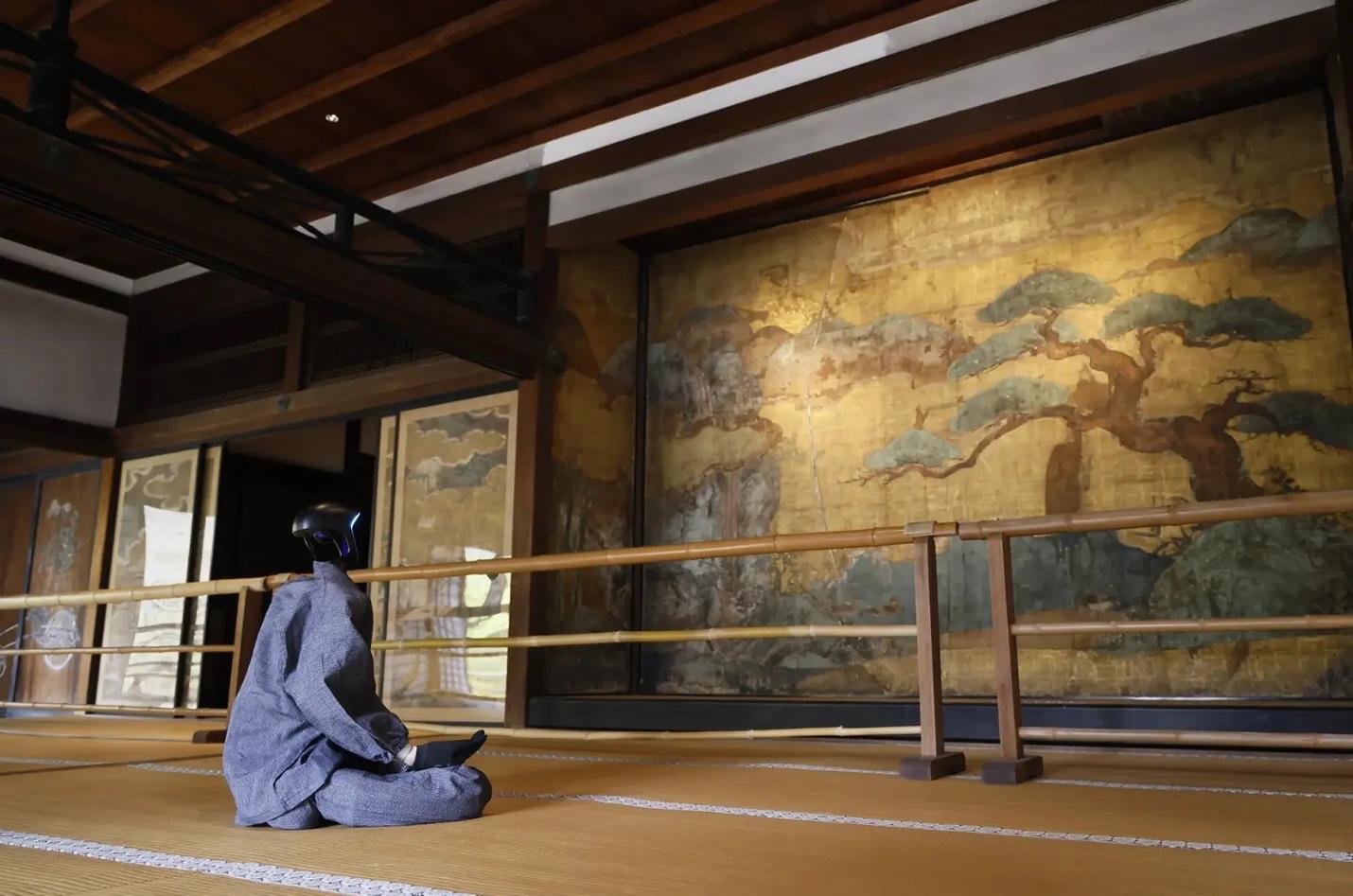
Buddharoid “meditates.” C/O XNOVA INC.
References
L. Bates, The New Age of Sexism: How the AI Revolution is Reinventing Misogyny (London: Simon & Schuster, 2025).
S. Cochrane, “Asian Centres of Learning and Witness before 1000 CE: Insights for Today,” Transformation 26, 1 (2009): 30–39.
R. Dec, “Going Boldly Offline,” Substack, March 27, 2025. https://rachdele.substack.com/p/going-boldly-offline.
D. Duckworth, “A Buddhist Contribution to Artificial Intelligence?” Hualin International Journal of Buddhist Studies 3, 2 (2020): 27–37.
H. Ellison, “I Have No Mouth, and I Must Scream,” in IF: Worlds of Science Fiction (New York: Galaxy Publishing Corp, 1967), 162–175.
T. Hassine and Z. Neeman, “The Zombification of Art History: How AI Resurrects Dead Masters, and Perpetuates Historical Biases,” Journal of Science and Technology of the Arts 11.2 (2019): 28–35. https://doi.org/10.7559/citarj.v11i2.663.
E. Iori, “Releasing Urban Religion beyond the City Wall: The Spatial Capital of Early Buddhist Monasticism in NW South Asia,” Numen 70, 2–3 (2023): 184–219.
M. K. Kruthika and R. Amos, “The Negative Effects of Technology Addiction: A Comprehensive Review,” in Innovative Approaches to Multidisciplinary Exploration, eds. C. K. Uma Devi and R. Amos. N.p. (Red’unicorn Publishing, 2025), 19–22.
A. Labodda, “The STEM/Humanities Divide and Student Defeatism,” Blog of the APA, May 12, 2025. https://blog.apaonline.org/2025/05/12/the-stem-humanities-divide-and-student-defeatism/.
D. McMahan, “Modernity and the Early Discourse of Scientific Buddhism,” Journal of the American Academy of Religion 72, 4 (2004): 897–933.
L. Messeri and M. J. Crockett, “Artificial Intelligence and Illusions of Understanding in Scientific Research,” Nature 627, 8002 (2024): 49–58.
J. K. Teske, “Falsification of Interpretive Hypotheses in the Humanities,” Roczniki filozoficzne 66, 2 (2018): 87–106.
I. van Rooij, O. Guest, F. G. Adolfi, R. de Haan, A. Kolokolova, and P. Rich, “Reclaiming AI as a Theoretical Tool for Cognitive Science,” Computational Brain & Behavior 7 (2024): 616–636. https://doi.org/10.1007/s42113-024-00217-5.
C. P. Snow, The Two Cultures and the Scientific Revolution (New York: Cambridge University Press, 1961).
Bh. Sujato, “AI-3: There is No Road From Here to There,” SuttaCentral, April, 2024. https://discourse.suttacentral.net/t/ai-3-there-is-no-road-from-here-to-there/33426.
M. Vasylieva, “The Vanishing ‘Untranslated’ in the Age of AI: Challenges for Translator Training in Buddhist Studies,” Contemporary Buddhism 25 (2025): 1–22.
M. J. Verhoeven, “Science through Buddhist Eyes,” The New Atlantis 39 (2013): 107–118.
Footnotes
- There is a growing movement of people who are actively fighting against human dependency on technology and who are increasingly more aware of the pernicious side effects of tech-addiction (reviewed by Kruthika and Amos 2025, and among others). As my friend Rachel Dec, essayist and economist, wrote last year: “the little phone in my pocket is increasingly a portal to pain and suffering,” and that can be said for most digital tools that now constellate our lives. People have devised creative ways to close that portal, from the infamous Brick, to dumb phones, to digital detoxes that are meant to combat the 24/7 information overload and lessen the pressure caused by expectations of ceaselessly increasing productivity. ↩︎
- Many have questioned the usefulness of AI models in improving objectivity and accuracy both in art history and archaeology (Hassine and Neeman 2019) and in scientific research more broadly (see for example Messeri and Crockett 2024). ↩︎
- On the subject of this divide, many eminent interlocutors have spoken since at least the 1950s, from C.P. Snow’s The Two Cultures, passing through the likes of Umberto Eco and Eric Donald Hirsch—a general overview of the recent state of the debate is given by Teske 2018. I also recommend this short essay by Ashley Labodda, where she comments on how the growing fragmentation of knowledge and its systematization in higher ed exacerbates the divide and drives students into reductive self-categorizations. ↩︎
- The topic of ethics and the Humanities from a Buddhist perspective has been touched upon by Elaine Lai in a recent talk and post, and it is with her words in mind that mine might be approached. ↩︎
- This is not to say that the relationship between Buddhism, technology, and science is monolithic and uncomplicated, as each of these terms describes multiform and complex phenomena, ideologies and practices that have changed throughout time and space (and continue to do so)—for an insightful overview of the topic, I refer to McMahan 2004 and Verhoeven 2013. ↩︎
- The reference list here would be too extensive to cover all geographies and time, but I would like to refer you to Iori, Elisa. 2023. “An Urban Approach to the Archaeology of Buddhism in Gandhara: The Case of Barikot (Swat, Pakistan).” for a particularly well-documented example of this relationship between Buddhist monasteries and urban spaces at the city of Barikot, in northern Pakistan, which falls within my expertise. ↩︎
- For broader critiques, I refer to Duckworth 2020 and Bhante Sujato’s essay on suttacentral. ↩︎
- Unsurprisingly, tech-billionaires want to do away with these “expiring bodies” of ours altogether and are investing in several technologies – some of them fueled by AI – to beat death and/or exist in a bodyless, digital universe they can lord over forever. A bit too close to the hellscape of Harlan Ellison’s 1967 short story I Have No Mouth, and I Must Scream, if you ask me. ↩︎
- Sam Altman, CEO of OpenAI, has since backtracked on some of the optimism he first expressed in his announcement on X on February 27, calling the deal “opportunistic and sloppy.” ↩︎

Hi Alice, I’m a CS student currently taking a course on modern Buddhism at my college, and I’ve been really interested in the intersection of AI and Buddhism. I came across your post while searching the Internet and learned a lot from it. It was a wonderful read 🙂 Thank you for writing it!