
This is a guest post written by Tomasz Sleziak. The author bio is below.
Both South Korea and Poland can be still considered as countries in states of flux, deeply affected by socio-political changes at the end of the twentieth and the beginning of the twenty-first century. The transition from totalitarian or authoritarian modes of governance towards democracy and/or free trade both in Central-Eastern Europe and on the Korean Peninsula necessitated a thoughtful reflection, in order to determine a new set of values for their respective nations. The popular culture has entertained the youth and oftentimes serves as a source of income for national coffers, in addition to frequently contributing towards large-scale social coherence, especially in the face of globalization, one facet of which has undoubtedly been the internet. However, the proliferation of “traditionalist” perspectives through advanced technological channels is a less discussed and delineated topic. As information technology (IT) developed, it did so concurrently with discourses concerning the changing images and functions of “lynchpin-traditions” that have defined Poland and Korea for hundreds of years—Christianity and Confucianism—and the set of patriotic values that they eventually came to inspire.
These systems were certainly not the singular credos that some Polish and Korean historians of old have imagined them to be; they strongly influenced the rationale of the upper social strata and the political institutions controlled by them. It was especially Neo-Confucianism that came to figure prominently in school textbooks, but the exclusive use of physical media would be seen as a negative in modern classrooms, in which pupils’ disparate backgrounds and health conditions, aside of other factors, have been recognized. As such, from the outset of the new millennium, the propagation of national values has been effectively conducted not only in situ at schools, but also through websites and portals typically, though not exclusively, under the aegis of governmental agencies. On the other hand, the frequent tensions between traditional heritages and modern, Western-style legal rationales, processes of globalization and the widely-perceived “personal interests” have resulted in manipulation of the key, overarching philosophies of Polish and Korean past, as well as the appearance of biases in repositories and their methodologies. As the legacies of the past, embodied in both modern and pre-modern literature, audio-visual recordings or technical compilations have become more accessible through the internet, exceeding its original intended audience and becoming accessible to scholars and researchers worldwide. Given that education via IT media entails the use of searchable databases, the importance of facilitation of data access by official and unofficial entities cannot be overstated; since it has bearing on the work of academic researchers, especially those engaged in comparative enquiries concerning Europe-Asia dynamics, the relevant aspects of digital educational efforts require certain attention.
When accessing state-supported websites and the associated databases one must consider the aspect of political neutrality. Both the Europe and Asia have had their share of ethno-cultural conflicts and the resulting martyrologies; the reality is that the worldwide trends of national, or patriotic education typically involve a juxtaposition of the idea of “Us versus Them” or “Us versus the Other.” The typical bogeymen in the case of South Korea have historically been either the Japanese or communists, typically affiliated with the North.
National Biases and Martyrologies
The suffering experienced by the nation during the occupation period (1910-1945) and other crises has been catalogued through the officially sanctioned repositories such as the Jijeokakaibeu 지적아카이브 (E. “Intellectual Archives”) website administered by the National Archives of Korea. Controversially, the terms “national” and “nationalism” were frequently utilized to manipulate the people during the period of authoritarian leadership that followed the Korean War (1953-1989), and to this day Koreans are deeply aware of the trend of their heritage being turned into a malformed and oftentimes populist pseudo-ideology by political groups. In modern era, a digital humanist with an official address in Korea can both experience firsthand and personally research these dynamics by the means of valuable online databases in the vein of the Jijeokakaibeu.
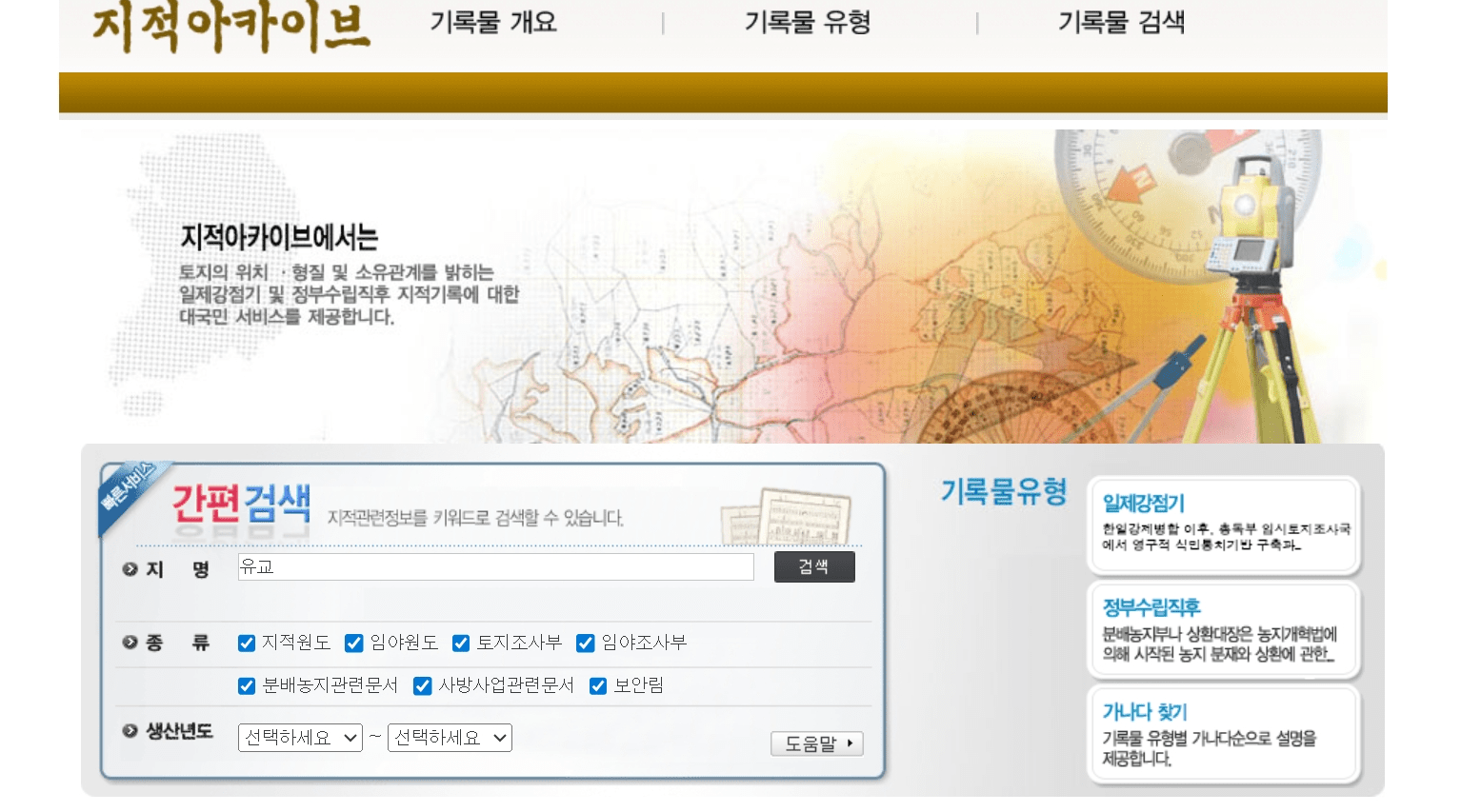
Figure1. Screenshot of the Jijeokakaibeu 지적아카이브.
In Poland, the Archiwa Państwowe (E. National Archives), likely the most prominent secular, and relatively unbiased databases of the nation’s historical records, not only catalogues text files and photographs pertaining to Polish history and international relations, but also includes helpful guides on how to approach genealogical inquiries and suggestions on retrieving employee documentation. The associated website Szukaj w Archiwach (“Search in Archives”) is a massive repository of data spanning from the medieval era (defined as “up to 1399” in the search engine) to modernity, allowing for searches based on such categories as banners, technical projects, audio-visual recordings or maps, in addition to more popular formats. Interestingly, this database also includes pictures of old Korea and documentation pertaining to the outlook of the Polish Communist Party concerning the Korean War and its relationships with North Korea, proving highly useful to researchers of Polish-Korean historical dynamics. A website comparable in scope and functionalities is KRONIK@ sponsored by Krajowe Repozytorium Obiektów Nauki i Kultury (E. The National Repository of Scientific and Cultural Objects), and priding itself on gathering the otherwise scattered samples of the national heritage while widely cooperating with various key institutions, including the TVP television channel and the National Museum in Warsaw. Access to KRONIK@ requires an account (inputting personal data not necessary), or access through the Mój Gov portal, which requires an ID authentication .

Figure 2. Screenshot of KRONIK@.
Moreover, and similarly to Korea’s Jijeokakaibeu, the Polish Instytut Pamięci Narodowej (E. The Institute of National Memory) not only collects data from the Second World War, documenting abuses by the Nazis and the Soviets, but also, and still controversially, the deeds of the individuals who either willingly or through force and manipulation became the collaborators of the secret police in the People’s Republic of Poland (1945-1989). This Institute and its online facets (such as the https://ipn.gov.pl/) have in recent years been controlled by various political parties, typically right-wing ones, accordingly shaping the popular perception of the country’s history. Polish education, as stipulated by Article 70 of the Constitution, is free in state schools. Moreover, national and ethnic minorities have the right to establish their own educational and cultural institutions with the aim of protecting their religious identity and preserving their identity. Nevertheless, a certain bias towards the Roman Catholic component of Polish culture finds currently political reinforcement, leaving online databases or repositories devoted to minorities as not particularly prominent.
Religious Perspectives and (Re-)framings of Tradition
The Catholic faith has, over time, become one of the main underpinnings of Poland’s national martyrology, and despite the separation between the state and religion enforced by Poland’s Constitution, the Church has, since the beginning of the 1990s, been accepted as a key institution contributing to the national sentiment and shaping the beliefs of the populace. Its’ activities therefore continue to influence academic rationale throughout the country, with several institutions recording key socio-political phenomena in addition to more “obvious” religious ones. Some of these institutions are Instytut Statystyki Kościoła Katolickiego SAC (E. The Institute of Catholic Church’s Statistics SAC), Katecheza—Konferencja Episkopatu Polski (E. Catechesis—The Conference of Poland’s Episcopate), and Opoka (E. “Bedrock”). The ISKKA SAC contains valuable databases pertaining to the ecumenical canon and the history of the Church in Poland in addition to articles published by episcopal and parochial councils, though the search functions are rather unwieldy due to the requirement of having a database link issued via e-mail in every instance. There is also the Główny Urząd Statystyczny (E. Main Bureau of Statistics) whose website contains multiple databases pertaining to the prevalence of cultural phenomena among Polish citizens. On the topic of Catholicism, the Bureau’s 2018 survey (Ciecieląg Piotr, Bieńkuńska Anna. Życie Religijne w Polsce. Wyniki Badania Spójności Społeczne. 18.12.2018. Online: stat.gov.plj (E. “Religious Life in Poland. The Results of the Research of Social Coherence”)) illustrates, for example, that between 2015 and 2018 the percentage of people professing their faith in the Roman Catholic Church fell by 0,9%, illustrating the apparent decrease of the Church’s “soft power” (Portal Informacyjny – Informational Portal). Despite this, the long-term promotion of conservative values often associated with Catholicism has certainly exerted significant influence on Polish households and the various basic aspects of their lives.

Figure 3. Screenshot from ISKKA SAC.
Somewhat analogously, and despite the relative lack of governmental statements on the importance of Joseon’s Neo-Confucian heritage in formation of modern school curricula, this doctrine certainly lies at the heart and grassroots of Korean society, and is acknowledged as such by state-supported academic entities. The Hanguk Gukhak Jinheungwon 한국 국학 진흥원 (E. Korean Studies Institute), under the auspices of the Ministry of Culture, Sports and Tourism is one of the main organizations supported by the government with the goal of preserving the core ideals of the nation. Among the websites that the Institute maintains are koreastudy.or.kr or ugyo.net, the latter of which in particular aims to spread the values of Seongnihak 성리학 (E. The School of Principle, chin. 性理學) of Joseon’s Neo-Confucianism; several documents, such as reports from private Confucian schools, diaries or ritual guidebooks are preserved here in digital form (as transcripts or photos in PDF format or in an annotated display window). Data entries can be searched “alphabetically,” on the basis of the title, author’s name, or by the associated time, geographic location, or subject/theme.

Figure 4. Screenshot from ugyo.net.
Yet another website of this type is the Gukka Yusan Potol 국가유산포털 (E. National Heritage Portal), where among the available search sections are Publications (K. 간행물, Ganhaengmul) and Intangible Historical Records (K. 무형유산 지식새김, Muhyeongyusan Jisiksaegim). The Jeontong Munhwa Poteol 전통 문화 포털 (E. The Traditional Culture Portal) is another valuable tool for Koreanists as well as the general public who seek data on particular historical personages, items and phenomena; the Jeontong Munhwa Baekgwa 전통 문화 백과 (E. “Encyclopedia of Tradition”) featured on that website allows searches through multiple criteria. The Database of Korean History is another phenomenal website that pools together data from hundreds of disparate historical resources (including royal chronicles, diaries of the Secretariat, or information on the “March 3” independence movement) to ease one’s inquiry into Korea’s culture; the links are convenient to use. Moreover, the Academy of Korean Studies—a university that also serves as a repository of national culture—has its own distinct website. Last but not least, the website of the Ministry of Data and Statistics is a repository of crucial data pertaining to social changes in modern Korea.

Figure 5. Screenshot of the National Hertiage Portal.
Aside of the Article 9 of the Constitution, which states that “The State shall strive to sustain and develop the cultural heritage and to enhance national culture” (Constitution of the Republic of Korea), there are notably no specific guidelines concerning methodological approaches to national doctrines encoded in South Korean Law. Point 2 of Article 6 of the Gyoyuggibonbeob 교육기본법 (E. The Framework Act on Education) stipulates that schools established by the state and local governments must not provide education on specific religions (own paraphrase), which by itself is certainly a statement modern in spirit and at odds with the philosophical climate clearly favoring the Cheng-Zhu Neo-Confucian orthodoxy from the fifteenth until the late nineteenth century. Moreover, these regulations collectively seem to promote (at least in theory) an environment where free study and interpretation of the ideological “backbone” of Korea are encouraged to flourish, even if the neutral and unbiased nature of a given database cannot be completely ensured.
In summary, any striving digital researcher is provided with a multitude of governmental and non-governmental online projects and digital databases aimed at preservation and proliferation of national heritage of Poland and Korea. While it is certainly debatable what “national” or “patriotic” could entail in a given case—not to mention the actual ease of access, intellectual neutrality and selectiveness of data—it goes without saying that students as much as established international researchers can benefit from the seemingly disparate rationales behind educational websites. Databases exhibiting Catholic and Confucian perspectives (or the more general religious-secular dichotomies) are prominent within the outlined cultural initiatives; at the same time the functionalities of the search engines the repositories are based on are constantly evolving within the scope of the IoT, and, consequently, aspiring scholars can continuously shape new narratives, expanding the interactive sphere of values.
References
Piotr Ciecieląg and Anna Bieńkuńska, Życie Religijne w Polsce. Wyniki Badania Spójności Społecznej (“Religious Life in Poland. The Results of the Research of Social Coherence”), December 18, 2018.
Tomasz Sleziak is a scholar in Korean studies (particularly Korean but also global Confucianism) and Post-Humanism, conducting research on Confucian socio-legal and metaphysical discourse throughout Korean history, as well as its placement within the global discourse on Post-Humanism, Trans-Humanism and Non-Humanism. He completed his PhD in Korean Studies at London’s SOAS after having achieved his Master’s Degree at Adam Mickiewicz University in Poznan, Poland jointly with research in Seoul at the Hankuk University of Foreign Studies. Sleziak’s previous work in The Digital Orientalist can be viewed here.
