
Introduction
In the middle Nile Valley—the region extending from present-day Aswan in southern Egypt to northern Sudan—Christian Nubian kingdoms flourished from the sixth to the fifteenth century. The three kingdoms of Nobatia, Makuria, and Alwa (also known as Alodia) developed a distinctive literate culture following their conversion to Christianity around 543, while maintaining cultural ties with the Byzantine Empire and Coptic Egypt. The Baqt Treaty of 652 secured roughly six centuries of peaceful coexistence with the Islamic regime in Egypt, and the period from approximately 850 to 1050 is generally regarded as the apogee of Christian Nubian civilization.
In medieval Nubia, texts were composed in Greek, Coptic, and Arabic, as well as in Old Nubian. Old Nubian belongs to the Eastern Sudanic branch of the Nilo-Saharan language family and represents an earlier stage of modern Nobiin (currently spoken by approximately 690,000 people in Egypt and Sudan). With the exception of Meroitic, it is the only indigenous language within the Nilo-Saharan family that possesses a continuous written record from the medieval period, and its textual corpus constitutes an exceptionally valuable primary source for the study of medieval African history. These materials, however, are scattered across institutions worldwide—including the British Museum, the Egyptian Museum in Cairo, and the Berlin State Museums—and the construction of a systematic research infrastructure has long been an outstanding desideratum. The project that has fundamentally transformed this situation is the Database of Medieval Nubian Texts (DBMNT), directed by Grzegorz Ochała of the University of Warsaw.

Figure 1. The DBMNT homepage. The photograph in the upper-left shows an Old Nubian manuscript.
Project History
The DBMNT was launched in 2011. Initially conceived as a supplementary resource to Ochała’s doctoral dissertation, Chronological Systems of Christian Nubia (2011), it began with 733 records from Nubian texts containing chronological information. Over more than two decades of continuous expansion, it has grown into a comprehensive database currently holding 4,518 text records. Ochała positions the project as the “Trismegistos of Nubia” and aims to establish it as the definitive knowledge resource for the written sources of Christian Nubia.
A pivotal moment came in 2012 with its integration into Trismegistos, the portal for textual sources of the ancient world maintained by KU Leuven, which holds over 800,000 records and serves as the international standard in papyrology and epigraphy. Through this integration, each Nubian text was assigned a unique Trismegistos identifier and embedded within the broader scholarly network of the Mediterranean world.
Subsequently, the project “What’s in a Name?” (2016–2018), funded by the Polish National Science Centre, produced a personal-name database systematizing 1,738 names, 2,576 spelling variants, and information on 3,725 individuals. The “IaM NUBIAN” project (2019–2021), supported by an EU Horizon 2020 Marie Skłodowska-Curie Action grant, added 8,538 records of identity markers. Through these developments, the DBMNT evolved from a simple textual catalogue into an integrated platform for social-historical, onomastic, and prosopographical research. The data is released under a CC BY 4.0 licence and is also available through Zenodo.
Database Structure
The DBMNT is a relational database built in FileMaker Pro 16. Its principal components are DBMNT Texts (4,518 records), DBMNT Names (1,738 records), DBMNT People (3,725 records), and DBMNT IM References (8,538 records).
Each text record carries detailed metadata, including provenance (with kingdom-level designations such as Nobatia and Makuria), present location, support (papyrus, parchment, stela, ostracon, etc.), technique, language (Old Nubian, Greek, Coptic, Arabic, and others), date, and genre. With respect to chronological information, the multiple dating systems concurrently employed in medieval Nubia—the Era of Diocletian, Anno Mundi, the Hijri calendar, and the indiction—are systematically recorded and cross-referenced.
Old Nubian is encoded in Unicode. The Old Nubian script is based on the Coptic alphabet, augmented by three additional letters of Meroitic origin: ⳡ (/ɲ/), ⳣ (/w/), and ⳟ (/ŋ/), each assigned its own dedicated code point. Data can be exported in XML, CSV, and Excel formats, and a REST API and OAI-PMH access are provided through Trismegistos.

Figure 2. Search fields available in the DBMNT advanced search interface.
Diversity of the Collected Material
The collected material exhibits considerable diversity in language, support, and genre, reflecting the multilingual reality of medieval Nubian society. Linguistically, the corpus comprises texts in Greek, Coptic, Old Nubian, and Arabic, including multilingual texts that combine these languages. The supports include stelae (991 items), wall inscriptions (977 items), manuscripts (324 items), and ostraca (over 79 items). The genres span liturgical texts, hagiographies, biblical translations, legal documents, administrative records, letters, and funerary inscriptions. The principal find-spots include Qasr Ibrim—the largest source—Faras, Old Dongola (the capital of Makuria), and the Ghazali Monastery.
The scholarly contribution of the DBMNT extends across several fields. In historical linguistics, it has enabled systematic research on Old Nubian, supporting analyses of typological features such as SOV word order and agglutinative morphology, as well as the elucidation of historical change through comparison with modern Nobiin. In social history, prosopographical data is being used to analyse social structure and ecclesiastical organization.
Among concrete results, Ochała’s re-reading of wall inscriptions from Faras has yielded the first attested evidence of female deacons in the Nile Valley (Ochała 2023). Use of the personal-name database has likewise allowed the correction of numerous “ghost names” that had been misread in earlier scholarship. Furthermore, material traces in manuscripts have illuminated religious practices involving the consumption of sacred writing—such as the licking of ink and the cutting out of pages—opening new avenues for a history of materiality (Ochała 2023).
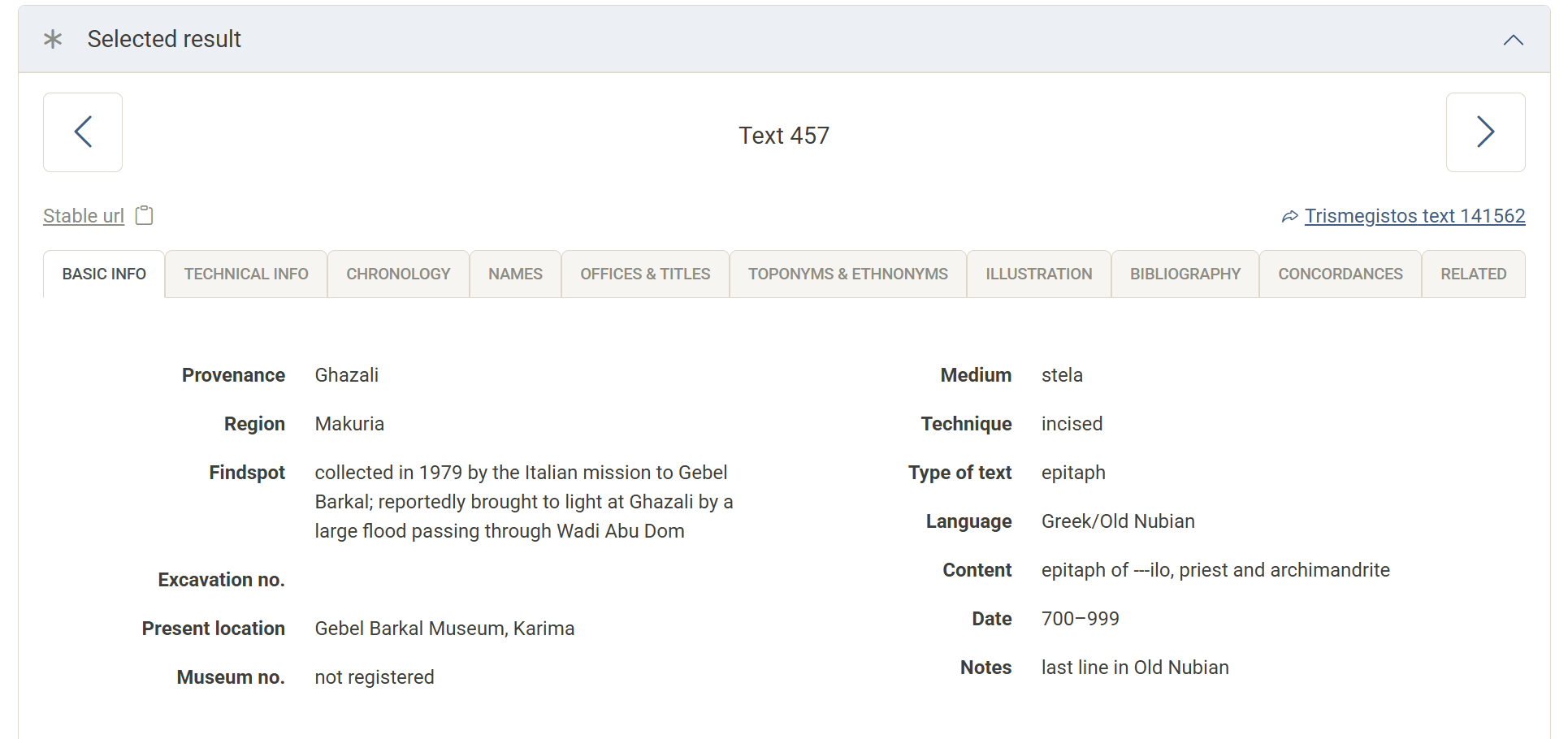
Figure 3. The individual record page for DBMNT Text 457: an eighth-century stela in Greek and Old Nubian, held at the Jebel Barkal Museum.
Conclusion
The DBMNT is an exemplary case of digital humanities work in three key respects: the digital visibilization of marginalized cultures, sustained long-term data construction, and adherence to international metadata standards. Although the Old Nubian textual corpus, if printed continuously, would scarcely fill a hundred pages, the project demonstrates how rigorous digital infrastructure can open up entirely new lines of research. In Japan as well, the methodology of the DBMNT may serve as a valuable reference for the construction of digital archives for endangered languages such as the Ryukyuan languages and Ainu.
The DBMNT has reintegrated, within a digital space, the dispersed written heritage of medieval Nubia and rendered it universally accessible. Should Ochała’s vision of a “Trismegistos of Nubia” be fully realized, a new horizon will open at the intersection of African history and the history of Christianity.
References
Grzegorz Ochała, Chronological Systems of Christian Nubia, The Journal of Juristic Papyrology Supplements 16 (Peeters Publishers & Booksellers, 2011).
Grzegorz Ochała, “Nubica Onomastica Miscellanea I: Notes on and Corrections to Personal Names Found in Inscriptions from Faras,” Études et Travaux 32 (2019): 181–198.
Grzegorz Ochała, “Female Diaconate in Medieval Nubia: Evidence From a Wall Inscription From Faras,” Bulletin of the School of Oriental and African Studies 86 (2023): 351–365.
The article is based on an English translation from the Japanese article 「中世ヌビア文献データベース:中世アフリカ文字文化研究のデジタル基盤」(The Database of Medieval Nubian Texts: A Digital Foundation for the Study of Medieval African Literate Culture) written by So Miyagawa, published in the 173nd issue of the Japanese Digital Humanities web-magazine『人文情報学月報』 (Digital Humanities Monthly, DHM) by the International Institute for Digital Humanities (人文情報学研究所). Please visit: www.dhii.jp/DHM/.


Thanks for posting. 👐🏾