
In this essay, I explore how we can read Indonesian literature in a way that preserves the highly particular and context-bound character of individual literary works while also accounting for the heterogeneity of Indonesian literature as a whole. I argue that such a reading becomes feasible only if we attend to the situated nature of Indonesian literature, characterized by the inseparability of textuality and context. More specifically, textual form and meaning emerge through particular configurations of social and material circumstances outside the text which, in turn, unfold within the text itself. Reading situated literature thus implies attending to the particular character of literary works by re-situating them within their specific spatial, temporal, social, or cultural contexts. However, situatedness creates a methodological challenge: How can we engage with Indonesian literary works’ particular character without reducing them to “representative examples” of diverse contexts within Indonesia’s heterogeneous literary field?
In an attempt to address this question, I argue for a situated (distant) reading that examines intersections of textuality and context to grasp the overall plurality of Indonesian literature while preserving the formative role of particular contexts in individual works. To explore the practicality of this approach, I experiment with my machine-readable corpus of Indonesian literary texts to make the contextual diversity of Indonesian literature explicitly visible and searchable. In doing so, I attempt to provide a tool that enables readers to oscillate between a holistic grasp of Indonesia’s heterogeneous literary field and the highly particular character of Indonesian literary works. In the remainder of this essay, I briefly conceptualize situated literature, after which I lay out its methodological implications. I conclude this essay by presenting my preliminary and exploratory tool for reading situated literature.
Indonesian literature’s situated character arises from its dominant mode of production rooted in its system of publication: a majority of literary works have been published through the numerous periodicals, newspapers, and magazines dispersed across the wide geographical spread of the archipelago. Instead of a few long works in the form of books, these kinds of publishers bring out many shorter pieces at weekly to monthly intervals (Danerek 2005; Davidson 1982; Kratz 1982). These publication conditions create a vast and scattered literary market that is characterized by a high volume of works written by a “participatory republic” of authors from diverse backgrounds (Derks 1996, 347). In doing so, these conditions do not merely determine where and when works appear but also shape the kinds of references, settings, temporalities, and publics that works imagine. For example, works are heavily time- and context-dependent, as they are often composed within short timeframes and oriented towards immediate publication to meet the market’s continuous demand (Derks 1996; Shackford-Bradley 2006). The myriad configurations of these variables, involving the editorial conventions of the publisher, the time and place of publication, and the background of the author, situate works within specific circumstances and contexts. These configurations are not merely external, existing outside the text; they shape how works compose textual form and construct meaning.
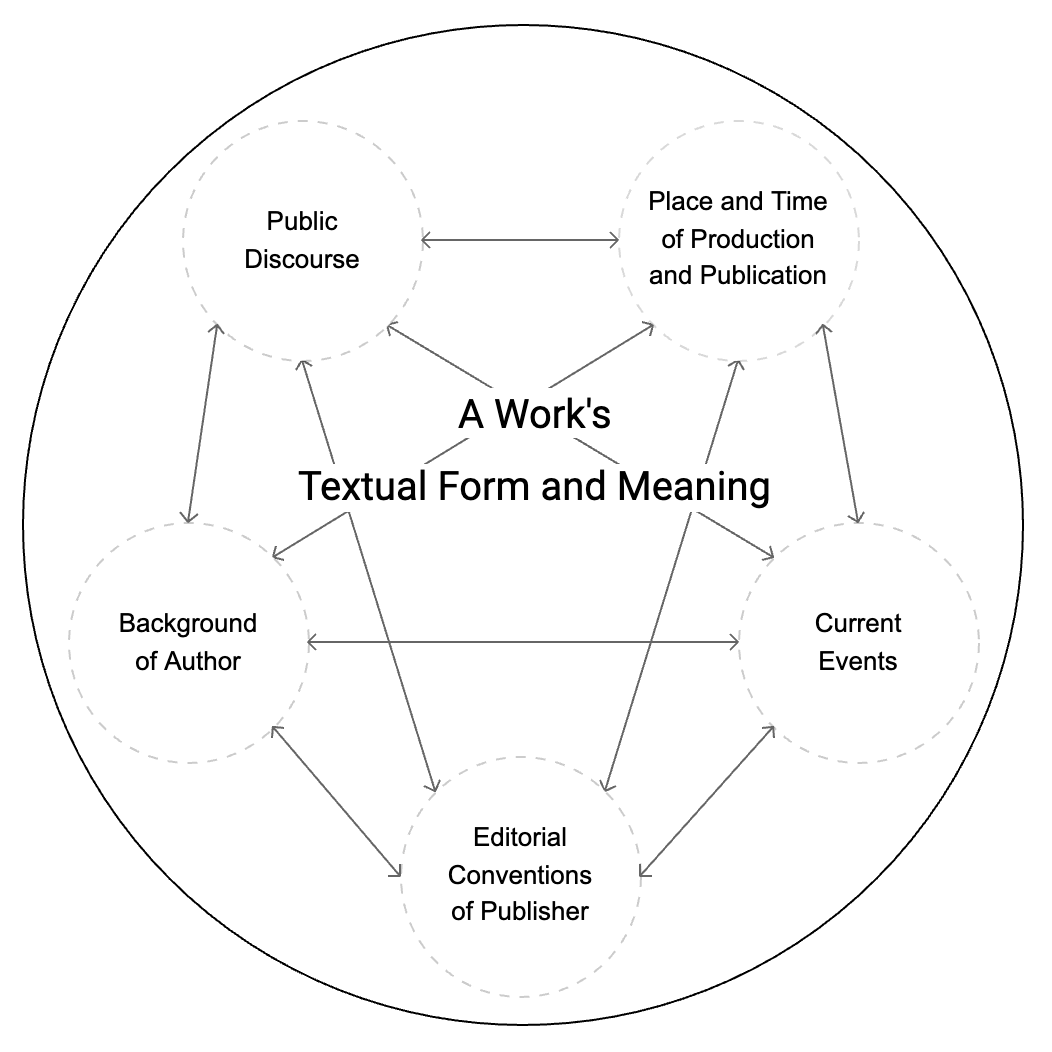
Figure 1: Situated Literature
However, Indonesian literary works are not passive in their situatedness but actively articulate and reconfigure the contexts and circumstances from which they emerge. For this reason, Indonesian literature has been characterized as being “committed” or “engaged” in providing “poignant expressions of social and political comment” and problematizing the “social world we share” (Kratz 1982, 140; Saraswati Putri 2016, 367). Rather than trying to be universally comprehensible, works engage with current issues and situate them within specific contexts that condition their meaning. By offering an “instant picture of a certain political and social situation” (Kratz 1982, 141), works reflect upon the lived realities of these particular temporal, spatial, social, political, or religious contexts (Danerek 2006, 91; Danerek 2013; Saraswati Putri 2016). They integrate context-bound events as “spectacles” in their narratives, “exploring the exigencies of a particular moment and engaging in the public discourse of that moment” (Shackford-Bradley 2006, 94–95). Hence, Indonesian literature’s situated character emerges from a mutual relationship between textuality and context: A work’s context is not external, and its textuality, meaning, and form are not internally constructed but in dialogue with a certain context and its public.
If situatedness describes the mutual formation of text and context, then a situated reading must identify the textual points at which this relationship becomes visible and legible. Thus, situatedness raises profound implications for how we conceptualize and approach literary works. This kind of situated literature, which occupies “the space between the novel and the daily news”, cannot be approached through generalized literary frameworks. Instead, “the reader […] is expected to be in more immediate proximity to the story or to be part of the ‘event’”, which involves engaging with the “thick description” of a work’s narrative (Shackford-Bradley 2006, 95). Thus, reading situated literature implies being particularly attentive to context or, more precisely, how context unfolds within the text of a work. The assumption is that a work’s textual form and meaning cannot be detached from the circumstances of specific localities and temporalities. Hence, interpreting a work involves placing and recognizing it within its particular context and addressing questions such as: How does the text articulate its surroundings, and how are these surroundings conditioning the text? Engaging with such questions implies attending to the points where text and context intersect, for example, specific places, periods, seasons, settings, sites, events, rituals, festivities, ceremonies, or incidents. These points of intersection function as chronotopes, contextual indicators that point to the “intrinsic connectedness of temporal and spatial relationships that are artistically expressed in literature” (Bakhtin 1981, 84). Through these contextual indicators, works can be re-situated within their specific circumstances.
Although scholars have long recognized Indonesian literature’s situated character, the methodological consequences of this recognition have not been fully addressed. More specifically, previous scholarship has emphasized the committed character of Indonesian short stories—that is, how works address lived realities specific to certain social groups, temporalities, and contexts—but heavily relied on works of recognized authors. For example, Danerek (2006; 2013) repeatedly justified his selection of works through a canonical logic by referring to the authors’ prominence in his analyses of short stories in the 21st century:
The three main figures discussed below are chosen because of their popularity. Critics acknowledge them and they have won literary prizes. They are also reprinted in anthologies, translated and researched into. In short they belong to the canon of literature. (Danerek 2006: 34)
Seno Gumira Ajidarma, whose stories will be addressed here, is an influential author and associated with the development towards documentation and current affairs, although he often writes surreal stories with elements of the fairy tale. He has contributed short stories to various publications for three decades, notably Kompas, and together the author and the newspaper represent a significant part of the canon of the contemporary Indonesian short story. (Danerek 2013: 420)
Shackford-Bradley (2006), as well, grounds her analysis in short stories written by highly recognized authors, such as Pramoedya Ananta Toer, Taufiq Ismail, Putu Wijaya, and Seno Gumira Ajidarma, all considered part of the Indonesian literary canon. Finally, Kratz’s (1982) much older work, The Indonesian Short Story After 1945, also emphasizes short stories written by canonical authors, including Idrus, Pramoedya Ananta Toer, and Umar Kayam.
While these four studies all acknowledge the formative role of context and particularity, they do not integrate this insight into their methodological approach. I therefore refer to these kinds of approaches as quasi-contextual, as they recognize the importance of context at the level of interpretation but not at the level of methodology and reading practice. They conceptualize context as central to the production of meaning and/or invoke it as interpretive background yet continue to rely on a small body of canonical works. As a result, a limited body of works written by recognized authors is repeatedly deemed as representative of specific, sometimes marginalized contexts, although many other non-canonical works may be much more directly situated within them. Through such a quasi-contextual reading, a small number of works come to stand in for Indonesia’s vast and heterogeneous literary field, which spans across a myriad localities and temporalities. This kind of reading risks selectively reproducing context rather than remaining attentive to a work’s context-bound particularity.
The problem, then, is one of scale. A situated reading of a single work can recover contextual specificity; but it cannot by itself reveal how such specificities are distributed across Indonesia’s vast heterogeneous field. In an attempt to capture this dynamic, some scholars have hinted towards an ethnographic mode of reading that attempts to re-position individual works into their immediate contexts, for example, through fieldwork or by examining the context-bound details within a text (Derks 1996; Shackford-Bradley 2006). However, this type of reading tends to focus on the particularities of individual works and contexts. This strict and narrow focus on individuality and particularity risks overlooking the heterogeneity of Indonesian literature as a whole, thereby trading plurality for specificity. Moreover, it can perpetuate biases that privilege some contexts and works over others (e.g. Java-centrism, standard language ideology, canonical bias), flattening the overall heterogeneity of Indonesia’s literary field. In contrast, situatedness implies attending to both particularity and plurality or specificity and range. To truly recognize this dual nature of situated literature, we must grasp plurality while reading specific enough to capture the formative role of particular contexts in individual works. I argue that this becomes practically feasible through a situated distant reading that takes into account the large body of heterogeneous works while preserving their context-bound particularities.
For this purpose, I propose a context atlas, an array of indices that make various dimensions of context (e.g., spatial, temporal, event-based) visible and searchable throughout a large collection of literary works. These indices function as “lookups,” each pointing to one of the innumerable intersections of text and context appearing throughout the collection of works. They enable context-sensitive retrieval of specific works from within their situated position in the literary field while keeping overall heterogeneity visible. Such a context atlas would allow readers to oscillate between text/context and particularity/plurality, zooming in and out between micro/macro perspectives. In this manner, situatedness becomes more than a mere theoretical claim: a practical tool and methodological measure that enables readers to grasp the myriad configurations that permeate Indonesian literature while preserving the particularities of individual works.
Using my machine-readable corpus, which currently contains 6,110 Indonesian literary texts, I aim to provide a preliminary example of a context atlas and its purpose. Throughout my corpus, 80 percent of works (4,894) explicitly use and mention 8,670 unique Indonesian toponyms. They are a useful preliminary index for a context atlas as they are computationally identifiable points that indicate the spatial horizon of literary works. As every work mentions about 5 toponyms on average, there are 25,877 geographical references in total across the corpus. The relatively high number of unique toponyms against the number of total mentions reveals an extremely diverse space of geographical contexts rather than a small “canon” of places. Every work mentions about 4 different toponyms, representing the particular spatial configurations that situate individual works within specific contexts. The sheer number of combinations between two unique toponyms is mind-boggling (50.969). At the same time, not all toponyms are mentioned together evenly across the corpus but rather cluster in numerous localized geographies. Finally, the corpus reveals a pronounced difference between center and periphery, where a small set of frequently mentioned places is surrounded by a large set of rarely mentioned places. Ultimately, these numbers, which can hardly be grasped without additional tools, illustrate the spatially situated nature of Indonesian literature, characterized by both particularity and heterogeneity: Works in textual form and meaning are conditioned by particular configurations of external circumstances which, in turn, unfold within the text itself.

Figure 2: Indonesian Literary Atlas
To make the above complexities practically legible, I positioned each unique geographic reference as a drawing pin on a virtual map, creating a preliminary version of an Indonesian literary atlas. The bigger the pin, the more frequently the represented place is mentioned across the corpus. Additionally, the pins’ colors divide places into three categories: the top 10 percent of the most frequently mentioned places, places of medium frequency, and places mentioned only once (see map legend). Each of these pins represents a geographic reference that “tacks” works to specific contexts. These references do not necessarily represent settings but act more broadly as spatial markers that indicate “the geographical range and horizon of a fictional space” (Piatti et al. 2009, 185). By systematically mapping these horizons, the atlas facilitates “the study of space in literature; or else, of literature in space” and becomes an “analytical tool” for reading situated literature (Moretti 1998, 3). Specifically, it allows readers to examine the spatial situatedness of literary works as “the result of two conflicting, and equally significant forces: one working from the outside, and one from the inside”: context, text, and their interaction (Moretti 1998, 5). However, one must keep in mind that this atlas is not the conclusion of a situated reading but only its beginning: a tool that acts as an entry point to explore the situated character of Indonesian literature.
Ultimately, this essay explored an approach to reading Indonesian literature, referred to as situated distant reading, which aims to capture the highly particular and context-bound character of literary works while also accounting for the heterogeneity of Indonesian literature as a whole. This approach integrates context not as a mere theoretical claim but as a methodological measure through which the act of reading itself can become situated. Through this methodological exploration, I sought to demonstrate the potential of combining critical inquiry with digital methodologies to advance understanding of Indonesian literature’s inherent complexities. By applying this methodological potential to my machine-readable corpus of Indonesian literary works, I tried to contest reductive and generalized literary frameworks and provide empirically grounded alternatives. However, in doing so, the essay only scratched the surface of what is technically possible and, therefore, should be understood not as an endpoint but as a catalyst and groundwork for further discussions and explorations.
References
Mikhail M Bakhtin, The Dialogic Imagination: Four Essays, edited by Michael Holquist. Translated by Caryl Emerson and Michael Holquist (University of Texas Press Slavic Series 1. University of Texas Press, 1981).
Stefan Danerek, “CERPEN KORAN: Its Canon and Counter-World,” Indonesia and the Malay World 41, no. 121 (2013): 418–38. https://doi.org/10.1080/13639811.2013.826425.
Stefan Danerek, Tjerita and Novel Literary Discourse in Post New Order Indonesia (Department of East Asian Languages, Lund University, 2005).
Jeremy H. C. S. Davidson, “The Modern Short Story in South East Asia: An Introduction,” In The Short Story in South East Asia: Aspects of a Genre, edited by Jeremy H. C. S. Davidson and Helen Cordell (Collected Papers in Oriental and African Studies. School of Oriental and African Studies, University of London, 1982).
Will Derks, “‘If Not to Anything Else’: Some Reflections on Modern Indonesian Literature,” Bijdragen Tot de Taal-, Land- En Volkenkunde 152, no. 3 (1996): 341–52. https://www.jstor.org/stable/27864773.
E. Ulrich Kratz, “The Indonesian Short Story After 1945,” In The Short Story in South East Asia: Aspects of a Genre, edited by Jeremy H. C. S. Davidson and Helen Cordell (Collected Papers in Oriental and African Studies. School of Oriental and African Studies, University of London, 1982).
Franco Moretti, Atlas of the European Novel, 1800-1900 (Verso, 1998).
Barbara Piatti, Hans Rudolf Bär, Anne-Kathrin Reuschel, Lorenz Hurni, and William Cartwright, “Mapping Literature: Towards a Geography of Fiction,” In Cartography and Art. Lecture Notes in Geoinformation and Cartography (Springer Berlin Heidelberg, 2009). https://doi.org/10.1007/978-3-540-68569-2_15.
L. G. Saraswati Putri, “Engaged Literature: An Examination of Social Issues Reflected in Contemporary Indonesian Literature,” Bijdragen Tot de Taal-, Land- En Volkenkunde / Journal of the Humanities and Social Sciences of Southeast Asia 172, nos. 2–3 (2016): 349–68. https://doi.org/10.1163/22134379-17202018.
Julie Shackford-Bradley, “Cerpen: How Indonesian Short Stories Re-Present Urban Space and Public Discourse,” Crossroads: An Interdiscliplinary Journal of Southeast Asian Studies 17, no. 2 (2006): 93–127.
