
In February 2025, I shared in The Digital Orientalist the announcement of releasing the first public Syriac Handwritten Text Recognition (HTR) model on the AI-driven Austrian tool, Transkribus (From Vienna to the World). At the recent Transkribus User Conference 2026 (TUC26) at the University of Passau (21–23 September 2026), I had the privilege to participate through a Scholarship Presentation, a Poster, and The Digital Orientalist Roundtable. I presented how our work has scaled far beyond that single base model into multi-script and multilingual HTR models in the framework of my Austrian FWF-funded project “Identifying Scattered Puzzles of Syriac Liturgy Manuscripts” and recently in collaboration with the FWF “Cluster of Excellence EurAsian Transformations”.

Participants of the Transkribus User Conference 2026 (TUC26) at the University of Passau, 21–23 September 2026.
In this article, I share a summary of my TUC26 contributions (my Scholarship Presentation can be watched on the Transkribus YouTube channel here) and provide further updates on the ongoing work on the 6th-century Estrangelo script within the HTR Winter School of IMAFO 2026 and the Vienna ‘Porta Orientis’ Pilot for building the first public East Syriac HTR Transkribus model.
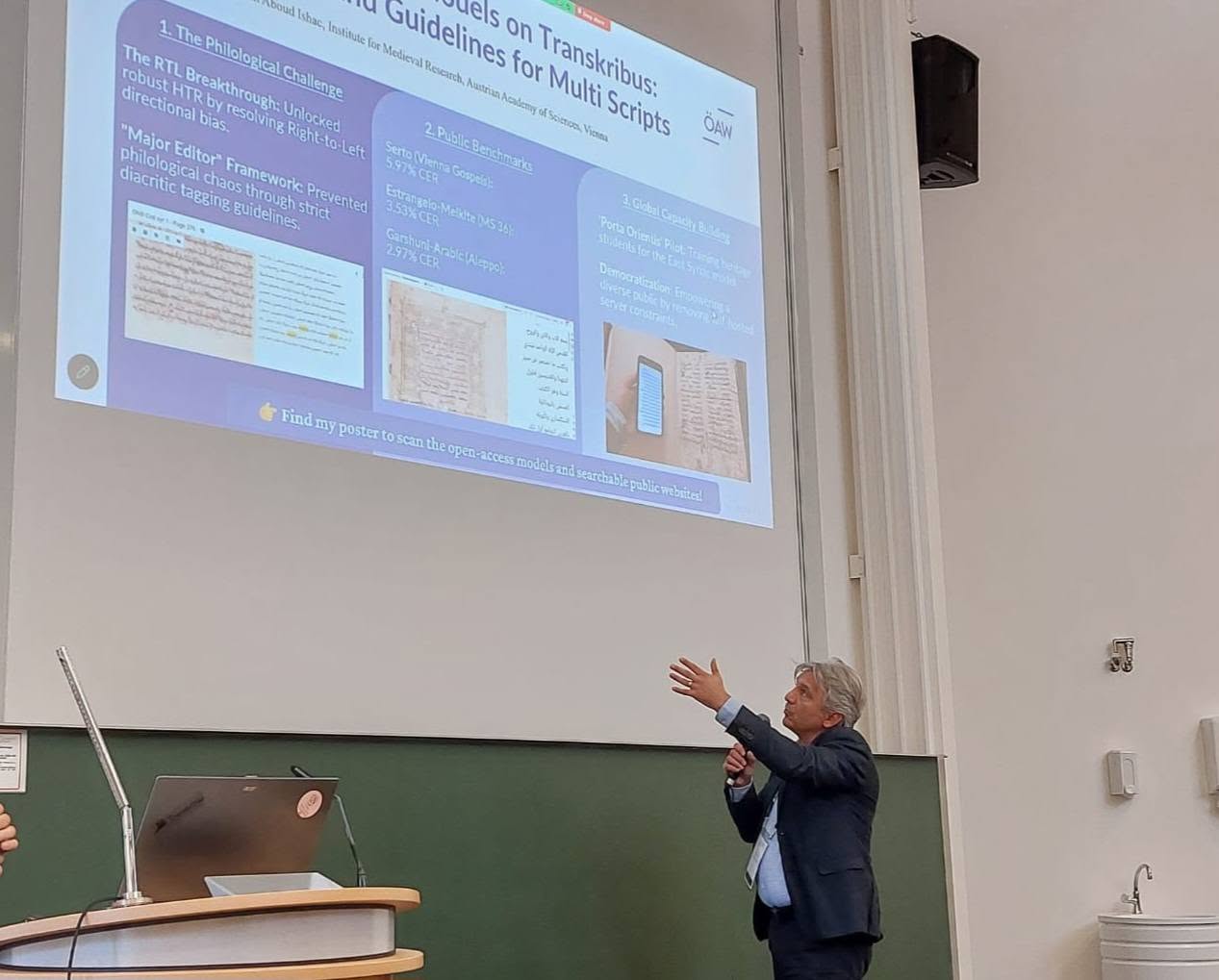
Presenting our multi-script public Syriac HTR benchmarks and guidelines at TUC26, University of Passau.
Introduction & The First Public Syriac HTR Models
In my poster at TUC26, I presented our work on constructing public Syriac-script HTR models on Transkribus, thanks to our collaboration with the Transkribus team. As we had to deal with the right-to-left (RTL) reality for Syriac, it became clear that dealing with non-Latin scripts and languages was a serious challenge. However, with a little bit of patience and through proper communication with the development team of Transkribus, we were able to overcome several challenges and achieve successful results. So, the key takeaway here is “collaboration,” which required good communication and dialogue with the tool’s team.

Poster presented at TUC26 in Passau (September 2026), summarizing our public Syriac HTR benchmarks, guidelines, and partnerships.
Beginning of the Journey: Syriac “Scattered Puzzles”
The title of my ongoing project, hosted since 2023 at the Institute for Medieval Research (IMAFO) – Division of Byzantine Research, Vienna, is “Identifying Scattered Puzzles of Syriac Liturgy Manuscripts” (ISP). By “puzzles,” I mean manuscript fragments that can be found in different libraries, either scattered in specific archival boxes or inside bindings. For example, during my research at Yale University’s Beinecke Library in September 2022, my curiosity led me to check a box of fragments that was catalogued as “Quranic Arabic.” I ended up finding important Syriac liturgical fragments (described in my posts for The Digital Orientalist here and here). Sometimes such Syriac fragments can be found used as flyleaves or binding waste inside other manuscripts. The goal of the ISP project is to identify the content of such fragments and to establish possible links with manuscripts in a digital workflow.

The Identifying Scattered Puzzles of Syriac Liturgy Manuscripts (ISP) project page on ÖAW’s IMAFO.DIGITAL portal.
Building a Specialized Syriac Liturgical Corpus: From OCR to HTR
The core workflow of the project is to construct a manuscript-based, specialized corpus organized around the categories of Syriac liturgical books. To begin constructing this corpus, I used texts I had manually typed since my PhD days (2010–2013), alongside printed texts processed with OCR. For printed texts with fixed typographic patterns, texts can simply be extracted using tools, such as Google Lens (as I have described in my previous posts in The Digital Orientalist here and here) or using Archive.org (as described here), which works remarkably well for printed Syriac.
However, for the purpose of the ISP project, I needed to extract text directly from manuscripts, because unedited manuscripts are the primary source for parallel material required to identify scattered fragments. That prompted our work with Handwritten Text Recognition (HTR) technology, which we use to extract the texts from many Syriac manuscripts.
Since there were no public HTR models for Syriac back in 2023 when the project started, it was necessary to start training the first model from scratch, making use of the texts I had typed or OCR’d in our first attempts to train a Syriac HTR model. It was frustrating at the beginning; however, after patient collaboration with the Transkribus team, it led to great results! For more details about training the first Syriac public HTR model, you can read my post from last year here.

IMAFO HTR Winter School 2024 at the Austrian Academy of Sciences (ÖAW) in Vienna.
For the ISP project, once the texts are transcribed digitally (now with several HTR models yielding excellent results), we convert them into TEI-XML files, and from there we export them to HTML as well as LaTeX and PDF editions. All of these outputs are deposited in the project’s GitHub repository (here) and published gradually on the project website (syriac-liturgy.org).
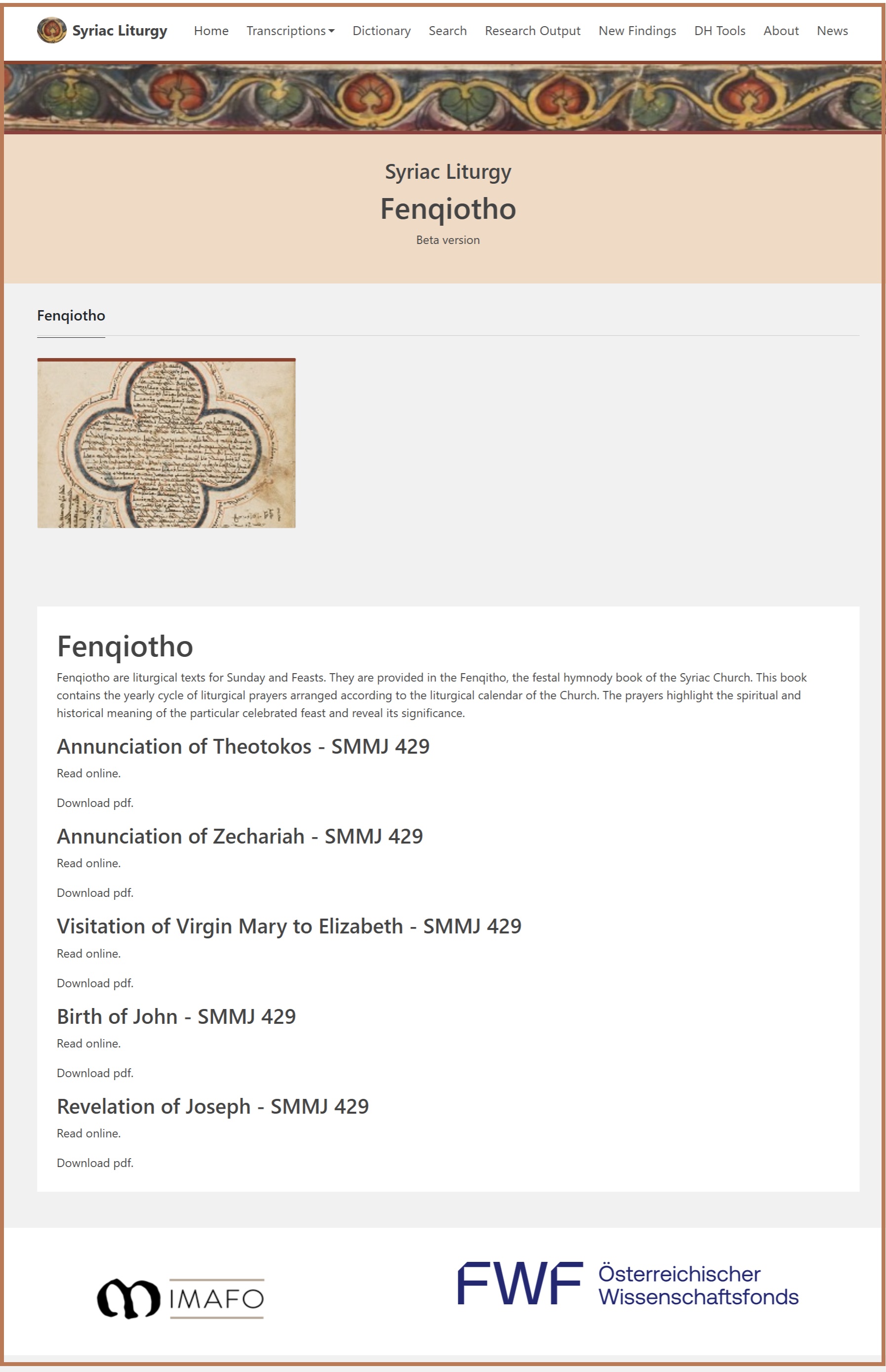
The Syriac Liturgy corpus portal (syriac-liturgy.org), providing open-access HTML transcriptions and downloadable PDF editions.
Overcoming the Right-to-Left Alignment & Desktop/Web Conflict
At a crucial moment, I identified the problem that led to our early technical failures. When uploading the dataset and the images, following a Transkribus collaborator’s instructions, the training did not work. When I inspected the alignment in Transkribus, I realized that the software was matching the image from left to right against text written from right to left. I noticed in the end that the system was trying to map it to the opposite side because it was scanning the line image from left to right while reading the ground-truth text from right to left. At first, I wondered whether a possible solution would be to reverse the text string to trick the system. However, in the end, I chose to communicate the issue to the developers. At the same time, I came across another problem: I found out that using the installed desktop client alongside the web app was causing synchronization conflicts for RTL text. This was solved more easily. We stopped using the desktop client and worked exclusively in the online web version and were finally able to train the first public Syriac HTR model on Transkribus!

Public Transkribus interface of the 1554 Vienna Syriac Gospels (ÖNB Cod. Syr. 1, fol. 93v) illustrating the initial RTL misalignment: “scanning the line image from left to right while reading the ground-truth text from right to left”.
Expanding to Multi-Syriac Scripts
Within the ISP project, there has been a necessity to deal with manuscripts in multiple scripts, such as Estrangelo (also with Melkite features, so we released the Second Syriac Public HTR model trained by the Syriac Group of the IMAFO HTR Winter School 2025 – Vienna: “Syriac New Testament of Jerusalem (Estrangelo – Melkite)”) and East Syriac, from different historical periods.

The second public Syriac HTR model on Transkribus (Syriac New Testament of Jerusalem, 3.53% CER), trained at the IMAFO HTR Winter School 2025.
Working on different manuscripts and training several HTR models within the ISP project, I could train multi-script “super-merged” models, which are already yielding strong results. For instance, these models helped remarkably in preparing the manuscript BL Add 14,470 (many thanks to the generosity of the British Library for sharing the images of this 6th-century codex, one of the oldest complete Syriac NT manuscripts) that we are using for our ongoing HTR Winter School 2026 Syriac Group project.

Estrangelo HTR line segmentation and transcription of the 6th-century codex BL Add. 14,470 (IMAFO HTR Winter School 2026).
In addition, our ongoing project, Vienna ‘Porta Orientis’ Pilot (many thanks also to the Scriptorium Syriacum Manuscript Center in Erbil), brings students from Iraq and monks from the Chaldean Order of Rabban Hormizd to Vienna to train the first public East Syriac HTR model (in collaboration between the ISP project and the Cluster of Excellence EurAsian Transformations).

Prof. Claudia Rapp and Abbot Dr. Samer Soreshow Yohanna signing the cooperation agreement during the Vienna ‘Porta Orientis’ Pilot workshop at the Austrian Academy of Sciences (19 October 2026), in partnership with Scriptorium Syriacum (Erbil) and the Cluster of Excellence EurAsian Transformations.
Multilingual Garshuni Manuscripts
Moreover, we confronted another major phenomenon: Garshuni, which is an allographic writing system where the script is Syriac, but the underlying language is Arabic. Historically, the Syriac script was also used to write Ottoman Turkish, Armenian, and Malayalam (a language spoken in Kerala, India, where Syriac remains a liturgical language). For the ISP project, I trained a dedicated Garshuni-Arabic model (thanks to a collaboration with Coptic monks in Egypt), which is also closely tied to our public outreach: every day on our project’s Facebook page, “On This Day: The Syro-Coptic Synaxarion” (see here), we share daily entries with the public from the Syro-Coptic Synaxarion.

The first public Garshuni-Arabic HTR model on Transkribus (2.97% CER), developed in collaboration with Coptic monks in Egypt.
In many manuscripts, we encounter bilingual pages where one column or section is Syriac in Syriac script, and the adjacent section is Arabic written in Syriac script (Garshuni). To process this, I trained a multilingual model capable of outputting both Syriac and Arabic scripts so that we can automatically generate Arabic-script transcriptions alongside the Syriac text. These models are not yet public, as they are still in the process of expansion.
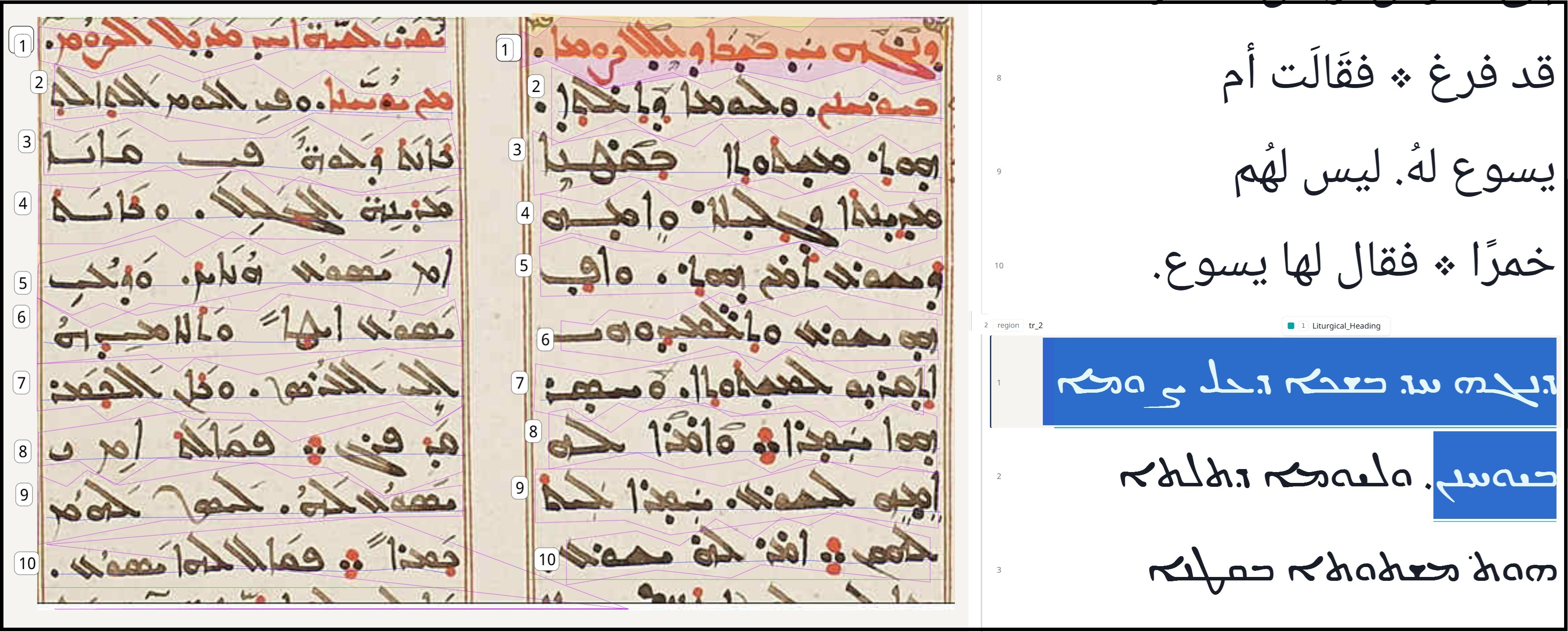
Bilingual Syriac and Garshuni-Arabic columns processed with our multilingual HTR model outputting both scripts simultaneously.
Keep in mind the core linguistic obstacle when working with Garshuni: the Syriac alphabet has only 22 letters, whereas the Arabic alphabet has 28 letters. This means that a single Syriac letter has to represent multiple distinct Arabic consonants, differentiated only by dots (for example, representing different Arabic dental or emphatic consonants with the same base Syriac character). When you add Arabic orthographic markers like shadda and madda, it creates significant ambiguity for automated recognition. Nevertheless, the larger and more diverse the training dataset we feed into the model, the better the disambiguation and accuracy become.

Automated Arabic-script transcription generated directly from a Garshuni-Arabic folio of the Syro-Coptic Synaxarion of Aleppo.
“Collaboration” is the Key Word!
When I announced the first public Syriac model on Transkribus (in The Digital Orientalist in February 2025), I urged Syriac digital projects that might have trained HTR models: “if you have a model trained on data that can be shared, consider making it public to benefit the entire Syriac community!” because that is how all of us can collaborate to build a sustainable ecosystem for Syriac Digital Humanities. After that announcement, we happily saw other teams begin sharing Syriac models trained on other platforms in open repositories like Zenodo. Indeed, in October 2025, Syriac models trained on Kraken were shared publicly on Zenodo, such as the Sophro Mhiro Syriac ATR model for Syriac scripts.

Open-access release of the Sophro Mhiro Syriac ATR model for Kraken on Zenodo (October 2025), reflecting growing community sharing.
This is a very good example of how sharing our models publicly can help everyone. So, back to the keyword mentioned at the beginning of this post: “collaboration” is crucially important—with the developing tools, with different projects, and with many colleagues (collaborators within the ISP project, HTR Winter Schools of IMAFO, and many others worldwide who have faithfully collaborated)—to build together a collaborative ecosystem for our present and future AI age!
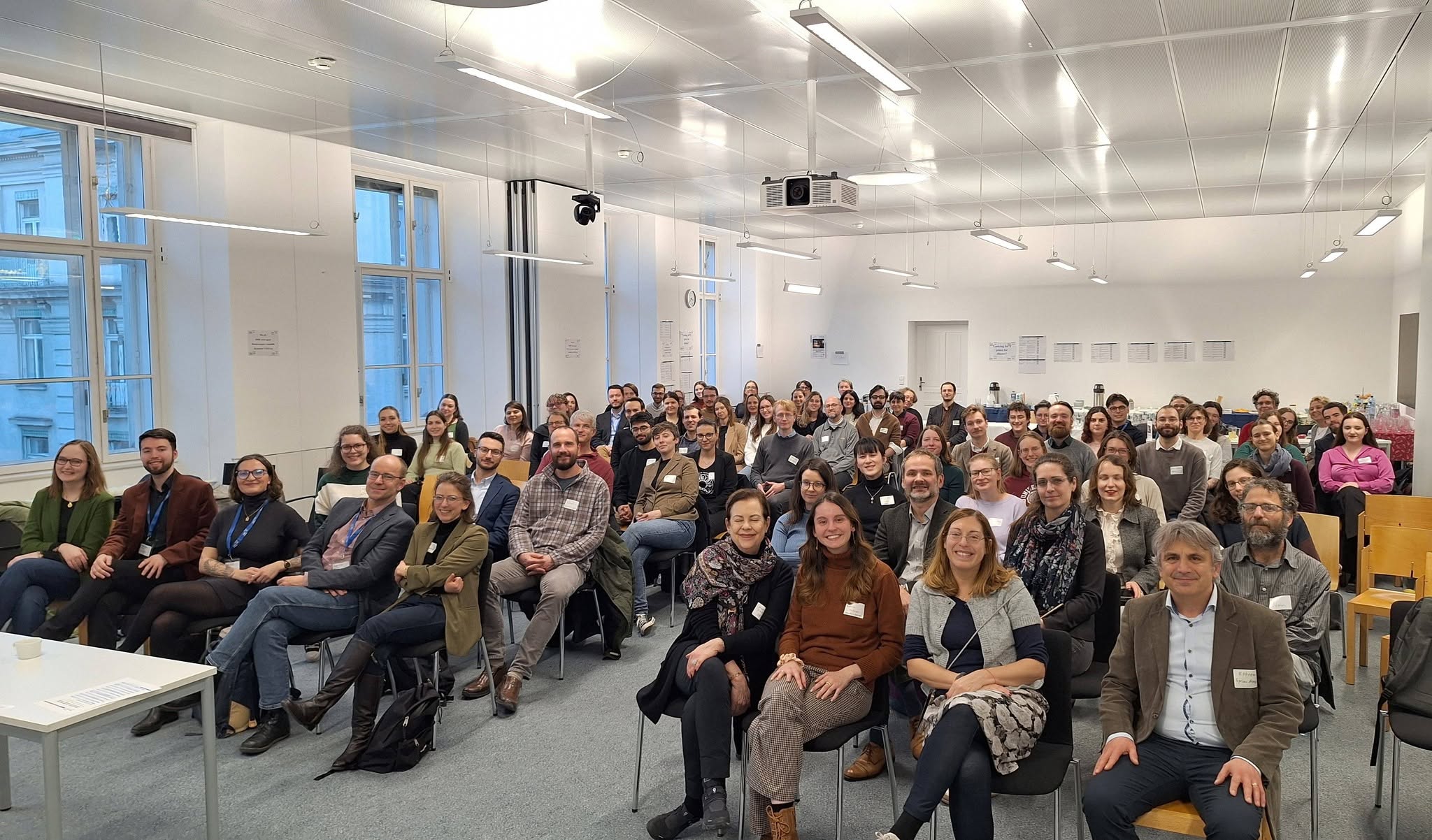
IMAFO HTR Winter School 2025 at the Austrian Academy of Sciences (ÖAW) in Vienna.

