
This is our third interview as part of the NIHU DH × The DO Interviews. This series features interviews with researchers working at institutions affiliated with the National Institutes for the Humanities exploring different projects, ideas, and initiatives.
This interview was conducted with with Prof. Suzuki Kohei who is based at the head office of the National Institutes for the Humanities. The interview explores Prof. Suzuki’s research, the digital humanities and rights issues, his running of the National Institutes for the Humanities legal rights help desk, and resources related to research and copyright law in Japan.
JM: Could you tell our readers briefly about your research and how it relates to the digital humanities [(henceforth DH)]? If readers want to learn more which of your publications do you recommend that they read?
SK: My research focuses on intellectual property law, with a particular emphasis on Japanese copyright law—a field closely intertwined with DH. I have been studying the relationship between libraries and copyright law in the digital age, and in the past my research has focused on topics including the digitization of library materials; digital lending; the use of out-of-commerce works; open access to research papers and copyright issues etc.
In DH research, both digitizing materials and using them are essential, so my past research directly applies to my work at the National Institutes for the Humanities [(henceforth NIHU)].
JM: You recently published the book, Introduction to Rights Management for Digital Archives (デジタルアーカイブの権利処理入門). Could you tell us what the book is about, the issues it is addressing, and what it hopes to achieve?
SK: First, let me explain the term “digital archive” (デジタルアーカイブ). It is a Japanese-made English term, and there is no established definition. I understand it as a term that refers to the entire system of preserving and providing information resources related to cultural heritage institutions (CHI) using digital technology. To digitize and publish information resources, we must properly handle various rights, such as copyright, portrait rights, and privacy rights. In the book Introduction to Rights Management for Digital Archives, which I co-edited, lawyers, legal scholars, and practitioners and researchers from CHI, we explain methods for managing these rights when creating and running digital archives. I hope that CHI staff who want to create digital archives but are unsure how to handle rights issues will learn from this book, and that it will help to promote digital archiving in Japan.

The cover of Introduction to Rights Management for Digital Archives.
JM: Something that I wanted to achieve when starting this interview series was not only to introduce the research being conducted at NIHU’s institutions but also introduce the wider ways in which affiliated institutions are engaging with DH on an administrative level. One part of your role is running NIHU DH’s legal rights help desk. Could you tell us about this? How was the help desk established? What sort of services does it offer? What sort of advice or assistance do people usually require?
SK: NIHU set the promotion of DH as a key priority for a six-year period starting in 2022. In DH research, the digitization of materials and text data mining (TDM) are frequently conducted. If the materials being used are very old, their copyrights have often already expired. However, because the duration of copyright is very long, materials protected by copyright often become the subject of research. Digitizing and performing TDM on copyright-protected materials can lead to copyright infringement unless the requirements for limitations and exceptions to copyright are met. In addition, DH research sometimes deals with materials that require the careful consideration of portrait rights, personal data, and privacy, but DH researchers are not always familiar with copyright or other laws. To promote DH research, a system to support these researchers is necessary. Therefore, NIHU has decided to establish a help desk for rights issues.
The help desk works in collaboration with lawyers, who have expertise in copyright and portrait rights, to respond to inquiries and consultations about rights issues received from NIHU researchers. Examples of inquiries and consultations received by the help desk so far include: TDM and copyright, conditions for lawful citation, open access publication and copyright, and the digitization of video works and issues regarding portrait rights and privacy. Please note that the support from the help desk is limited to NIHU researchers, so we are unable to engage in inquiries and consultations from researchers affiliated with other institutions. This is partly due to legal restraints in Japan, but it is also linked to time constraints emerging from the help desk’s popularity. The help desk has received more than 130 consultations in the two years since it opened. Since I conduct my own research and work on other NIHU DH projects alongside the help desk, it is difficult to respond to inquiries and consultations from organizations outside of NIHU. Although it is desirable for other institutions and universities to establish help desks like NIHU’s, I think many universities find it difficult to do so due to budget constraints. To support such institutions and universities, I aim to write introductory books like the aforenoted Introduction to Rights Management for Digital Archive and to create and publish a guide on rights issues in DH research, which I will mention later.
In addition, the Ministry of Education, Culture, Sports, Science and Technology (MEXT) has shown interest in the activities of the NIHU DH help desk. At the request of MEXT, I presented a report on our activities at an expert panel on the humanities and social sciences established by the ministry, which may help to shape similar projects in Japan in the future.
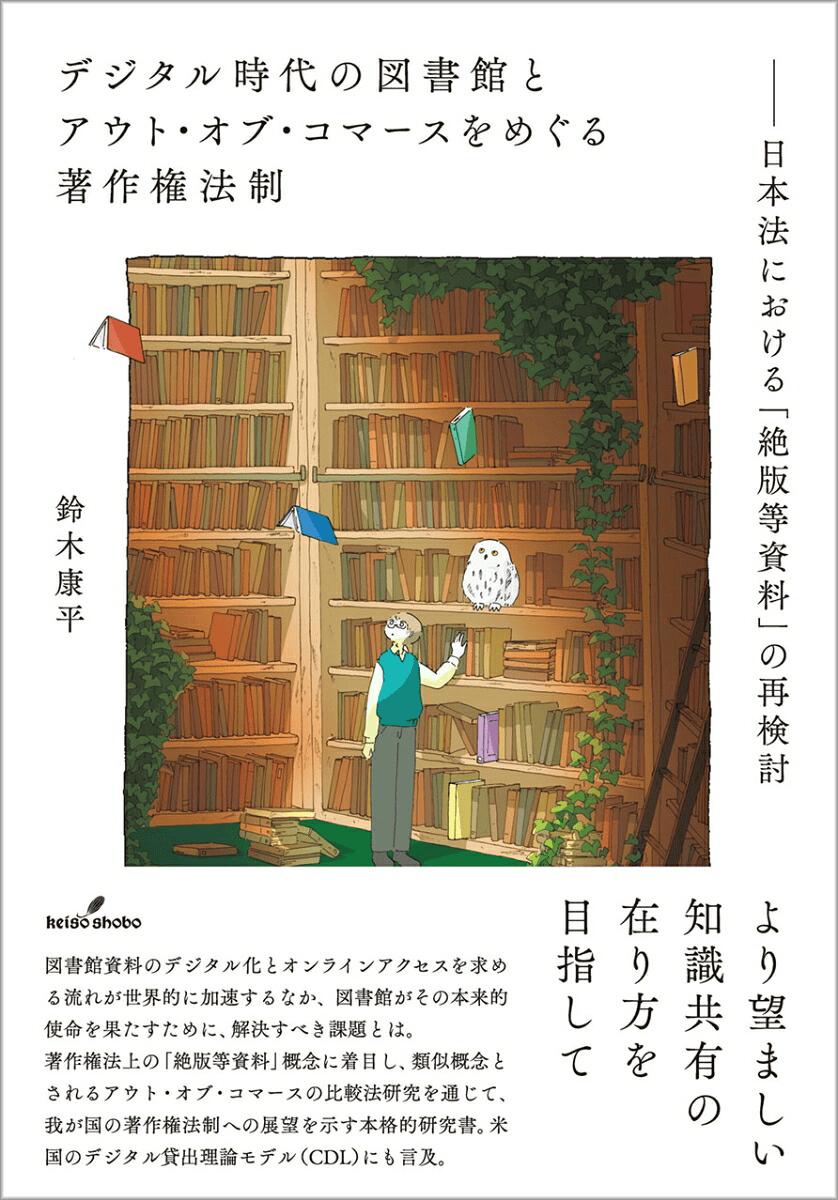
The cover of Prof. Suzuki’s first book Copyright Law Concerning Libraries and Out-of-Commerce Works in the Digital Age: Reconsidering “Out-of-Print and Other Materials” under Japanese Law (デジタル時代の図書館とアウト・オブ・コマースをめぐる著作権法制:日本法における「絶版等資料」の再検討).
JM: What do you think are the key legal issues facing DH researchers today and as individual researchers how can we address these?
SK: Although this issue is not limited to DH researchers, one challenge faced by researchers who work with copyrighted works is the relationship with AI. With the rapid development and spread of AI in recent years, the limitations and exceptions to copyright regarding TDM are being reconsidered worldwide. Globally speaking, Japanese copyright law has allowed the flexible use of materials for TDM. However, as you may know, many creators have expressed concern about their works being used for AI training. Some people argue that Japanese copyright law should be revised. In Japan, there are no judicial precedents regarding AI training yet, and there are various discussions about how it will be judged under the current copyright law.
In the future, I believe the use of AI in DH research will be inevitable. When utilizing AI, we must use copyrighted works properly. However, the relationship between AI and copyright is an issue being discussed by copyright experts around the world, and there is no clear answer yet. Although we do not need to hesitate too much about uses that are legally permitted, we, as researchers, need to think about the delicate balance between the public interest generated by research activities and the interests of copyright holders.
JM: Do you have any recommendations for resources or advice for those concerned about legal issues related to their research in Japan or abroad?
SK: The Agency for Cultural Affairs (ACA) posts an overview of Japanese copyright law in English on its website. It also explains the relationship between AI and Japanese copyright law, which is helpful even for DH research that does not use AI. However, please note that there are various discussions about the relationship between AI and copyright. The materials from the ACA summarize the discussions at the time they were created, so actual courts may not judge the same way. See the page on copyright here and the report on AI and copyright here.
In addition, the WIPO (World Intellectual Property Organization) Japan Office posts English papers about research and topics regarding Japanese intellectual property law on its website.
Finally, although it is only available in Japanese, there is the “Guide to Rights Issues in Digital Humanities (DH) Research,” which I was involved in creating through the activities of NIHU DH. This guide briefly introduces copyright, portrait rights, personal data protection, and privacy, which are likely to become issues in DH research. It also explains major rights issues in a Q&A format.
AI Disclosure: ChatGPT was used to create the cover image for this post.

