
This is a guest post by Khemarato Bhikkhu.
Shortly after ordaining, a young monk in Thailand will be given a small, cardboard box. Heavier than you might expect for its small size, it’s tightly packed with six paperback volumes. These books contain everything a young monk will need to know to pass Thailand’s standardized “Nak Tham” exams, administered at the end of each rainy season in each province across the country.
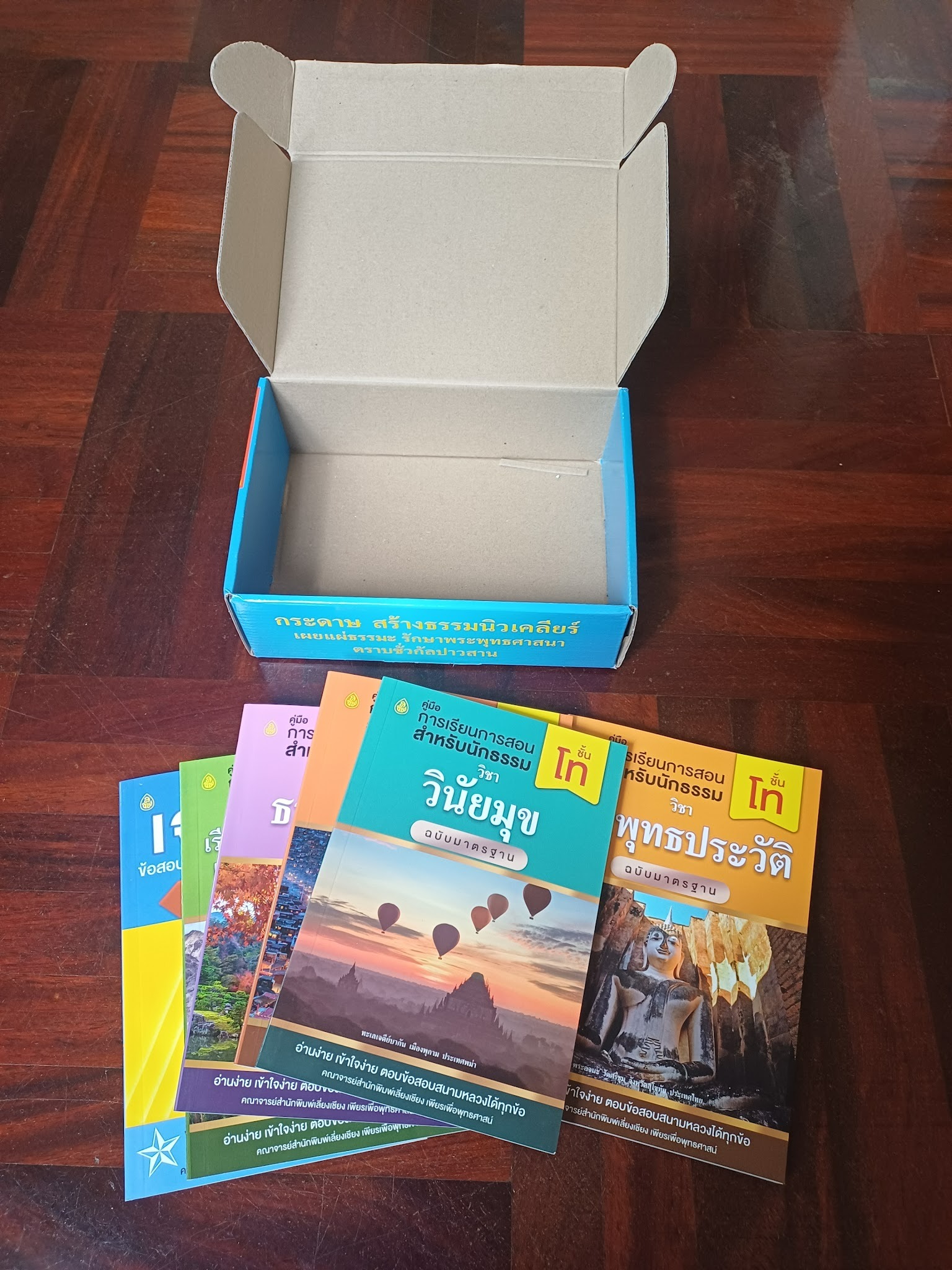
Figure 1: A cardboard box containing Thailand’s standard, Buddhist curriculum, Nak Tham, level two in six paperback volumes.
Larger temples in Thailand, with a sufficient class of incoming monks, will typically host classes during the rainy season covering the five subjects in those books: Buddhist history, Buddhist doctrine, Buddhist texts, the Monastic Discipline, and Buddhist culture (with the sixth book pictured above containing practice tests for the national exam). For smaller temples, with insufficient monks to justify a formal class, the books themselves serve as the teacher. The student is simply encouraged to read and ask a senior monk if he has any questions.
This standard, Thai curriculum is certainly convenient for the temples, but it has its drawbacks. Because it teaches a standardized test, it focuses more on the memorization of facts which are easily tested. And because of the politics that went into its writing, the national curriculum presents a very conservative version of Buddhism that is as interested in creating good Thai citizens as it is in creating wise Buddhists. So, even if this Thai curriculum were translated into English (and some of it has been), its parochial nature would be a poor fit for a global audience. A similar critique could be made about the Buddhist curriculums of Sri Lanka, Japan, and Tibet.
To the Western Buddhist, the academic discipline of “Buddhist Studies” is something of an awkward gift. We are grateful, of course, for any opportunity to learn about our religion more deeply in our native language. And, of course, it was partially through the Western academy that many of us converts first encountered the Dharma. And yet, the Western, academic study of Buddhism grew out of Colonialism and that colonial attitude is still palpable.
There is still too often an assumption in the discipline that the reader couldn’t actually believe this stuff. This is, of course, insulting, but is also bad scholarship, as when, for example, an otherwise careful metaethicist casually dismissed the Buddhist critique of their framing with a sarcastic “big, if true”, losing out on an opportunity to engage more deeply with the philosophy they were supposedly explaining. I have even heard an American professor of Buddhism say that their goal in teaching their first-year Buddhism course was to break the students from any romanticism about the subject. They then wondered aloud why so many of their students dropped out.1
The lack of a balanced curriculum somewhere between these two extremes of credulity and scepticism has been described by American scholar-monk Bhikkhu Bodhi as one of the key challenges to Western Buddhism in the 21st century. Having previously worked at an education technology company, and not being one to shy away from a large task, I decided to take a stab at it myself after I ordained.
As the only American monk at my monastery in Thailand, and not speaking any Thai when I arrived, I found myself having to organize my curriculum for myself out of the free material I could find online. Eventually, an Australian monastic mentor of mine encouraged me to create a website out of the material I had collected and out of that, “The Open Buddhist University” was born.
The Open Buddhist University (OBU) website is my not so little box of Buddhist books which today I am happy to share with you. Like the Thai box that inspired it, my website can be used either by educators looking for resources to teach from or by students looking for a vetted and organized, free curriculum to study. However, unlike the Thai box, our courses are pan-sectarian and university-level (or at least they strive to be!). But unlike most academic courses, ours are (again, mostly) presenting the view from “inside” the religion.
Our website currently has 16, self-directed courses listed roughly from the beginner-level to the more advanced. Some of the courses, such as Bhikkhu Bodhi’s introduction to the Suttas, are purely a lecture series done by a respected teacher, put online for your free use. These courses contain just the lectures as mp3 files, with a few reading assignments thrown in.
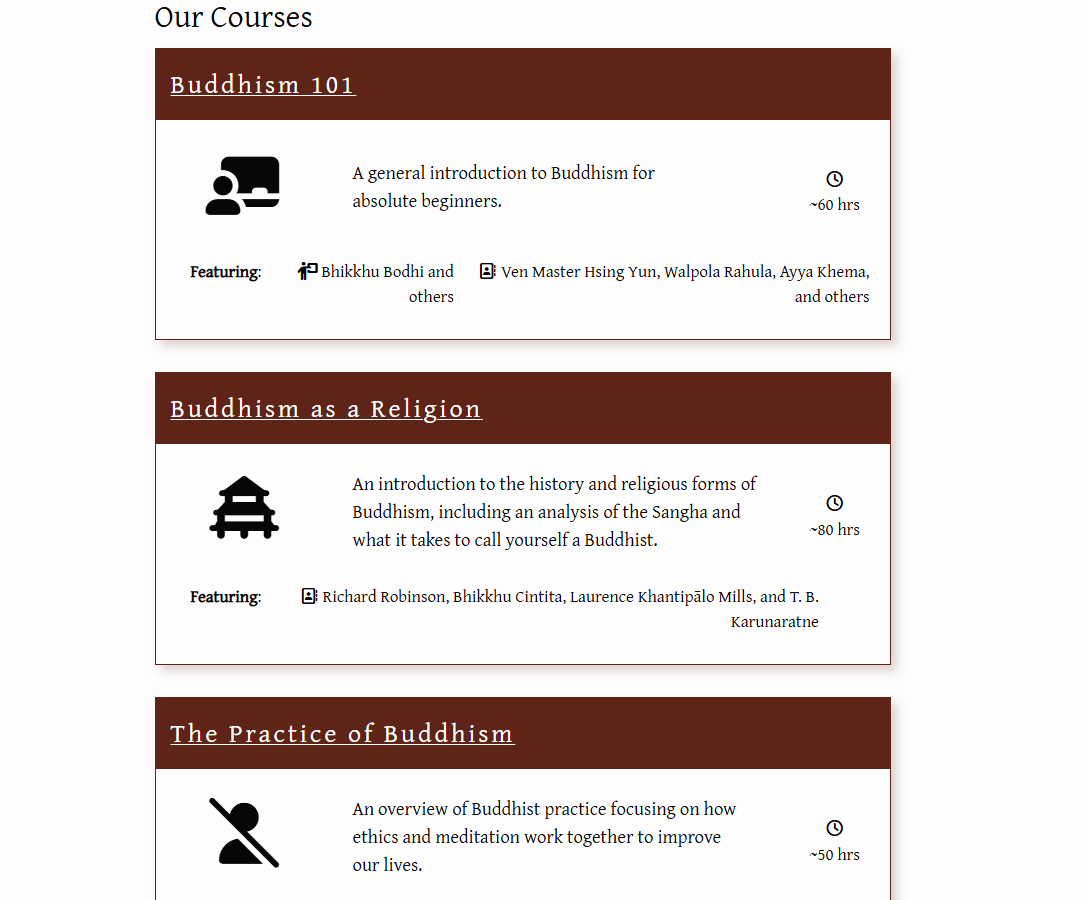
Figure 2: Some of OBU’s courses
Some of OBU’s courses are built around an existing lecture series, but have been significantly expanded with helpful and interesting material from around the web to make something more comprehensive than the original course. Our Buddhism 101 course, for example, was built around another lecture series Bhikkhu Bodhi did on YouTube, but has been expanded with additional lectures by a variety of teachers from different sects and with a variety of readings from a Biography of the Buddha to meditations on love. Students taking the course have appreciated the added variety of perspectives and have been inspired by the inclusion of more stories, personal reflections, and meditations.
Lastly, some of OBU’s courses are syllabi that I have written myself from scratch from the many open access works I’ve found across the internet. Our intermediate course on the life of the Buddha is one such example, where the course is simply a list of readings ordered according to the Buddha’s biography.
Our courses are self-contained and don’t require that you take them in order, so feel free to jump into the one that seems interesting or relevant to you! Like the box of books I began this article with, OBU simply provides materials for your study. How you choose to use them is up to you. I especially want to encourage our students to skip whatever isn’t interesting or isn’t serving them. While I have arranged the courses with some arc in mind, they also contain enough repetition that if a particular work is not doing it for you, you can set it aside without missing much. That’s the beauty of self-directed learning!
We also have a large teaching library of additional topics beyond our courses, so if there’s a particular topic you wish to study more deeply (such as “Buddhism and Animals” or “Right View”), but aren’t sure where to begin, a nice place to start is with our curated bibliographies which we continuously expand and keep up-to-date.
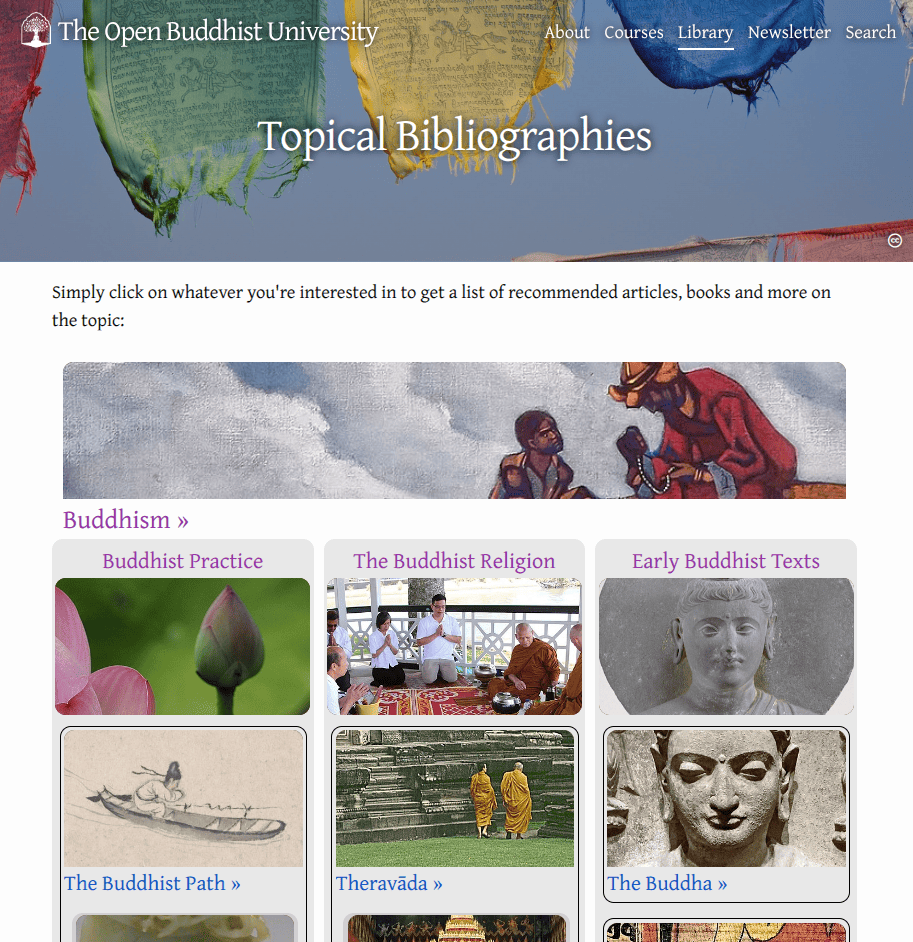
Figure 3: Screenshot of the OBU’s bibliographies page
For university educators looking for an out-of-the-box “Intro to Buddhism” syllabus to adapt for their class, I’d recommend taking a look at our Buddhism as a Religion course which has organized readings on Buddhist history and sociology in a lesson-by-lesson plan. The course covers the history of Buddhism accurately, while also being respectful to each tradition and gives the student some idea of the breadth and beauty of the Buddhist traditions: a hard balancing act to pull off, but I’m proud of what we’ve managed to put together here!
I also think the Buddhist Ethics course would be fun to teach from as it weaves together the early Pāli Suttas with Shantideva’s Way of the Bodhisattva.
But the teacher (or advanced student) of Buddhism can also leverage our library of open access material to find teaching materials introducing a variety of topics. You can use our custom-built instant-search to see if we have what you’re looking for or navigate our full taxonomy of subject tags to explore the breadth of our library, including the bibliographies we’re still working on filling out.
For the practicing Buddhist, an online resource cannot replace your need for a teacher and a spiritual community, and there are also many well-funded apps and websites out there for teaching meditation, so OBU is not in the business of providing direct spiritual instruction. With that said, however, any student with an existing practice should, I hope, understand how our Buddhist Practice course, for example, is applicable to their own life–even when the course declines to make its spiritual implications explicit.
I myself, in my practice, have benefited greatly from the many, fine resources I have chosen to share over at https://buddhistuniversity.net (Otherwise, I wouldn’t have bothered!). But I have also benefited greatly from the simple exercise of organizing my learning into a website that others can understand and learn from. Sorting and tagging my reading into an explicit web of knowledge forces me to reflect on and integrate what I’m learning. And, of course, you only really learn something once you try to teach it!
In the present era where we are all drowning in algorithmic content, I would love to see more websites like this one dedicated to slow and thoughtful curation: places where one can go not to mindlessly scroll but to stop and learn. I’ve tried, at OBU, to build one such online place. I hope you enjoy it.
For those interested in the more technical aspects of the OBU; an interview with Khemarato Bhikkhu will be published soon.
- If you’re wondering how I responded to this shocking admission of pedagogical incompetence, dear reader, I suggested that they might focus more on teaching those aspects of the subject that they loved if they wanted to have more engaged students. Our conversation quickly ended there, as it seems they were not interested in discussing teaching so much as complaining about it. I’m sure the reader has also met a professor or two with a similar attitude. ↩︎
Cover image: Nicholas Roerich, Pearl of Searching, 1924. Image via Wikimedia Commons, public domain.

