
The Open Buddhist University (OBU) is an unaccredited, freely accessible digital resource founded in 2020. Its mission is to provide a comprehensive, English-language curriculum in Buddhist Studies, open to all. I had the pleasure of interviewing Khemarato Bhikkhu,1 who developed and maintains this exceptional resource, to learn more about the creation and evolution of OBU, the challenges and potential of open-source infrastructure, and the ways in which digital resources like the OBU can enrich monastic and academic approaches to Buddhist Studies.
For those interested in the OBU’s course offerings and how to navigate its vast content, see Khemarato Bhikkhu’s recent article introducing the project.
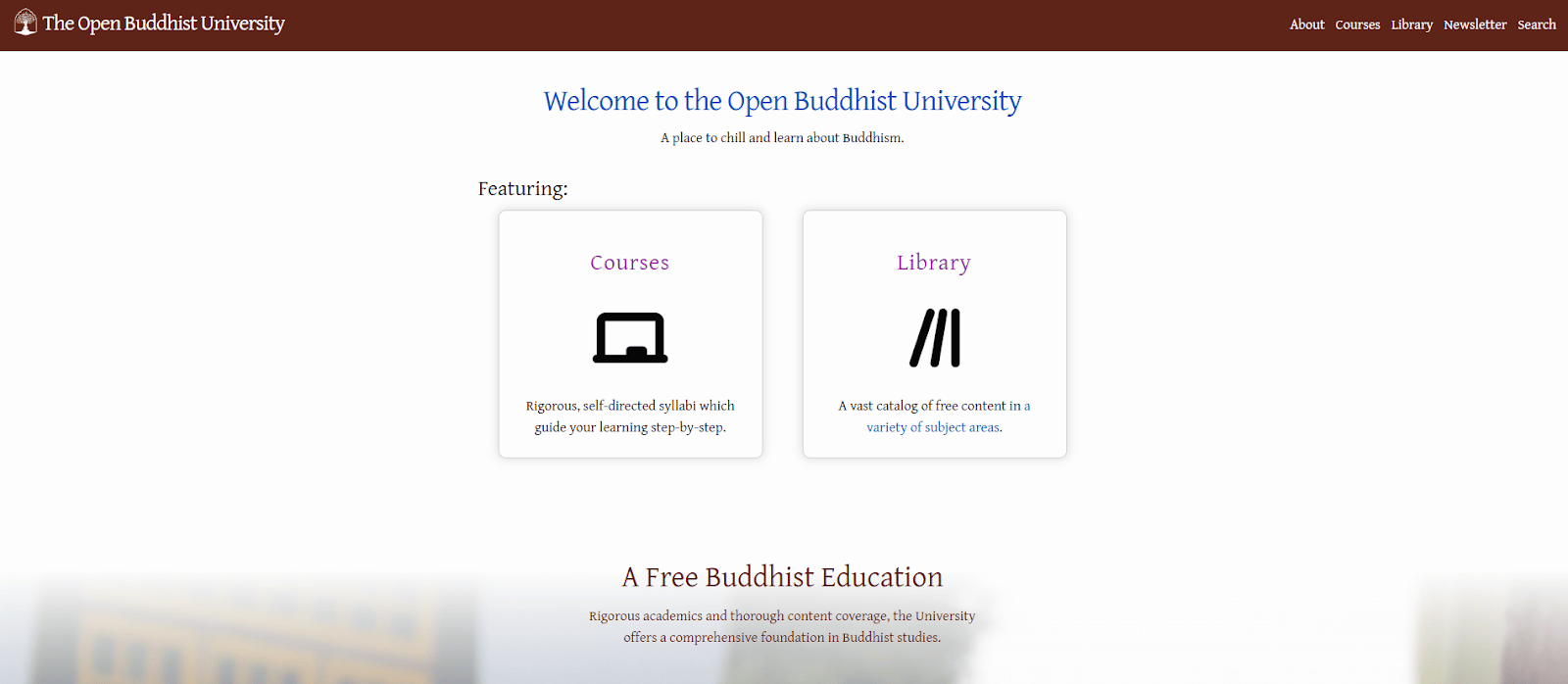
Figure 1: Screenshot of the OBU website
RG: How did you first come to engage with digital humanities, and how do you identify within it — as a scholar, developer, curator, or some combination?
KhBh: As a curator and developer. My interest came first from the digital side. My degree is in Computer Science, but what I quickly found, even as an undergraduate, was that nearly everyone could use a coder. So whatever I was interested in — whether that was psychology, linguistics, or something else — I could get my foot in the door of any field simply by offering some coding or IT help.
RG: And how did the OBU come to be?
KhBh: It started when I left home in 2018. I began wandering as a Buddhist postulant hoping to ordain as a monk. People gave me all kinds of great recommendations as I traveled — things I should be reading and listening to — and it quickly got to the point where I needed to be more intentional about how I was organizing everything just for my own sanity.
Once I had my Google Drive collection organized, I began sharing it with the other postulants I met on the road and they encouraged me to open it up publicly, which I did in 2019. I had wanted to stay away from software engineering, but in 2020, Bhante Sujato (cocreator of suttacentral.net) convinced me to turn the collection into a proper website for those who are starting to make a serious study of Buddhism.
RG: The OBU describes itself as organising “content from across the Web” into self-directed syllabi. What does that curation process look like in practice? What criteria guide decisions about what to include?
KhBh: In practice, I spend a lot of time on my phone reading things!
I download PDFs from open access collections and do a preliminary sort into topics. If an article catches my eye, I’ll read it right away, and if not, I file it away to read when doing a deeper dive on that topic. After I read a piece, I have a rubric you can read about to decide how to file it. Essentially, I ask myself who I would recommend it to, if anyone.
This opinionated, manual curation sets the OBU apart from other open access collections. And the time and software skills I have allow me to manage a much wider corpus than similarly-curated Buddhist libraries such as The Zen Site or Access to Insight, which are both excellent but much more targeted in scope.
RG: How do you manage the practical demands of maintaining and expanding the OBU? And have questions around long-term sustainability and stewardship shaped how you have built it?
KhBh: As much as possible, I try to manage those practical demands with code. For example, the homework assignments in the Buddhism 101 course are self-grading Google Forms. It’s not a perfect technology, but it means I don’t have to grade homework myself nor maintain the form code either. Google manages that for me.
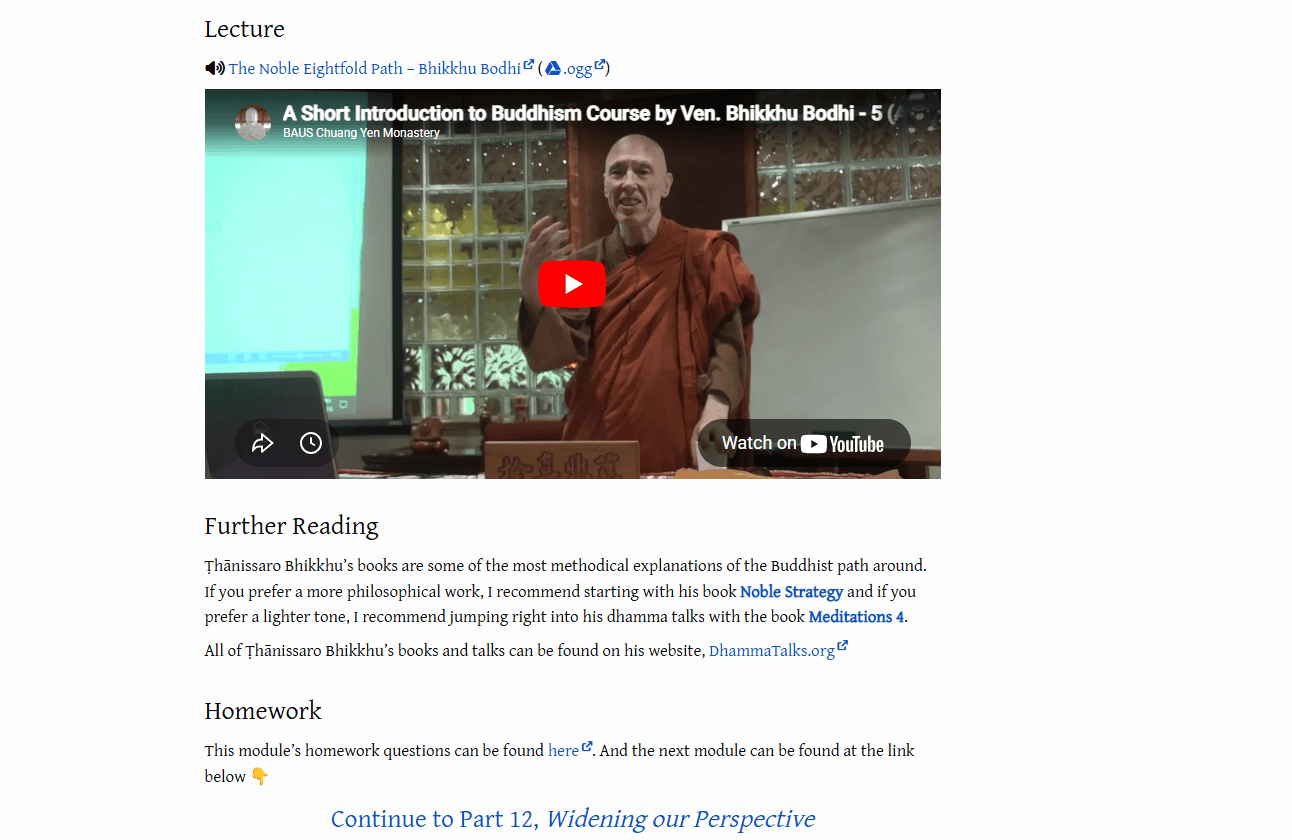
Figure 2: An example of OBU’s lectures, with further reading and homework assignment
Or another example, I have a link checker bot that tests every hyperlink on the site once a month and emails me a list of the links that broke and where they are in my code. This makes it easy to fit into my schedule because I know it will take about an hour, at most two, every 24th of the month, to maintain our thousands of external links and keep them working — something I wish other websites did!
For the management of my Google Drive folders, I have a number of Python scripts I’ve written to ingest new content, organize files, remove duplicates, etc.
And long term sustainability? I’m not sure how “long term” the OBU curriculum will remain useful! The Dhamma itself is timeless, but I have already received a couple of messages from our Gen Z readers saying that the language in some of our books is too old-fashioned for them! If the OBU curriculum can be inspiring and useful for people for a few decades, I’ll be happy enough with that. According to the actuarial tables, I should be able to manage it myself for that long. Beyond that, the source code is on GitHub and Gen Alpha can decide if it’s worth continuing from there.
RG: Even with the help of code it’s a lot of work! Is the OBU a collaborative endeavour?
KhBh: We have one layman who helps out with the administration, paying for the domain etc., and one digital librarian who has been helping me for a couple years with data entry. We also occasionally get software patches supplied by people on GitHub, which is always a pleasant surprise.
RG: Does the work of the OBU connect with, challenge, or enrich more ‘traditional’ modes of scholarship? How should those using the OBU navigate or reflect on this?
KhBh: Thanks for this question.
Today, there are many people who go to university to get a master’s in Buddhist Studies not because they need the credential but just to make a serious study of Buddhism. I think studying Buddhism, even rigorously, should not cost you anything. People in the West should be able to turn to the Saṅgha for an education in Buddhism, just as Asians have been able to do for millennia.
Of course, the OBU, as a digital resource, cannot provide everything that in-person instruction can, but I hope that it can provide a starting point for people with a serious interest.
I also hope that OBU can provide a useful resource for my fellow English-speaking monastics. There is currently a lack of a good curriculum for monks in English; existing pedagogies are either highly sectarian or highly secular. Junior monastics and monastic teachers should be able to leverage the OBU’s curated collection to craft more rigorous and engaging courses than they otherwise could, as most monks don’t have the time or the expertise to vet the thousands and thousands of articles and books that we have.
RG: Has the OBU changed or influenced your own work or practice in any way?
KhBh: It’s definitely changed how I read! Because I’m constantly thinking about where within my taxonomy a given work sits, I find I am a lot more deliberate about making connections to other things I’ve read and am thinking about how a work informs or relates to my big-picture understanding. When that understanding changes and I revisit my ontology, it also forces me to reconsider the works I’ve read before on that topic and I often get something different out of it when I read it in that new light.
It’s also given me the opportunity to meet and speak with wonderful scholars, such as yourself, who I wouldn’t otherwise have been able to meet, so that’s been a huge plus!
RG: And what about your engagement with digital humanities more broadly — has it changed your approach in any way? Have there been any losses alongside the gains?
KhBh: I think the biggest change for me, speaking as a reader, is one of intertextuality. Of course, writing and reading has always been intertextual, but when I read dead-tree books, I’m locked in with that author for some time and only later go out and put that text into conversation with others. Now that my reading is mostly digital, I find myself bouncing between texts more frequently: Does that cited work actually say what this author claims it says? Let me jog my memory about that discourse… etc. It feels more rigorous and critical.
That said, I do sometimes worry that I’m not empathizing with the authors as much as when I was forced to spend more time in their world.
RG: What do you consider some of the most significant developments in digital humanities in recent years? Are there emerging trends, methods etc., that you find particularly promising or that give you pause?
KhBh: Well, my website, of course!
More seriously, I’ve been heartened to see bigger organizations embracing open data as a worthwhile philanthropic endeavor. You can now host large datasets for free on Zenodo, OpenAlex is doing great work building out the academic graph, etc.
And, of course, I have AI on my mind a lot these days. In the world of Early Buddhist Texts, there are cool things happening with AI in search, for example vector search, accessibility (SuttaCentral Voice), and code generation. For example the Digital Pali Dictionary has made their database more accessible by “vibe coding” a website and a browser extension and so on. These tools are all making Early Buddhist Texts scholarship easier than ever.
The thing I worry about the most with AI is how we’re going to manage the slop. AI-generated spam is getting everywhere and harder to weed out. This seems like an area where DHers could contribute some new ideas: how can we continue to collaborate openly in a world flooded with what Joshua St. Pierre calls “cheap talk”?
RG: Beyond the challenges of AI, where do you see the most pressing gaps?
KhBh: Well, the biggest gap in digital humanities to me is that our software is often so finicky. We often have to work around bugs or missing features in our tools and as a software engineer I’m here to say that it doesn’t have to be this way. Our tools could be good, but for that to happen, we as a society have to take Open Source Software (OSS) seriously. OSS is critical infrastructure for our universities (and society as a whole) and yet we mostly outsource its maintenance to a small group of volunteers. This is, frankly, irresponsible.
Universities should hire professional “Research Software Engineers” to maintain and extend the Open Source tools that their staff relies on. Just as chemistry departments hire glass blowers and music departments hire piano tuners, humanities departments should also have the funds to hire in-house professionals to maintain their digital tools.
RG: How do you hope the OBU will have changed — or have contributed to changing — the landscape of Buddhist Studies education and scholarship over the next decade?
KhBh: I hope that the OBU can help bridge the current divide between the academy and the monastery because I think that both sides have a lot to gain from the other.
As a monk, I’m steeped in the Early Buddhist Texts and their world. When I read academic books on, for example, early Mahayana texts, the references and ironies and so on in those works often escape the scholar who is approaching the text from the “wrong side,” as it were. I mean that the historian is often reading for “Proto-Madhyamaka” or whatever ideas, but the original authors didn’t see themselves as “Proto-” anything. They just saw themselves as Buddhists! Without an understanding of the Early Buddhist world that they’re coming from, I don’t think you can really understand these texts, even academically.
And as a Buddhist, as someone with faith in the historic Buddha, understanding the real history of my religion is something I also find important, especially as I think about how we Western monastics adapt this tradition to our culture. What is essential? Where might we be flexible? Where shouldn’t we be? These are pressing questions that, to my mind, are answered by learning the Dhamma itself, of course, but then also our two and a half millenia of history.
RG: The OBU also includes secular material — do you see this as part of a Buddhist Studies education?
KhBh: Actually, we shouldn’t limit our understanding to Buddhism itself. In the modern world, monastics need to have some understanding of the wider world. There are many stories of well-meaning monks leading disastrous projects (see, for example, Battling the Buddha of Love by Jessica Marie Falcone) because they never got a basic education. So, to help, at least in theory, address this issue, the OBU doesn’t just offer material on Buddhism. We also have “liberal arts” courses and open access bibliographies on essential secular topics such as human biology and communication studies.
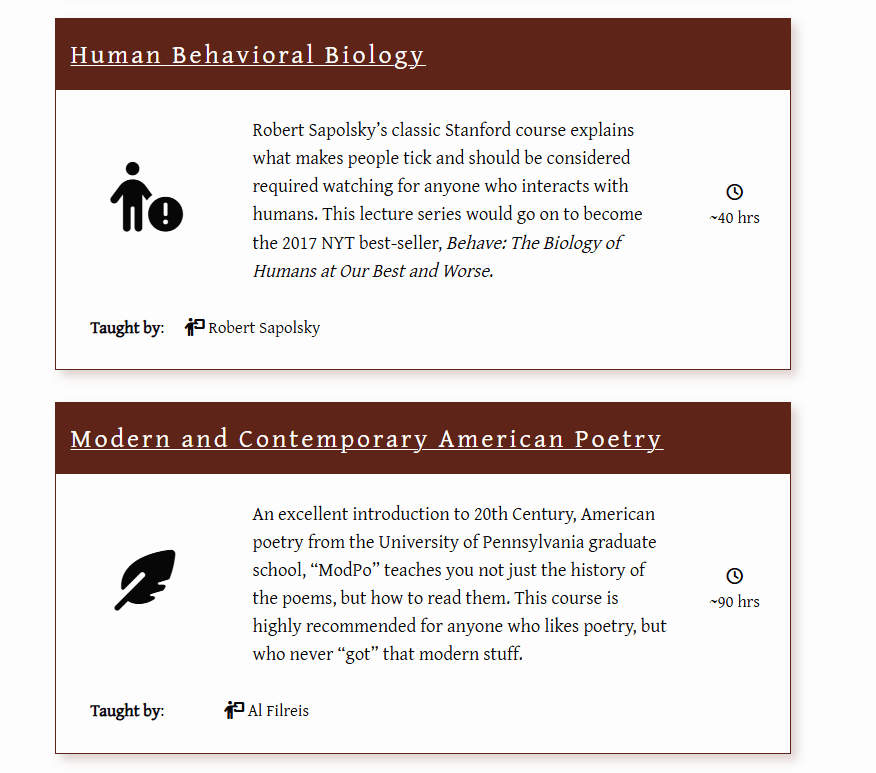
Figure 3: Some of the ‘liberal arts’ courses at OBU
My little website is, of course, unlikely to tip the scales much on either front, but it is my flag in the ground saying: I think secular topics and historical approaches are valuable even for Buddhists to learn, and even the academic study of Buddhism should be grounded in the emic understanding of the faith.
RG: Is there anything you would do differently if you were starting again?
KhBh: To be honest, not really! It’s all gone quite well so far, I think, in large part because I have let the project evolve slowly and organically. I use the simplest technology I can and try not to over-engineer things.
RG: What is the future of the OBU? Are there topics or resources that you are hoping to develop further, and are there areas where gaps make expansion difficult?
KhBh: In the next couple years, I’m hoping to expand the library further into different aspects of Buddhism in the West as well as covering more about the history of the Mahāyāna. I also plan on improving and expanding our course offerings, turning more of our existing bibliographies into proper courses.
The trickiest part about creating the courses is finding good, free lectures to tie the course together. I have also noticed a relative dearth of comparative scholarship that crosses the Mahāyāna/Theravāda divide. I would love to read a Mahāyāna take on Pāli poetry for example, or a comparative history of Early Modern Buddhism across Asia, or a sympathetic reading of the Platform Sutra from the Theravāda perspective, etc. but such books are hard to come by.
RG: What would you say to someone who is new to digital humanities and uncertain about where to begin?
KhBh: I’d say, start wherever you’re interested and with whatever skills you already have. There is so much to do from digitizing texts to cleaning data sets to working on software that pretty much anyone can contribute something. And if you’re interested in helping out at the OBU, feel free to send me an email (info[at]buddhistuniversity.net) with your interests!
My thanks to Khemarato Bhikkhu for taking the time to speak with me about this ambitious project!
- The interview text has been lightly edited for clarity and flow. ↩︎
Cover image: Nicholas Roerich, Human Ancestors, 1919. Image via Wikimedia Commons, public domain.


