
“…till 7 in the Morning the 22th, seeing Molalia playn N.N.W. we stood away N.W. and N. about the west ende of the Island, and Came to Anchor on the North syde in a little Bay in 24 fadome water… Molalia is one of the 4 Islands of Comory, Angazesia, Juanny, and Mayotta beinge the other three… These three Islands are veary full of good refreeshinges, but Principally Mayotta, as I was enformed by the Arabs trading in Molalia; and the Dutch stoppe thear.”
– Thomas Roe, 22 July 1615
The aforementioned is an extract from the journal Thomas Roe (1581-1644) published in The Embassy of Sir Thomas Roe to the Court of the Great Mogul, 1615–19: As Narrated in His Journal and Correspondence, edited by William Foster for the Hakluyt Society (1899). He was an English diplomat and an ambassador to the Mughal empire. Roe arrived in Surat, India, in 1615 as the first official English ambassador to the Mughal court. His primary objective, on behalf of King James I, was to secure a commercial treaty with the emperor Jahangir that would grant the English East India Company the right to establish permanent trading factories in the empire.
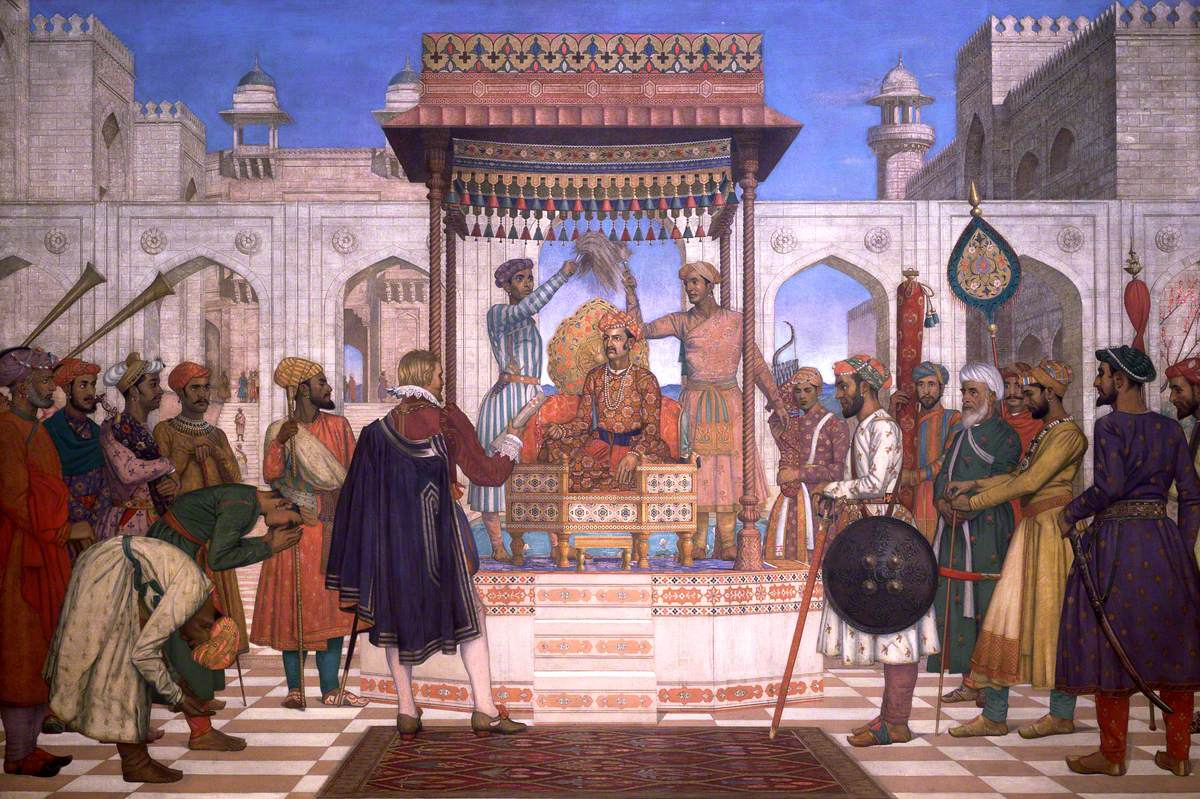
Fig. 1: Sir Thomas Roe (in white pants, immediate left of the steps) at the Court of Ajmer, 1614 by William Rothenstein (1927). Courtesy of the Parliamentary Art Collection / Art UK (source).
On 22 July 1615, about four months after sailing from England, Thomas Roe’s ship reached Mohéli (Molalia), one of the four islands that form the Comoros archipelago, off the east coast of Africa. The Comoros were a customary stopover for the ships rounding the Cape of Good Hope, offering fresh water and provisions before the long final leg to Surat. Roe’s fleet anchored in a small bay on the north the island of Mohéli, however, in the passage that follows, he goes on to describe the three neighbouring islands i.e. Angazesia, Juanny, and Mayotta as well, weaving together what he observed and what he heard about the archipelago.
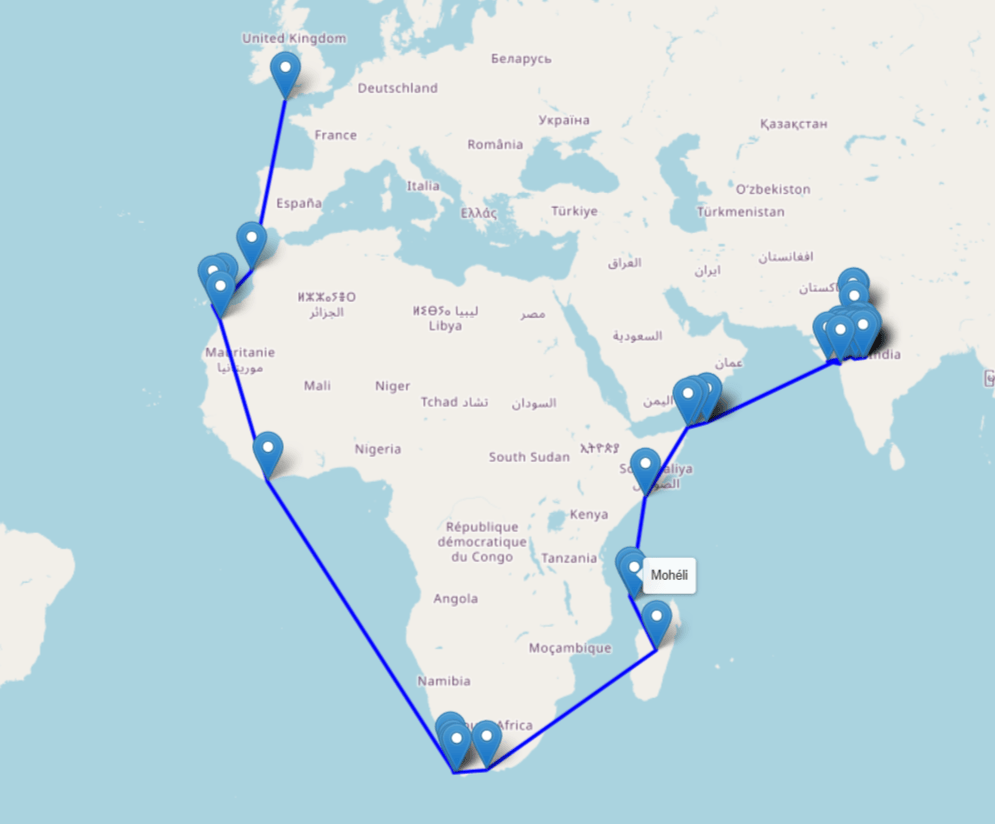
Fig. 2: Visual representation of Thomas Roe’s voyage to India (1615) featuring the stop at Mohéli, produced for my project ‘A Digital Comparative Study of English & French Travel Writings on India During the 17th Century’.
In this article, I am trying to tackle a problem that I encountered while working on my master’s research project “A Digital Comparative Study of English & French Travel Writings on India During the 17th century”. One of the objectives of the project was to digitally reconstruct the voyage of the authors as recounted by them in their journals and travelogues (Fig. 2). A normal end-to-end workflow for such a work would look as described in Fig. 3. However, there is a gap in this approach.

Fig. 3: Technical workflow to generate a map of the voyage from a historical text.
The kind of narration presented in the extract, while descriptive and informative in nature, pose a problem of the presence i.e. determining the relationship that the narrator holds with a place name mentioned in the text – if the narrator is actually witnessing it or if it’s been merely referenced.
Roe’s entry for 22 July 1615 is a clear example. He writes that his ship “came to Anchor” off Mohéli, a direct, first-person presence marker. A few lines later, describing the neighbouring islands, he adds that Mayotta is especially rich in provisions, “as I was enformed by the Arabs trading in Molalia” (Roe and Foster 1899). This is a reported-speech construction. Mayotta has been mentioned in the text not because Roe went there, but because people he met at Mohéli told him about it. A standard NER-to-gazetteer pipeline has no mechanism for making the distinction between the two. It extracts every place name with equal confidence whether the author went there, heard about it from someone else, or mentioned it only in passing.
Travelogues have been proved to be a very crucial source of information for historians. They give us a first-person view of the early world and can be used for reconstructing trade routes, diplomatic itineraries and cross-cultural contacts. When researchers convert historical travelogues into visual maps, they treat the itinerary as structural historical data. For automated tools too, the reading needs to be correct and contextual to be able to appropriately map the journey.
Named Entity Recognition (NER) models, while great at extracting information such as names of people, dates, and places, is incapable of identifying what role an entity plays in the sentence. Because the tool cannot read the structural context surrounding the entity, it treats every place name with equal weight. It would extract Molalia and Mayotta as identical geographic entities, completely missing the fact that Roe was physically present at the former while only hearing about the latter from local sailors.
To address this issue, spatial humanities scholars and computational linguists turn to methodologies that examine sentence structure, grammar, and narrative context to understand the relationship between words. Instead of creating tools from scratch, researchers borrow existing frameworks from computational linguistics and text analysis to determine relations between different components of a sentence. The problem can be approached in several ways.
One essential structural framework is the Semantic Role Labeling (SRL), as explored in relation extraction and syntactic parsing by Shi and Lin (2019). SRL deconstructs a sentence into predicate-argument structures, identifying the action verb, the agent performing it, and the locative arguments attached to the specific event. Basically, this approach revolves around identifying the verb and its relationship with other parts of the sentence. In a sentence like “We came to anchor in Molalia,” SRL correctly identifies anchored as the predicate and labels Molalia as the direct location of that physical action. However, SRL alone cannot fully solve the presence problem. While it identifies clause-level mechanics, SRL is designed to answer the question: who did what where, rather than evaluating whether the author physically observed the place or merely received reported information about it.
This is where the theoretical framework of evidentiality can come into play. As Su, Huang, and Chen (2010) explain, evidentiality is the linguistic encoding of the source of information and the writer’s degree of certainty or mode of knowing. Evidentiality distinguishes between direct sensory experiences such as seeing or visiting a location and indirect information such as hearsay, third-party reports or logical inferences. By pairing SRL’s clause analysis with evidentiality markers, a text processing pipeline can check whether a location argument sits inside a direct physical predicate frame (came to anchor) or an indirect reporting frame (enformed by).
In recent years, Large Language Models (LLMs) have increasingly been used in historical text processing for tasks like transcription, correction of transcription errors, and named entity recognition (Greif et al. 2025; Boros et al. 2024). An LLM can be effectively incorporated to bridge the gap between structural parsing and context awareness. Studies on historical text processing demonstrate that LLMs, when supplied with clear domain instructions, can handle complex early modern syntax and non-standard orthography effectively without the need for complex NLP pipelines or manual rule-building (Hiltmann et al. 2025). Rather than treating entities in isolation, LLMs evaluate the surrounding narrative context, leveraging both structural clause roles and evidential cues to determine the author’s relationship to a location. These tools, however, also carry risks. Messeri and Crockett (2024) warn about “AI hallucinations” and that AI tools can create “illusions of understanding”, where researchers believe they understand a source better than they do.
The “problem of presence” in travel writings, exemplified by Thomos Roe anchoring at Mohéli while reporting on Mayotta, exposes a critical limitation in standard digital humanities pipelines. While traditional NER creates a false equivalence among all mentioned locations and treats them as identical spatial data points, it is important to look at the structural framing of the text to remove false positives. Approaches such as SRL, evidentiality and use of domain-prompted LLM can provide necessary context-awareness to distinguish firsthand physical presence from secondary hearsay.
While this study focuses specifically on resolving geographic presence in historical travel narratives, the underlying challenge and its solution extends across digital historical scholarship. Moving from surface entity extraction to context-aware parsing ensures that computational tools accurately reflect the true meaning, source, and historical reliability of primary records.
References
Emanuela Boros, Maud Ehrmann, Matteo Romanello, Sven Najem-Meyer, and Frédéric Kaplan, ‘Post-Correction of Historical Text Transcripts with Large Language Models: An Exploratory Study,’ in Proceedings of the 8th Joint SIGHUM Workshop on Computational Linguistics for Cultural Heritage, Social Sciences, Humanities and Literature (LaTeCH-CLfL 2024), edited by Yuri Bizzoni, Stefania Degaetano-Ortlieb, Anna Kazantseva, and Stan Szpakowicz (Association for Computational Linguistics, 2024). https://doi.org/10.18653/v1/2024.latechclfl-1.14.
Gavin Greif, Niclas Griesshaber, and Robin Greif, ‘Multimodal LLMs for OCR, OCR Post-Correction, and Named Entity Recognition in Historical Documents,’ arXiv:2504.00414. Preprint, arXiv, April 1, 2025. https://doi.org/10.48550/arXiv.2504.00414.
Torsten Hiltmann, Martin Dröge, Nicole Dresselhaus, et al., ‘NER4all or Context Is All You Need: Using LLMs for Low-Effort, High-Performance NER on Historical Texts. A Humanities Informed Approach,’ arXiv:2502.04351. Preprint, arXiv, February 4, 2025. https://doi.org/10.48550/arXiv.2502.04351.
Thomas Roe and William Foster, The Embassy of Sir Thomas Roe to the Court of the Great Mogul, 1615-19: As Narrated in His Journal and Correspondence, I (Hakluyt Society, 1899).
Peng Shi and Jimmy Lin, ‘Simple BERT Models for Relation Extraction and Semantic Role Labeling’. arXiv:1904.05255. Preprint, arXiv, April 10, 2019. https://doi.org/10.48550/arXiv.1904.05255.
Qi Su, Chu-Ren Huang, and Kai-yun Chen, ‘Evidentiality for Text Trustworthiness Detection,’ in Proceedings of the 2010 Workshop on NLP and Linguistics: Finding the Common Ground, edited by Fei Xia, William Lewis, and Lori Levin (Association for Computational Linguistics, 2010). https://aclanthology.org/W10-2102/.


One thought on “Where They Actually Went: The Presence Problem in Digitised Travel Writing”