
Introduction
In 2009, Unicode 5.2.0 encoded 1,071 Ancient Egyptian hieroglyphs based on Alan Gardiner’s symbol list (Everson and Richmond 2007). Their inclusion in the standard maintained by the Unicode Consortium established a foundation that allows them to be stored and exchanged as the same sequence of code points regardless of the font or operating system. However, at that time, Unicode could not reconstruct the two-dimensional layout—the core of the text—from linear text. Consequently, users continued to rely on workarounds, such as outputting text using specialized editors like JSesh (Rosmorduc n.d.) based on the ASCII-based Manuel de Codage (MdC) (van den Berg n.d.; Buurman et al. 1988), whose development began in 1984 and was published in 1988, and then pasting the resulting images into word processing software, such as Microsoft Word.
Hieroglyphs are a writing system in which the identification of symbols (which character it is) and typesetting (how to arrange them) are difficult to separate. Multiple symbols are arranged within a virtual square frame called a “quadrat,” where symbols of varying sizes are combined and positioned vertically and horizontally to fill the space aesthetically and efficiently. Figure 1 shows a standard layout in which hieroglyphs are arranged to “tile” within a quadrat, while Figure 2 shows a non-standard layout in which hieroglyphs are placed in a single horizontal line. Although the basic hieroglyphs themselves were included in Unicode 5.2.0, they could only be displayed in a horizontal row as shown in Figure 2, and the mechanism to “tile” them within a quadrat, as shown in Figure 1, was long missing (Richmond 2015, 1).

Figure 1: Standard hieroglyph layout. The reading direction is from left to right. When a sequence of short characters occurs, they are stacked vertically.

Figure 2: Hieroglyph Unicode layout without control characters. Even when a sequence of short characters occurs, they are simply arranged side by side.
Introduction of Format Control Symbols—From Unicode 12.0 to 15.0
The turning point came with Unicode 12.0 in 2019. Invisible “Egyptian Hieroglyph Format Controls” (U+13430–U+13438), intended for insertion within hieroglyph sequences, were introduced (Unicode Consortium 2026a). The nine characters, vertical joiners, horizontal joiners, insertion position controls, overlay controls, and segment separators, incorporate the academic de facto standards, such as the colon (vertical joiner) and asterisk (horizontal joiner) used in MdC, as portable control characters within Unicode. This approach was clearly articulated by Bob Richmond, Andrew Glass, and others during the proposal stage in 2016 as a policy to treat quadrat formation as a shaping process for complex characters and implement it using the OpenType mechanism (Richmond 2015; Glass et al. 2017).
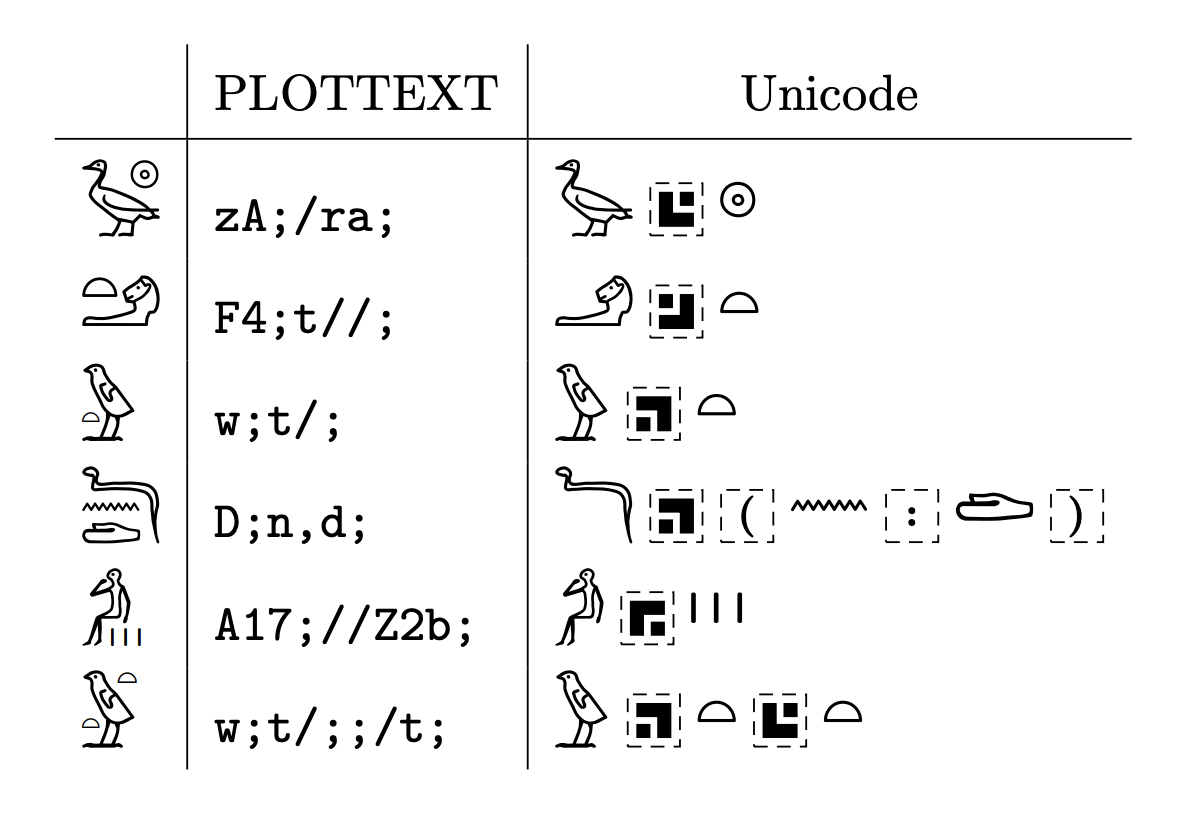
Figure 3: Control characters that enable various proposed layouts within quadrats (Glass et al. 2021, 5).
In Unicode 15.0 (2022), 29 characters were added, including specifications for critical editions, such as “damage” indicators, thereby expanding the system to 38 characters (Glass et al. 2021). Features essential to epigraphy, such as cartouches (royal name frames) and selek (enclosures), the representation of missing portions, and even the shading of damaged areas, were officially standardized. This expansion is significant in that it established a method for implementing character layouts based on existing academic conventions using Unicode control characters and shaping (Nederhof, Polis, and Rosmorduc 2021).
In Unicode 16.0 (2024), approximately 3,995 characters were added as “Egyptian Hieroglyphs Extended-A” (U+13460–U+1355F), expanding the scope from the standard set of the Classical period to include character groups frequently used in later materials, such as Ptolemaic texts (Unicode Consortium 2024). This extension is accompanied by Unikemet (Unicode Egyptian Hieroglyph Database; UAX #57), specified as Unicode Standard Annex (UAX) #57, which provides “identification information, classification, and implementation assistance” (Suignard n.d.). Furthermore, rather than assigning separate code points for rotated hieroglyphs, a model using standard variation selectors has been adopted (Figure 4) (Werning 2024).

Figure 4: Example of angle adjustment using a variation selector (Werning 2024, 2).
The Practical Gap Filled by Egyptian OpenType
Control characters are merely “instructions” for layout; execution is left to the font and the renderer. Text composition is only possible when the three elements, the standard (Unicode), the implementation (shaping engine), and the resources (fonts), are all in place (Figure 5). Egyptian OpenType, developed by Andrew Glass and released as open source, filled this practical gap (GitHub n.d.a).

Figure 5: An example of complex character layout achieved using OpenType. Each quadrat contains 2 to 4 characters (Glass et al. 2021, 5).
Egyptian OpenType is a Python 3-based tool that analyzes linear hieroglyphic fonts and automatically generates OpenType tables containing quadrat placement rules that follow control characters (Glass n.d.b). According to the design document (eot.md), its strategy consists of the following multi-step process: (i) Analyze control characters and surrounding symbols to define a block structure, (ii) assign hierarchical nested regions (outer frame → inner frame), (iii) select glyph sizes that fit within the regions, and (iv) construct the final layout using anchors and mark chains. Furthermore, it is explicitly stated that correct rendering depends on the Universal Shaping Engine (USE) hieroglyph cluster model (Glass 2020; Microsoft Typography n.d.), meaning that the three-pronged approach of standards, implementation, and resources has been translated into concrete processes.
It should be noted, however, that since control characters belong to the General Category and are invisible, incorrect input is easily overlooked unless separate tools for input, proofreading, and verification are put in place; this should be recognized as a challenge for the future. Egyptian OpenType itself refers not only to font generation but also to testing and the generation of keyboard data, highlighting the importance of “peripheral devices” that the standard alone cannot provide.
The History of Hieratic and Demotic in Unicode
Hieratic (priestly script) and Demotic (popular script) are etymologically derived from hieroglyphs, but their encoding models are inherently complex due to features such as cursive connections, intra-word modifications, abbreviations, and ambiguous character boundaries. Characters specific to Hieratic are merged with hieroglyphs in Unicode and do not have independent codes (Unicode Consortium 2026b). This design reflects the practice in scholarly Egyptological publications of transcribing Hieratic texts into their corresponding hieroglyphs. However, Unicode 16.0’s Extended-A block includes symbols derived from Hieratic, such as signs belonging to Gardiner’s category Z (“Strokes, signs derived from Hieratic, geometrical”), as part of the Extended Repertoire.
As of 2026, Demotic remains unincluded (Script Encoding Initiative n.d.). Its graphological nature, characterized by significant variant forms and an ambiguous distinction between characters and glyphs, conflicts with Unicode’s design principles (Rosmorduc 2006; Grosshans 2014), making the definition of character sets, the regulation of variant forms, normalization, and the establishment of input models central challenges for the future. For the time being, practical needs will be met by “selectively including symbols necessary for cursive writing within the Hieroglyphic Extension”; however, much work remains to be done to encode Demotic to a level where it is practically usable as a writing system.
SINUHE HieroTyper Unicode: From Format Controls to Practical Input
The input interface provides a further link between Unicode encoding and everyday scholarly work. SINUHE HieroTyper Unicode, developed by the present author, is a browser-based environment for selecting and composing Egyptian hieroglyphs. Here, SINUHE stands for “Simplified Input Nexus in Unicode of Hieroglyphic Egyptian.” The new system should be distinguished from the earlier SINUHE the Hierotyper, whose name expanded to “Sublime INput of Unicode for Hieroglyphic Egyptian” and whose input method drew on Japanese input technology. Figure 6 uses the old SINUHE Hierotyper with a font that uses ligatures created by Marwan Kilani, whereas Figure 7 uses the new SINUHE, where the layout is handled entirely with Unicode control characters. The new application provides a dedicated web editing interface (Miyagawa 2026).
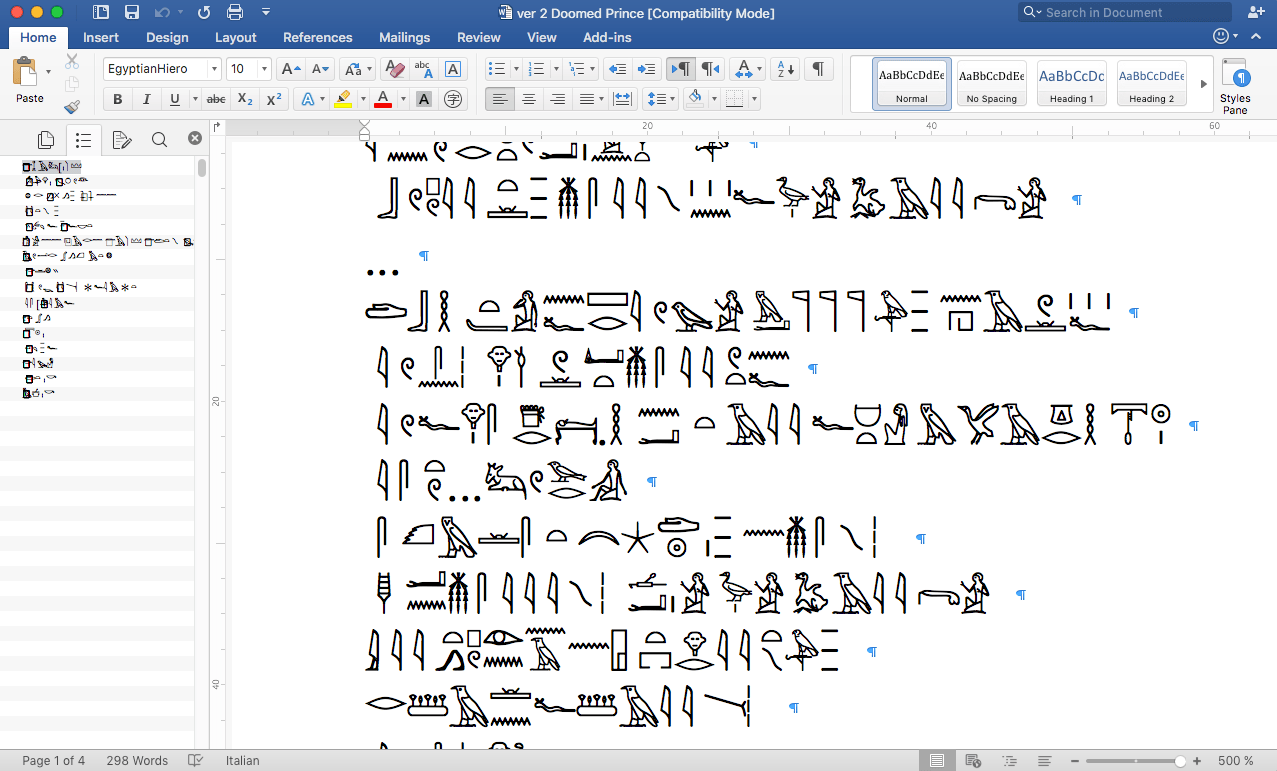
Figure 6: Microsoft Word displaying typeset Egyptian hieroglyphs by SINUHE the Hierotyper.
Its sign palette makes the basic repertoire of 1,071 hieroglyphs searchable by phonetic value, Gardiner code, and category. Alongside sign selection, the interface provides operations for vertical and horizontal joining, overlay, and insertion. It also offers conversion from Manuel de Codage to Unicode, allowing familiar sign codes and layout notation to serve as an input route to encoded hieroglyphic text. These functions address the practical difficulty of entering signs together with the otherwise invisible instructions that govern their arrangement.
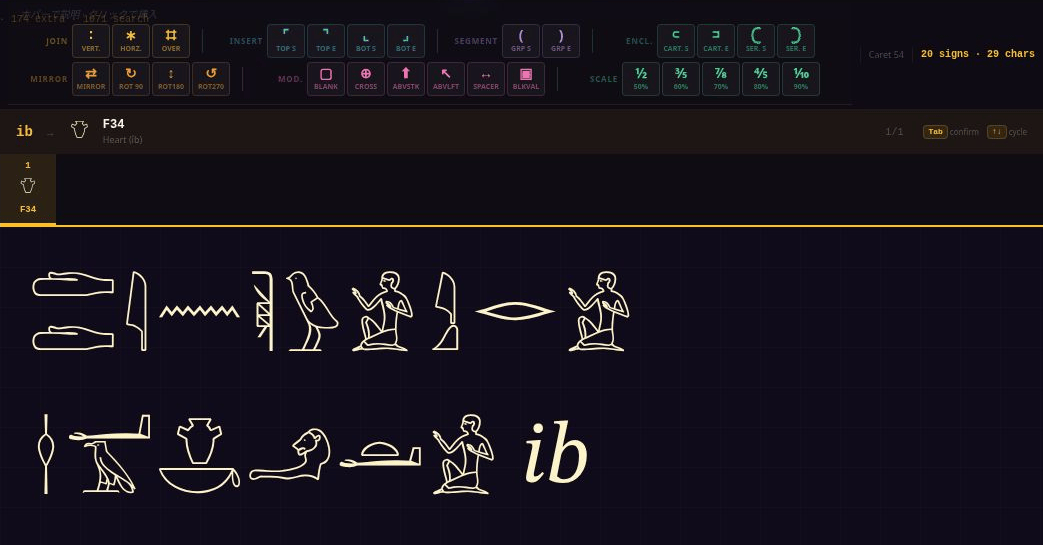
Figure 7: SINUHE HieroTyper Unicode main interface, featuring the sign palette and composition controls.
SINUHE HieroTyper Unicode thus complements the rendering infrastructure discussed above by providing an interface for users to construct Unicode sequences. This distinction matters for reuse: the signs and their encoded arrangement can be retained as text, while the resulting appearance still depends on the receiving application’s font and shaping support. Moving a sequence to another application does not by itself guarantee identical rendering. For scholarly transcription, the selected signs and their arrangement must also be checked against the source, and the original image and editable data should be retained alongside the Unicode text.
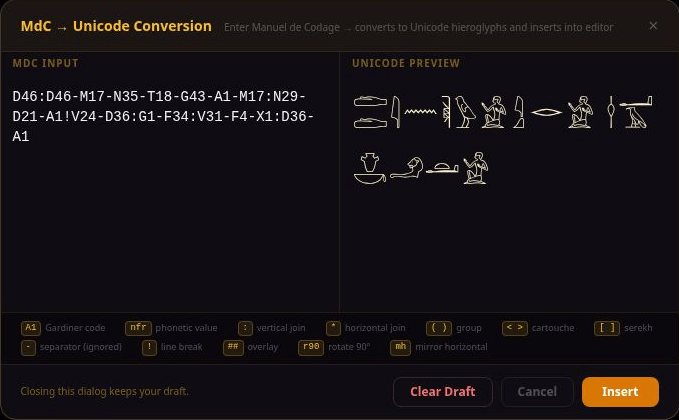
Figure 8: Manuel de Codage (MdC) to Unicode conversion dialog in SINUHE HieroTyper Unicode.
References
Jan Buurman, Nicolas Grimal, J. Hallof, Michael Hainsworth, and Dirk van der Plas, Inventaire des signes hiéroglyphiques en vue de leur saisie informatique: Manuel de codage des textes hiéroglyphiques en vue de leur saisie informatique, 3rd ed. Informatique et Egyptologie 2 (Paris: Diffusion de Boccard, 1988).
Michael Everson and Bob Richmond, “Proposal to Encode Egyptian Hieroglyphs in the SMP of the UCS.” ISO/IEC JTC1/SC2/WG2 N3237, L2/07-097 (2007). https://www.unicode.org/L2/L2007/07097-n3237-egyptian.pdf.
GitHub, “Microsoft Font-Tools (Egyptian OpenType).” Accessed October 13, 2026. https://github.com/microsoft/font-tools.
Andrew Glass, “Cluster Model for Egyptian Hieroglyphic Quadrats,” Unicode Document L2/20-176 (2020). https://www.unicode.org/L2/L2020/20176-hierogyph-cluster.pdf.
Andrew Glass, “Egyptian OpenType,” font-tools repository, GitHub. Accessed October 13, 2026. https://github.com/microsoft/font-tools/blob/main/EgyptianOpenType/eot.md.
Andrew Glass, Ingelore Hafemann, Bob Richmond, Serge Rosmorduc, and Vincent Razanajao, “A Method for Encoding Egyptian Quadrats in Unicode,” Unicode Document L2/17-112R (2017). http://www.unicode.org/L2/L2017/17112r-quadrat-encoding.pdf.
Andrew Glass, Jorke Grotenhuis, Svenja A. Gülden, Ingelore Hafemann, Mark-Jan Nederhof, Stéphane Polis, Bob Richmond, Serge Rosmorduc, and Daniel A. Werning, “Additional Control Characters for Ancient Egyptian Hieroglyphic Texts,” Unicode Document L2/21-248 (2021). https://www.unicode.org/L2/L2021/21248-egyptian-controls.pdf.
Frédéric Grosshans, “Re: Egyptian Demotic,” Unicode Mailing List, January 13, 2014. http://unicode.org/mail-arch/unicode-ml/y2014-m01/0026.html.
Microsoft Typography. “Creating and Supporting OpenType Fonts for the Universal Shaping Engine,” Learn Microsoft, September 20, 2022. https://learn.microsoft.com/en-us/typography/script-development/use.
So Miyagawa, “SINUHE HieroTyper Unicode (Simplified Input Nexus in Unicode of Hieroglyphic Egyptian).” Accessed October 13, 2026. https://sinuhe.vercel.app/.
Mark-Jan Nederhof, “The Manuel de Codage Encoding of Hieroglyphs Impedes Development of Corpora,” in Proceedings of the 11th International Conference of Egyptologists (2012). https://mjn.host.cs.st-andrews.ac.uk/publications/2012b.pdf.
Mark-Jan Nederhof, Stéphane Polis, and Serge Rosmorduc, “Unicode Control Characters for Ancient Egyptian,” in Texts, Languages & Information Technology in Egyptology, edited by Stéphane Polis and Jean Winand, (Liege: Presses Universitaires de Liège, 2021), 193–204. https://orbi.uliege.be/bitstream/2268/254893/1/NederhofEtAl_2021_icecontrol.pdf.
Bob Richmond, “Egyptian Hieroglyphs in Unicode Plain Text: A Note on a Suggested Approach,” Unicode Document L2/15-069 (2015). https://www.unicode.org/L2/L2015/15069-egyptian-plain.pdf.
Serge Rosmorduc, JSesh. Accessed October 13, 2026. https://jsesh.qenherkhopeshef.org/.
Serge Rosmorduc, “Re: Egyptian Demotic,” Unicode Mailing List, May 24, 2006. http://unicode.org/mail-arch/unicode-ml/y2006-m05/0158.html.
Script Encoding Initiative, “Script Encoding Initiative,” UC Berkeley. Accessed October 13, 2026. https://sei.berkeley.edu/.
Suignard, Michel, ed. “Unicode® Standard Annex #57: Unicode Egyptian Hieroglyph Database (Unikemet).” The Unicode Consortium. Accessed October 13, 2026. https://www.unicode.org/reports/tr57/.
Unicode Consortium, “Chapter 11: Cuneiform and Hieroglyphs,” in The Unicode Standard, Version 17.0, (Mountain View, CA: The Unicode Consortium, 2026). https://www.unicode.org/versions/Unicode17.0.0/core-spec/chapter-11/.
Unicode Consortium, “Egyptian Hieroglyph Format Controls,” in The Unicode Standard, Version 17.0, (Mountain View, CA: The Unicode Consortium, 2026). https://www.unicode.org/charts/PDF/U13430.pdf.
Unicode Consortium, “Unicode 16.0.0,” September 10, 2024. https://www.unicode.org/versions/Unicode16.0.0/.
Hans van den Berg, “Manuel de Codage,” Centre for Computer-Aided Egyptological Research. Accessed October 13, 2026. http://www.catchpenny.org/codage/.
Daniel A. Werning, “Additional Variation Selectors as Substitutes for Legacy v5.2–v15 Hieroglyphs,” Unicode Document L2/24-177 (2024). https://www.unicode.org/L2/L2024/24177-additional-var-selectors.pdf.
This article is based on an extended version English translation of the Japanese article「Unicode の制御文字で組む古代エジプト・ヒエログリフ:Egyptian OpenType の衝撃」(“Typesetting Ancient Egyptian Hieroglyphs with Unicode Control Characters: The Impact of Egyptian OpenType”), written by So Miyagawa (Institute of Humanities and Social Sciences, University of Tsukuba). The original appeared as installment 92 of the series “Digital Humanities Trends in Europe and the Middle East” in issue 176 of 『人文情報学月報』 (Digital Humanities Monthly, DHM), published on March 31, 2026, by the International Institute for Digital Humanities (人文情報学研究所). Please visit: www.dhii.jp/DHM/. The extended part which was not included in the original Japanese article was written on Google Doc and ocassionally structured and corrected by its Gemini plug-in.

