
Between 2024 and 2025, I worked on my thesis for my Masters in East Asian Studies at New York University. It explored the impact that the painter Antonio Fontanesi and sculptor Vincenzo Ragusa had on their Japanese students while teaching at Japan’s first national art school, the Kōbu Bijutsu Gakkō 工部美術学校, and consequently on the spread of yōga 洋画 (Western style art) in the Meiji art world.[1]
The biggest boon in my research was traveling to Japan during the summer to do archival research. I spent most of my days scouring the library of Keio University’s Mita Campus and the Tokyo National Research Institute for Cultural Properties, and it became clear how much more material there was on my thesis topic than in the States. While I struggled to find relevant texts at my home institution’s library, in Japan there were hundreds of Japanese language resources I could use.
Even so, Japan was a place where physical rather than digital resources were available. This meant that I lacked access to the convenience of digitally highlighting and immediately receiving the meaning of unknown characters (kanji) through Apple’s built-in dictionary app, and had to rely instead on other dictionaries. Being part of a generation reliant on digital resources, I mainly used two. The first was the app Japanese—a mobile application, which allows users to look up the meaning of terms, create vocabulary lists and study them through flashcards. Luckily, it can also be used offline. The second was the website Jisho, which has a much larger vocabulary database and allows you to search for characters with more complex radicals. I have been using both tools for years in my study of modern Japanese, and grew to like them because they both allow me to search for kanji by typed input, by choosing the radicals from which they are constructed, and by drawing the characters myself. However, what I discovered during my Masters’ research, when reading through Japanese-language sources published before the second half of the 20th century, is that one is more capable than the other at recognizing historical characters that only appeared in century old texts.
These historical characters represent the traditional form of kanji and are known as kyūjitai 旧字体, meaning “old character forms.” The kanji that we come across today are conversely known as shinjitai 新字体, “new character forms.” Although both styles had existed side-by-side for some time,[2] shinjitai completely replaced kyūjitai following reforms to Japan’s writing system after WWII. These postwar reforms aimed to simplify the writing system, in particular kanji, due to the belief that its complexity had “hindered the country’s progress in fields like science and technology” (Bucko and Lunchenko 2025). This was achieved through the release of the Tōyō Kanji List (当用漢字表 Tōyō kanji hyō) in 1946, which contained 1850 characters designed for common use with rules on how to use them (Ternon 2026).
Even though shinjitai is now the standard in Japanese printing, books and articles published before the publication of the Tōyō Kanji List naturally used kyūjitai. Since my research topic revolved around Meiji yōga art, I came across a lot of these characters during my research and search for texts. Like any historian, I grew particularly familiar with the kyūjitai forms of common kanji, including i 圍 (now 囲), ga 畫 (now 画), kai 會 (now 会), gaku 學 (now 学), kuni 國 (now 国), and zu 圖 (now 図).
Whenever kyūjitai forms appeared, I would often rely on Jisho to recognize them. Whether by drawing the character or selecting the radicals, Jisho would eventually list the character among the suggested kanji results and offer the shinjitai equivalent. This conversion ability, which is capable of showing the modern equivalent alongside the historical form is highly important, especially since many transcription standards used for historical texts require the use of modern characters. One potential problem, however, is that it does not clearly label whether characters are historical or modern. Jisho lists the shinjitai equivalent amongst older variants of the character. There is a risk, therefore, that the user mistakes these variants for shinjitai equivalents.
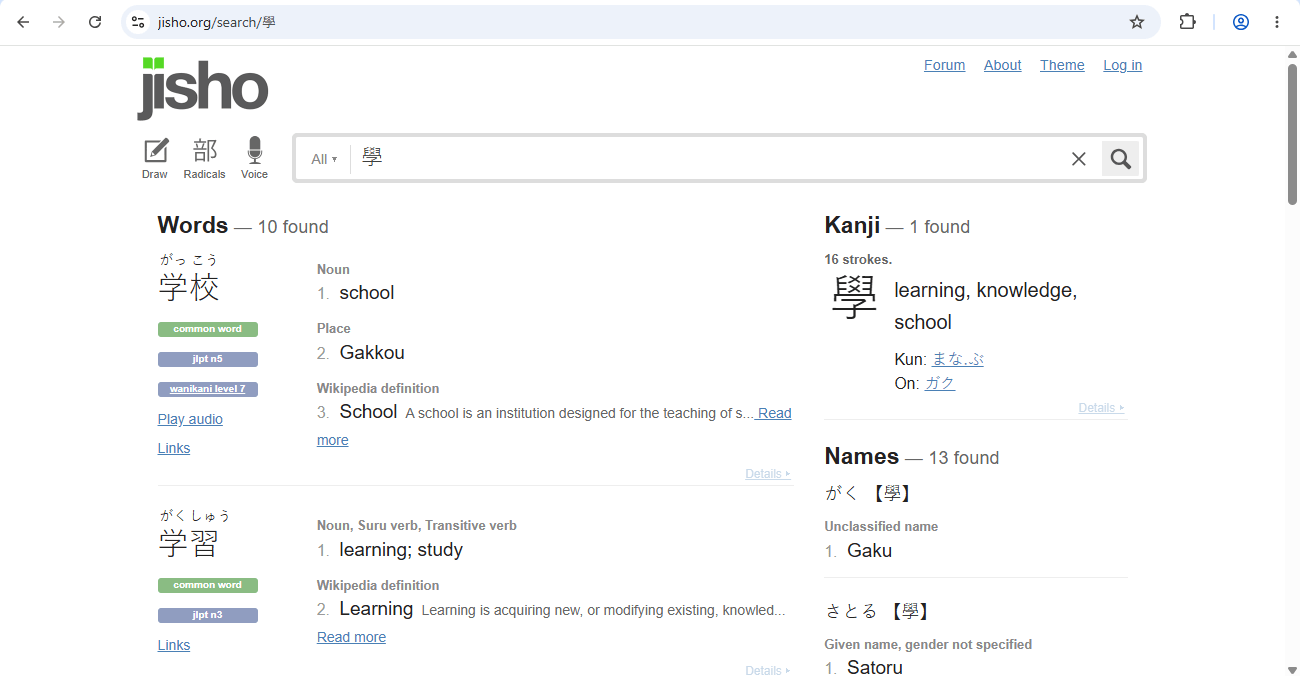
Figure 1. Screenshot of Jisho search results. Looking up the kanji gaku 學, the website offers words written in its shinjitai form as well as displaying the kyūjitai to the right.
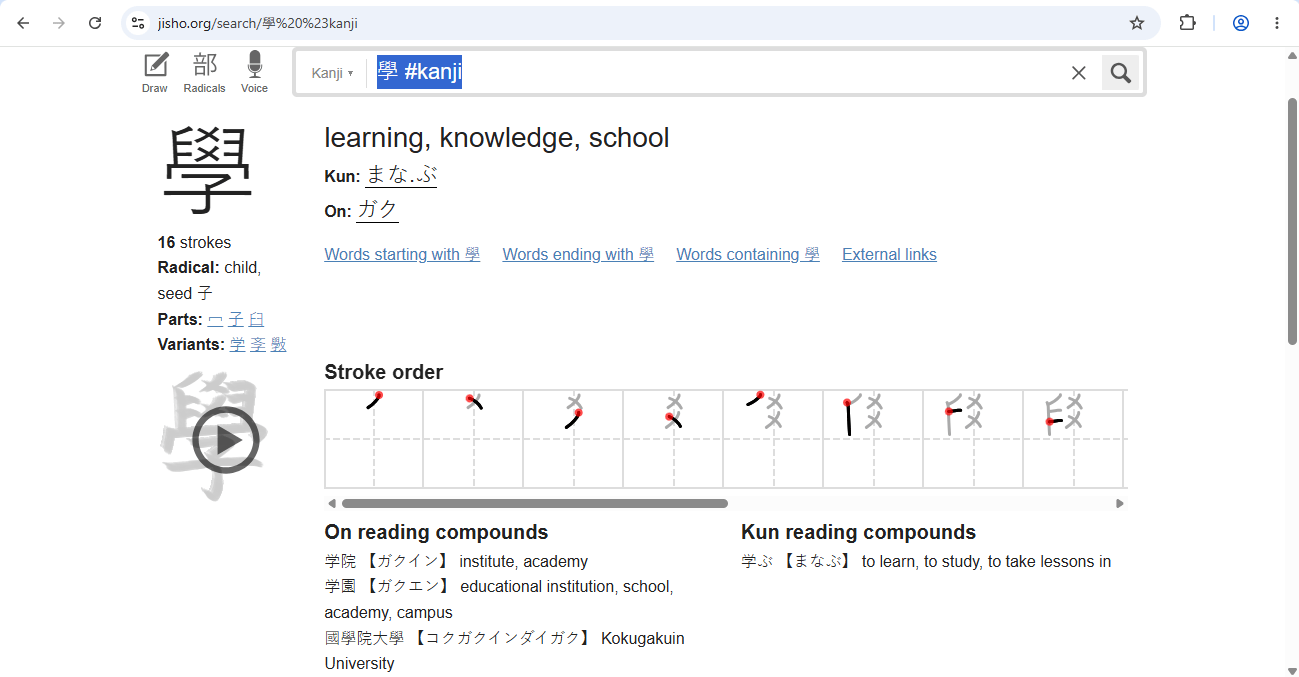
Figure 2. Screenshot of the kanji profile for gaku 學 on Jisho. It shows the character’s variants, stroke order, and reading compounds among other things.
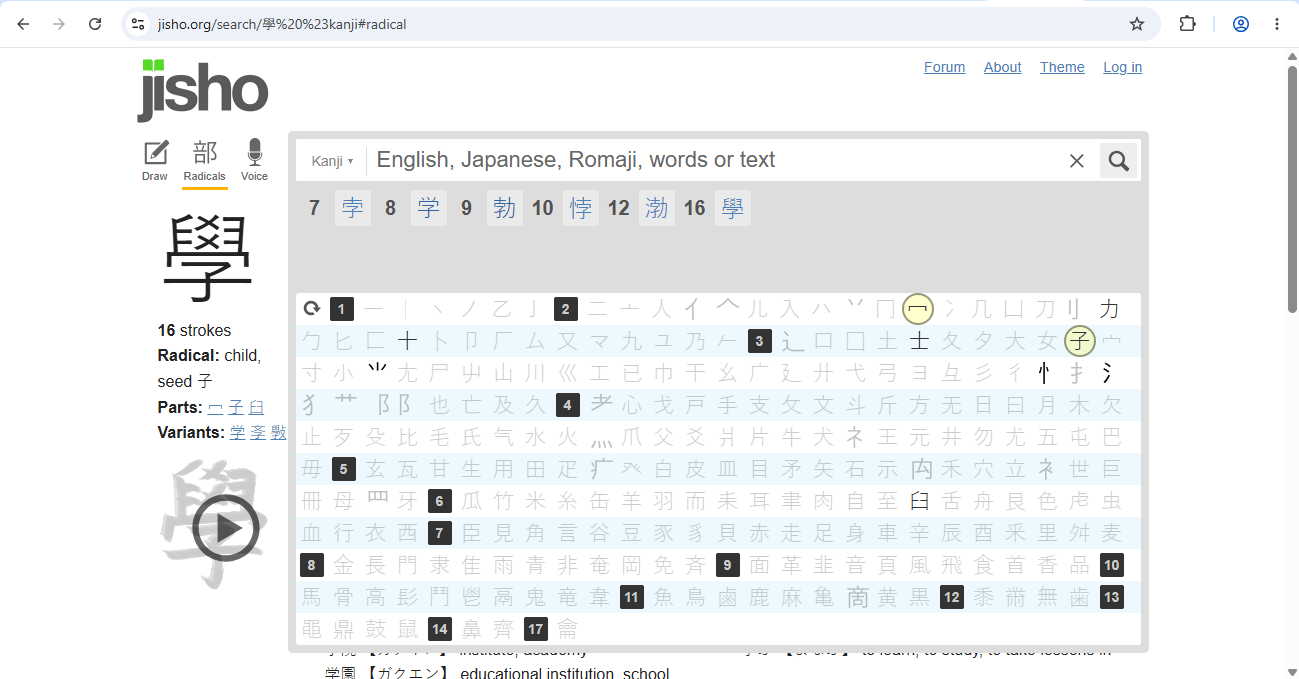
Figure 3. Screenshot of Jisho’s search by radicals. The kyūjitai form of gaku 學 appears among the suggested kanji, as well as the shinjitai 学.
In contrast, Japanese often does not record kyūjitai in its database. Even when one tries to search for kanji by handwritten input or selecting radicals, kyūjitai forms do not appear among the suggested results. There are some exceptions such as the characters gaku 學 and kai 會, but these can only be found by searching for them by radicals and not through the character drawing function.
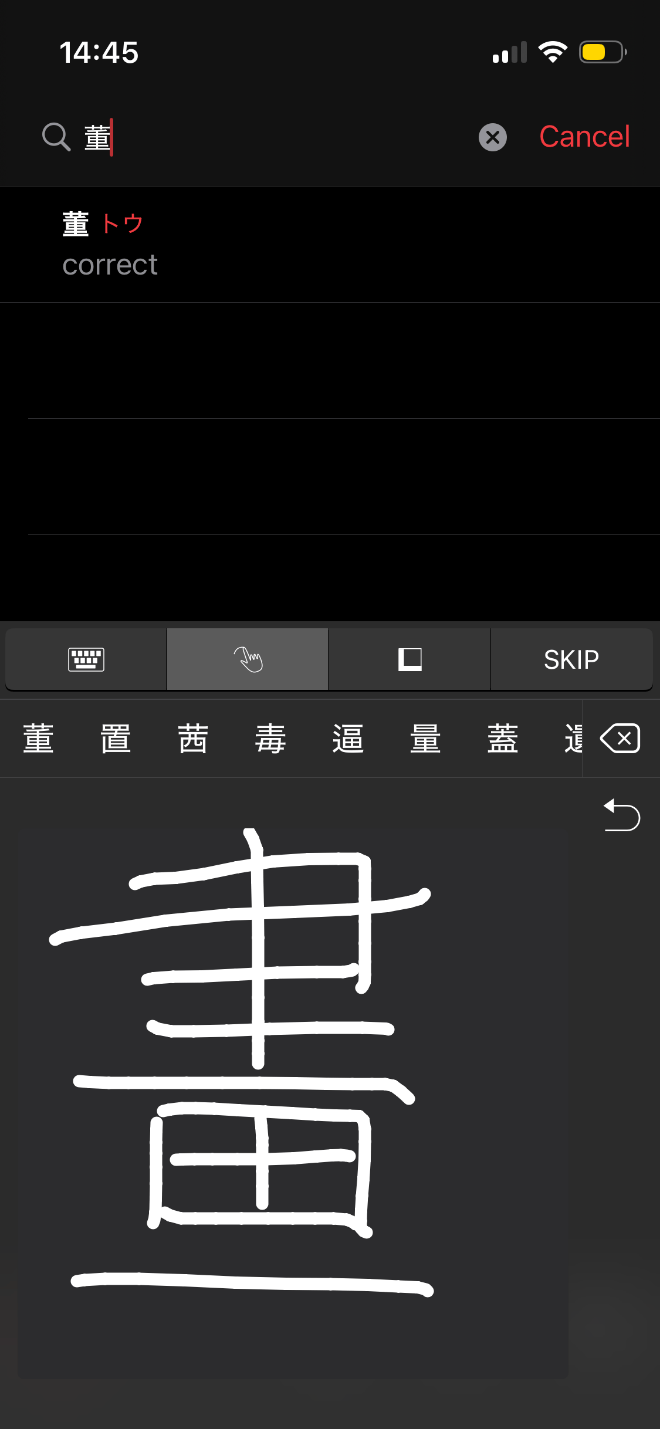
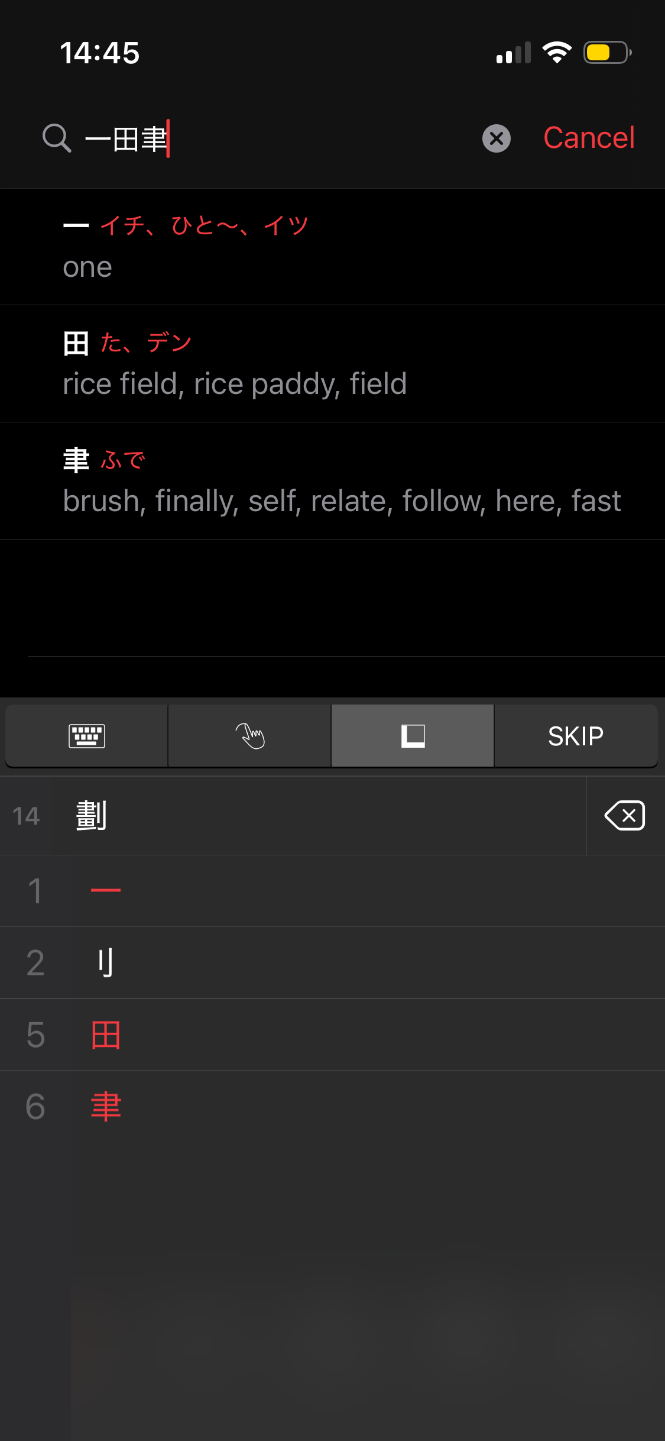
Figures 5 and 6. Screenshots of Japanese’s search results for the kyūjitai form of ga 畫. Both the drawing function and radicals lookup are incapable of finding the correct character.
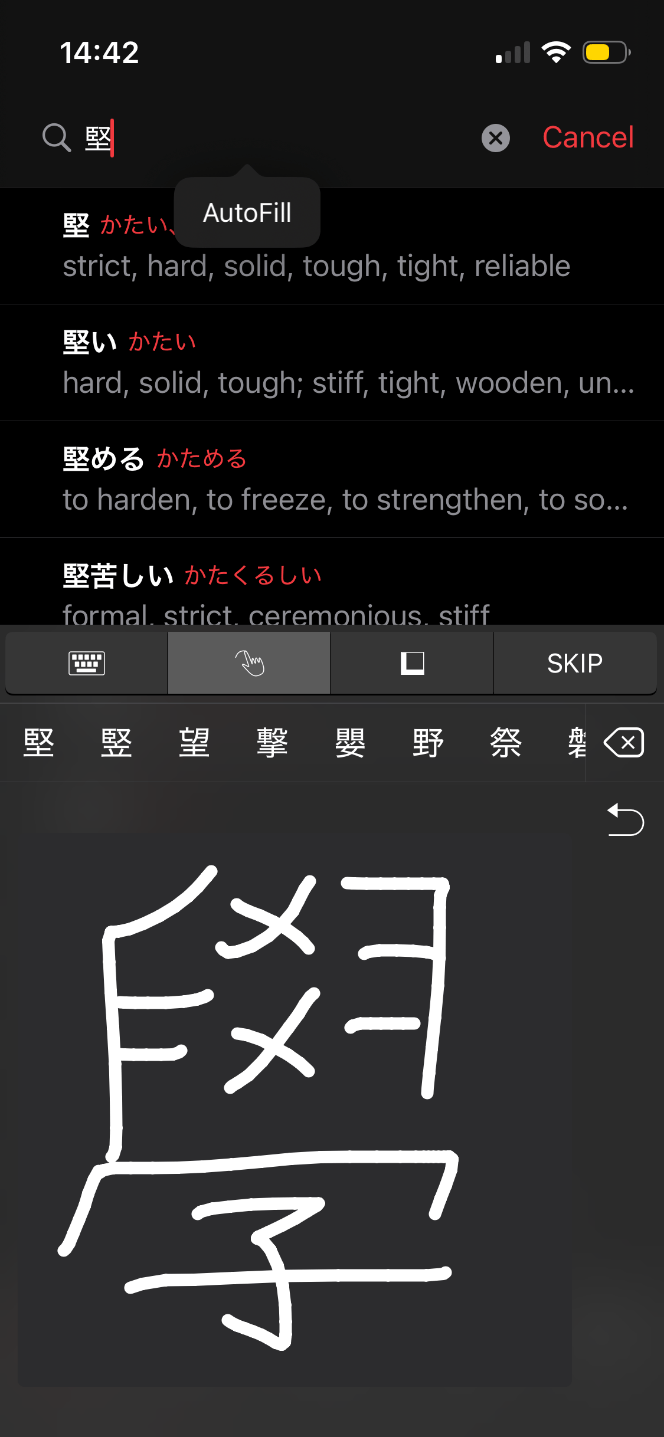
Figure 7. Screenshot of Japanese’s search results for the kyūjitai form of gaku 學 using the drawing function which is unable to find the correct character.
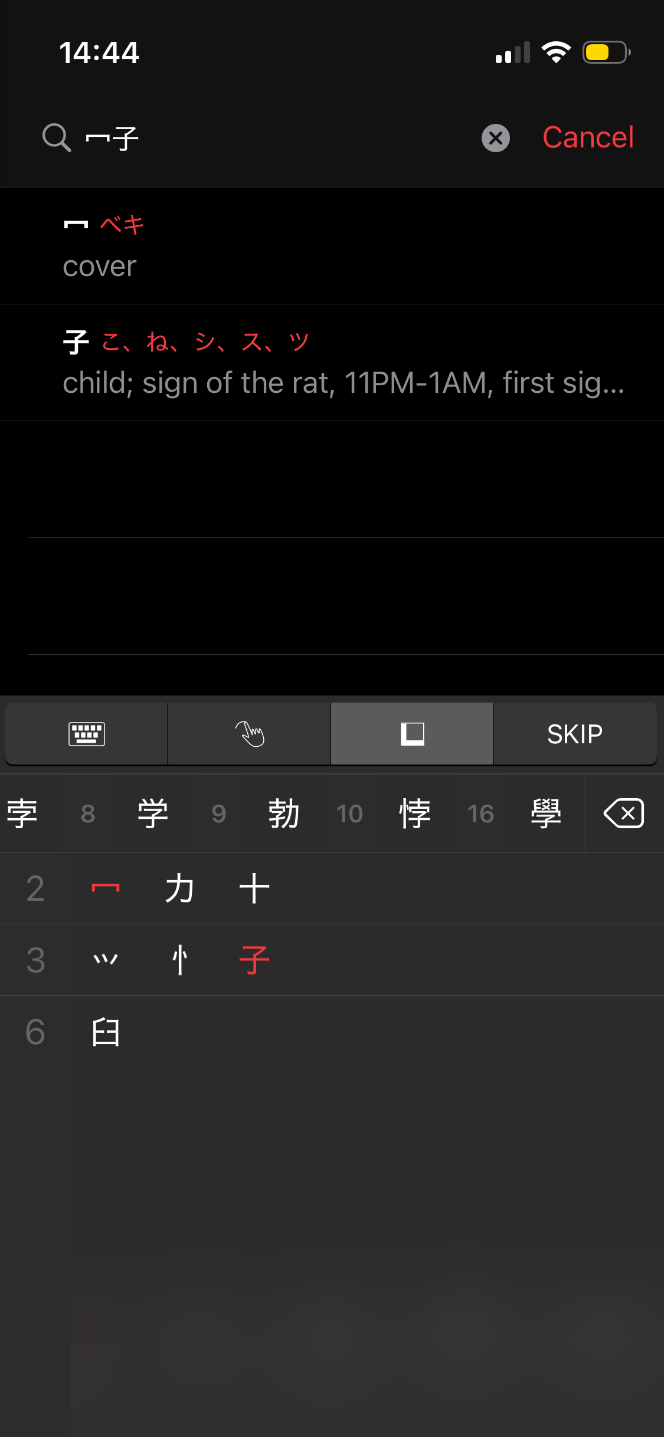
Figure 8. Screenshots of Japanese’s search results for the kyūjitai form of gaku 學 using the radical lookup function which manages to locate it.
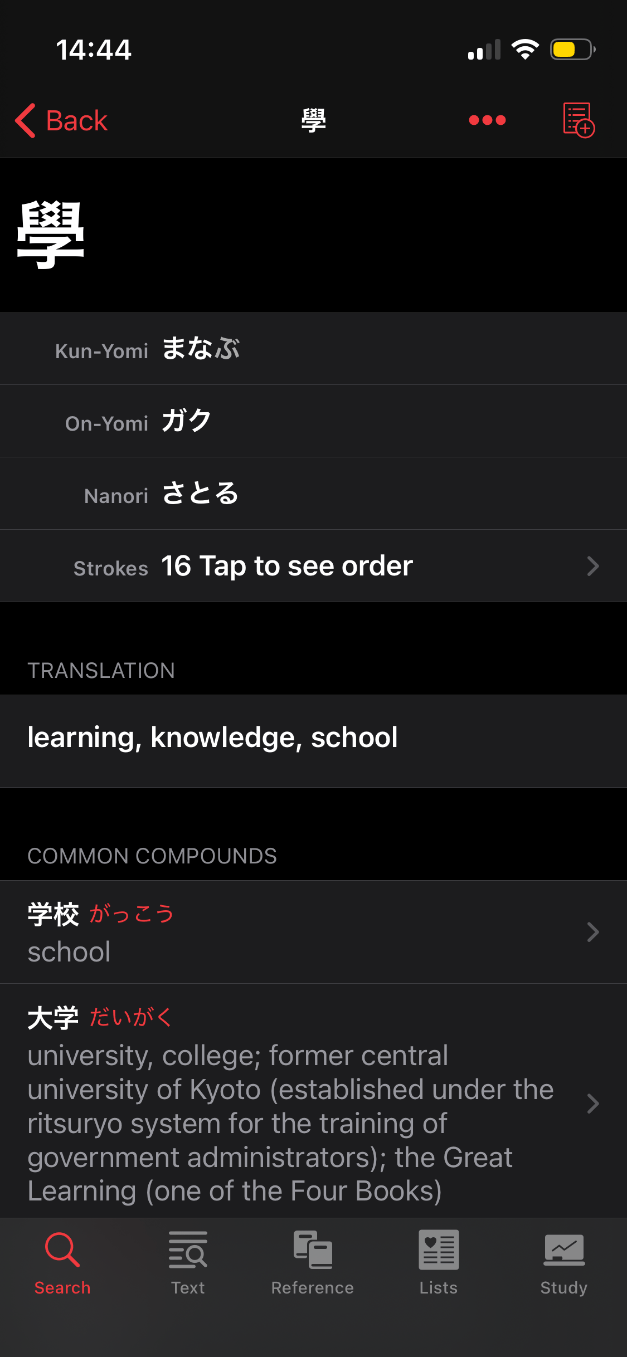
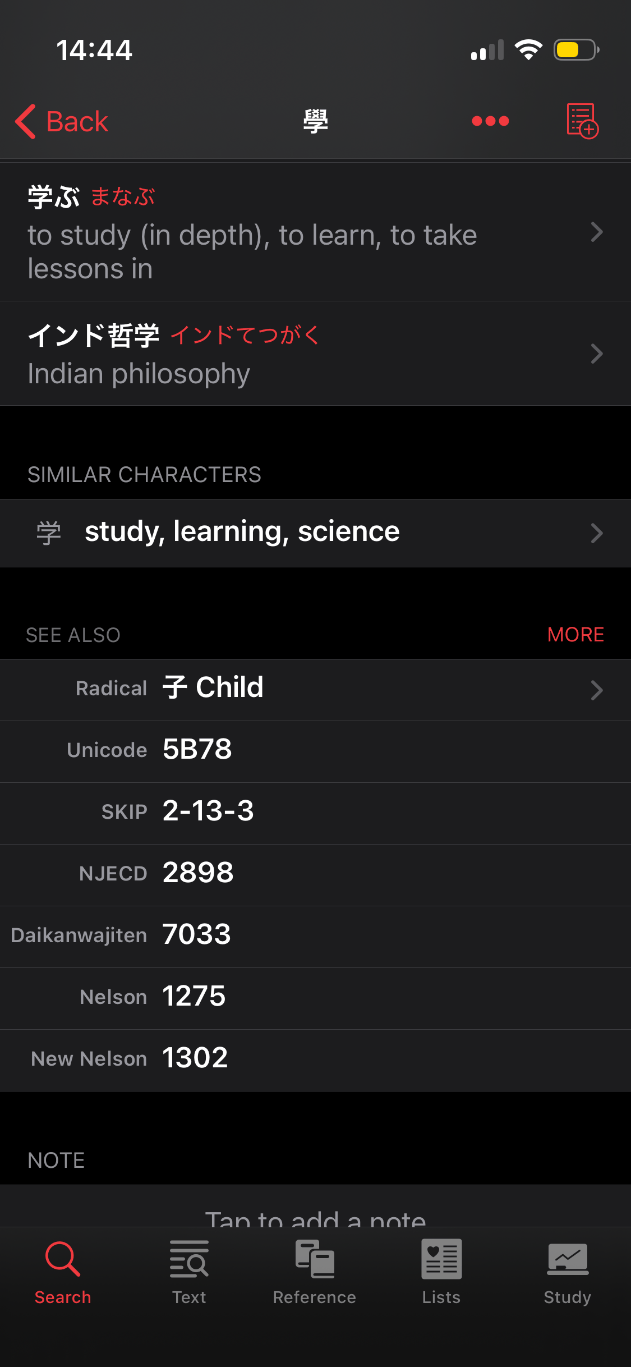
Figures 9 and 10. Screenshots of the character’s kanji profile on Japanese. They show the character’s reading compounds, equivalence to its modern form gaku 学 (listed as “similar characters”) among other things.
Both dictionaries utilize multiple data sources, which include entries for vocabulary, kanji stroke order, and pronunciation. They share four. The first, JMdict, is a general dictionary managed by the Electronic Dictionary Research and Development Group (EDRDG) with roughly 170 000 entries created by Jim Breen and maintained by him and a team of volunteers (Jisho 2026). The second source is Kanji VG, a project which provides vector graphics to record kanji’s shapes, and stroke direction and order data, created by Ulrich Apel and several contributors. The third is the Tanaka Corpus, a large collection of sentences compiled by Professor Yasuhito Tanaka at Hyogo University and his students over the course of several years. Finally, both dictionaries use resources related to the Japanese Language Proficiency Test (JLPT). Jisho’s come from Jonathan Waller’s JLPT Resources page, while Japanese’s is the 2001 version by Thierry Bézecourt.
Jisho, however, lists ten sources in its database, four more than Japanese. One of them is RADKFILE, also developed by Breen and EDRDG, which is a database of radicals which drives the radical lookup functions of the website. This is the basis for the expanded radical lookup in Jisho. Another is the KANJIDIC Project, which compiles and distributes different information on kanji. It is in this resource in which older kanji forms, kyūjitai, are recorded (EDRDG Wiki 2026), allowing Jisho to recognize them in its database.
It would be easy then to dismiss Japanese as a lesser dictionary compared to Jisho. It should be pointed out, however, that the former is mainly a learning app. It does contain a smaller database of kanji, with hardly any consideration to older forms, but it also has more functions than Jisho. Alongside the previously mentioned flashcard features, the app records whether certain pieces of vocabulary have been studied or not, as well as the level of mastery the user has for each one. In addition, it contains multiple classifications of different vocabulary based on the number of radicals, subject, level of acquisition, etc. Thus, although the dictionary function is useful, it is not necessarily the primary function of the app. Indeed, since the app focuses on helping users to learn modern Japanese, most older character forms would likely be considered redundant.
These are only two of several online Japanese to English dictionaries available to the public. For people working with older Japanese sources, Jisho is by far the most adequate. Being a free resource without the need to sign up for a paid subscription, or be part of an exclusive organization, Jisho represents a potentially suitable, if not often overlooked, choice (contingent on an internet connection) for searching for historical characters. A more rounded study would include other dictionaries and an analysis of the websites’ and apps’ coding. Nonetheless, the advice of a former advisor of mine should be followed either way—do not rely on a single dictionary, always make sure to cross reference multiple ones if you are able to. After all, where an entry on a piece of vocabulary, including its old form, is missing in one dictionary, it can be found in another one.
Notes
[1] Fontanesi and Ragusa were Italian oyatoi gaikokujin お雇い外国人 (foreign government advisors) who worked in Japan from 1876 to 1883. Fontanesi oversaw the school’s Painting Department due to his profession as a landscape painter. Although he left after two years due to health complications, he was remembered fondly by his former students. Ragusa oversaw instead the school’s Sculpting Department and remained until the school’s closure in 1883. The only other Italian oyatoi during this period were their colleague Giovanni Vincenzo Cappelletti, an architect overseeing the teaching at the school’s Preparatory Department, and the engraver Edoardo Chiossone, who established the engraving division of the Japanese Printing Bureau of the Ministry of Finance.
[2] Based on a comment from the editor, October 9, 2026.
References
Jisho, “About,” Accessed September 14, 2026, https://jisho.org/about.
Emmanuel Ternon, “Building an efficient Shinjitai (新字体) to Kyūjitai (舊字體) converter by taking a deeper look at the Kakikae Japanese script reform,” Medium, accessed September 14, 2026, https://medium.com/@emmanuel.ternon/building-an-efficient-shinjitai-%E6%96%B0%E5%AD%97%E4%BD%93-to-ky%C5%ABjitai-%E8%88%8A%E5%AD%97%E9%AB%94-converter-by-taking-a-deeper-look-at-the-c82fa25f3367
Rodomír Bucko and Olha Lunchenko, “Comparison of Kyūjitai and Shinjitai Character Forms in Modern Japanese Writing System,” in The Issues of Oriental Studies in Ukraine: Abstracts Collection of the IX All-Ukrainian Remote Scientific and Methodological Conference, Kharkiv: V. N. Karazin Kharkiv National University, 2025, 9, https://www.researchgate.net/publication/390955690_Comparison_of_kyujitai_and_shinjitai_character_forms_in_modern_Japanese_writing_system.
EDRDG Wiki, “KANJIDIC Project,” Accessed October 5, 2026, https://www.edrdg.org/wiki/KANJIDIC_Project.html.
Cover Image: Created by the author Caterina Peracchi. The image is shared under a CC BY-NC 4.0 license.

